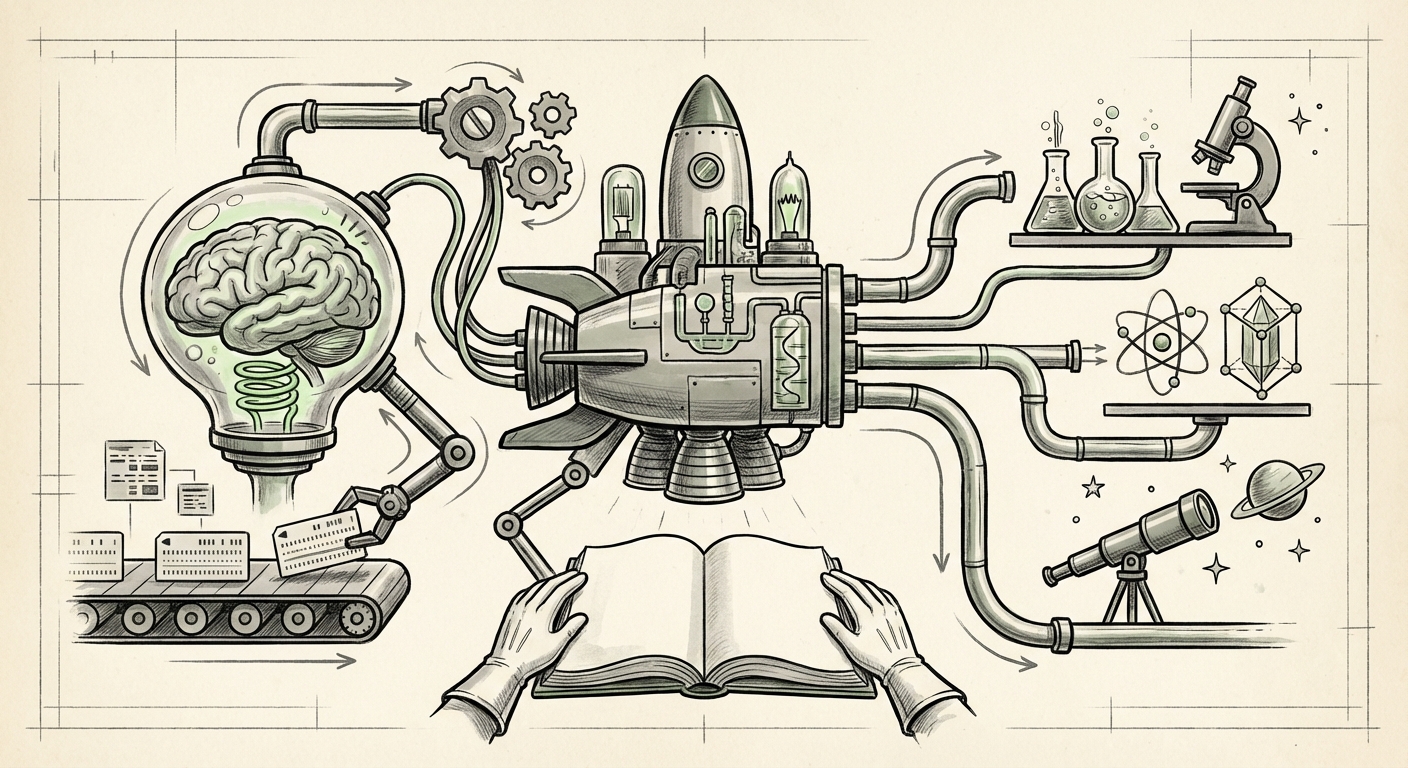
The AI landscape shifts rapidly. In 2023 and 2024, we witnessed Generative AI transform software engineering. Tools moved from novelties to essential components, fundamentally changing how code is written, debugged, and deployed. Now, a key figure at the forefront of this revolution is pointing toward the next massive inflection point. Kevin Weil, who leads OpenAI’s science team, suggests that 2026 will be for **science** what 2025 was for software engineering: the year AI fundamentally reshapes the domain.
Weil’s prediction is bold. It implies that current AI assistants (like GPT-4, which he notes is already boosting researcher productivity) are just the warm-up act. The main event—a period where AI acts as a true co-pilot in fundamental scientific discovery—is slated for 2026, preceded by necessary advancements in 2025. This analysis synthesizes this prediction with supporting industry trends to understand what this shift means for R&D, business strategy, and the future of human knowledge.
To grasp the weight of Weil’s 2026 prediction, we must understand the 2024 trajectory in software engineering. Over the last 18 months, Large Language Models (LLMs) moved beyond simple text generation. They started writing complex functions, translating legacy code, and accelerating unit testing. For many engineering teams, this translated directly into a 30-50% boost in output efficiency. This integration phase was characterized by:
Weil suggests that science is about to enter this same intense adoption and integration phase. If 2025 is the year the next-generation models arrive, 2026 will be the year scientists fully integrate these powerful reasoning engines into the core loop of the scientific method.
The breakthrough in science hinges directly on the capabilities of the next generation of foundational models. Weil notes that GPT-5 is already impacting research, but the true 2026 revolution requires models that surpass current reasoning limitations.
Our analysis of the expected capabilities of successor models to GPT-4 suggests a move toward enhanced multimodal reasoning and deeper logical consistency. When investors and developers look for recent articles discussing the shift from scaling laws to novel architectures, they are seeking confirmation that the next model generation won't just be bigger, but fundamentally smarter at solving multi-step problems. For science, this means:
If the next frontier model arrives in 2025 with these robust capabilities, it immediately becomes the most powerful tool ever introduced to the research lab, setting the stage for rapid experimental breakthroughs in 2026.
AI won't revolutionize all science simultaneously. The fields most ripe for this "breakout" acceleration are those that are data-rich, simulation-heavy, and rely on complex combinatorial optimization. These are the areas where even small improvements in efficiency yield massive results.
Areas like drug discovery and materials science are textbook targets for AI revolution. These fields require screening billions of possibilities to find one viable candidate—a perfect task for advanced probabilistic reasoning engines. Reports on AI accelerating the pace of discovery in these areas show existing traction, but 2026 promises automation of the *creative* phase, not just the screening phase.
For biotech executives, this means faster time-to-market for new therapies. For materials engineers, it means designing novel catalysts or superconductors in months, not decades. This accelerated pace is precisely what Weil envisions when he speaks of a scientific inflection point.
Perhaps the most insightful part of Weil’s statement is the inclusion of a requirement for "more humility." This is where the technical reality clashes with the hype cycle. While 2026 models will be powerful reasoners, they are still not infallible experts in the physical world.
Academic commentary and high-level discussions often focus on the challenges of verifying AI-generated scientific claims. Current LLMs excel at pattern matching within their training data, but they can still confidently fabricate non-existent references or propose physically impossible structures (hallucinations). Weil’s call for humility implies that the next era of AI science is not about replacing the scientist with an algorithm, but about creating a powerful, non-human intuition that the human expert must rigorously test.
For R&D leaders, this means infrastructure investment must focus not just on running the models, but on building robust, automated experimental feedback loops. The scientist’s job shifts from generating every hypothesis to designing the perfect validation process for the AI’s best ideas.
We can map the expected evolution of AI in science across three phases, validating Weil’s timeline (based on the search query focusing on AI productivity gains in scientific research timeline):
| Phase | Timeline Focus | AI Role (Analogy) |
|---|---|---|
| Phase 1: Assistance | 2023–2024 | The Coder/Assistant (Drafting emails, summarizing papers, writing simple code blocks). |
| Phase 2: Integration | 2025 (Post-GPT-5) | The Co-Pilot (Guiding complex workflows, generating multi-step logical paths, handling early-stage modeling). |
| Phase 3: Acceleration | 2026 | The Co-Investigator (Autonomously proposing novel experiments, solving intractable problems, dramatically compressing discovery timelines). |
If Weil’s prediction holds, the implications extend far beyond academic publishing. They represent a significant economic disruption.
Businesses relying on R&D—pharmaceuticals, advanced manufacturing, energy—must prioritize infrastructure that supports AI-driven discovery now. This means not just licensing the latest models, but developing internal platforms that can feed proprietary, high-quality, structured data into these systems. Companies treating AI as a mere efficiency tool in back-office functions will be left behind by those treating it as the engine of their future product pipeline.
Furthermore, the investment narrative is already shifting. Recent analyses of VC firm theses on AI in the life sciences sector show growing capital dedicated to "deep tech"—companies building AI specifically to manipulate the physical world, confirming that the market sees this 2026 inflection point as highly investable.
The social impact of accelerated science is immense. If AI can discover a room-temperature superconductor or a highly effective new class of antibiotics years ahead of schedule, the benefit ripples across global economics, health, and sustainability. However, this speed also raises ethical questions discussed in articles concerning AI researchers discussing the roadmap to AGI post-GPT-4. If the pace of discovery outstrips our ability to regulate or ethically deploy the results, we face new governance challenges.
How can organizations prepare for an AI-driven scientific renaissance in 2026?
Kevin Weil’s prediction is not a guarantee, but a roadmap based on internal progress and industry momentum. The transformation of software engineering in 2024 provided the blueprint. The arrival of more capable frontier models in 2025 will provide the engine. The true test—the revolutionary impact on fundamental science—awaits us in 2026, provided we approach this new era with both ambition and necessary scientific rigor.