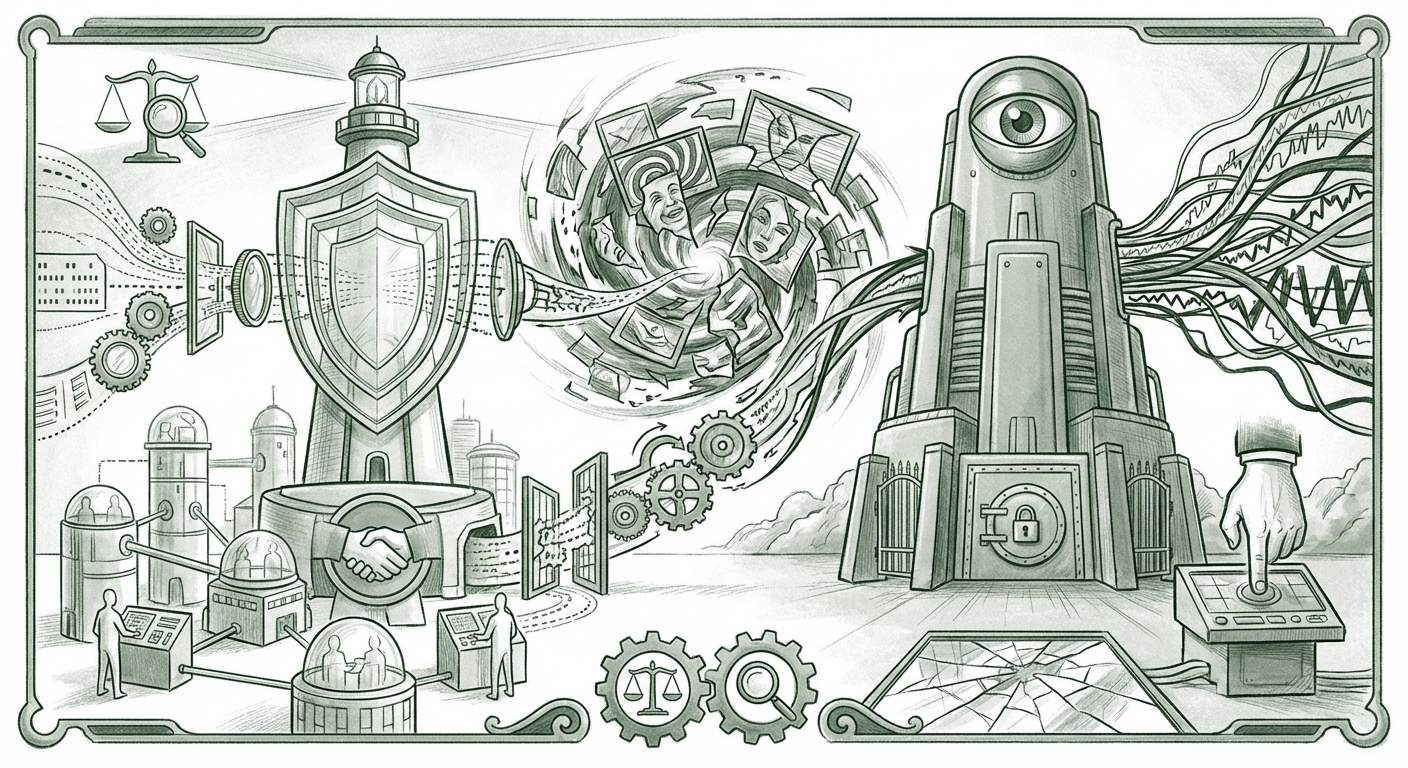
The accelerating power of Artificial Intelligence presents humanity with a profound choice. It is not merely a choice between fast innovation or slow caution, but a fundamental decision about the kind of future we wish to inhabit. This tension was powerfully articulated by Anthropic CEO Dario Amodei, who issued a stark warning: democratic societies must be vigilant to ensure that their adoption of powerful AI systems does not inadvertently make them resemble the autocratic rivals they seek to counter.
Amodei’s demand is clear: Freedom and democratic principles must serve as the bedrock of AI deployment, not secondary considerations overridden by the pursuit of efficiency or security theater. This is a call to action for governance that champions human rights over unchecked algorithmic control. To understand the gravity of this moment, we must look beyond the immediate capabilities of large language models and examine the global competitive landscape, the legislative response, and the internal ethical fault lines within AI development itself.
In democratic systems, checks and balances, privacy rights, and freedom of expression are non-negotiable pillars. Autocratic systems, conversely, thrive on centralized control, mass surveillance, and the rapid, opaque deployment of technology to manage populations. The danger Amodei highlights is the "drift"—the temptation for democracies, when facing existential threats (be they economic competition or information warfare), to adopt the very tools of mass control that undermine their foundational identity.
Think of it this way: If an AI tool can perfectly track and predict public dissent with 99% accuracy, a democratic government faces immense pressure to use it for "stability." But deploying such a system fundamentally changes the relationship between the state and the citizen, pushing the society closer to an authoritarian model, regardless of the initial intent. This is the trap of **value erosion through convenience**.
The path democracies choose is being shaped in direct comparison to the strategies of global competitors, particularly China. Analyzing these contrasting national strategies clarifies what practices democracies must actively avoid:
Nations operating under authoritarian structures often view AI as a tool for state consolidation. Data acquisition is vast and largely unrestricted, surveillance technologies are deployed swiftly across public spaces (often employing advanced facial recognition and predictive policing), and the alignment of the technology serves the state's political stability above all else. This results in high-speed technological implementation, but at the cost of individual autonomy.
The comparison is essential because, as noted in analyses tracking the "US vs. China AI Race," the West often feels compelled to match the speed of deployment seen in Beijing. However, rushing adoption without equivalent legal safeguards risks automating internal authoritarianism.
Reference Context: Research comparing the US Executive Order approach with China’s centralized strategy highlights these differing priorities on power centralization versus individual rights protections. (See analysis structure from sources like the CFR, e.g., [The US vs. China AI Race: Diverging Paths on Governance and Power](https://www.cfr.org/article/us-vs-china-ai-race-diverging-paths-governance-and-power)).
In response to this high-stakes environment, established democracies are creating complex regulatory frameworks. The European Union’s landmark **EU AI Act** represents the most significant attempt to institutionalize democratic values into technology law. Its central mechanism is a risk-based approach:
The success of this approach hinges on striking a delicate balance: protecting citizens from harmful surveillance and bias without crippling the ability of European companies to innovate. As policymakers navigate the final stages of implementation, ensuring that safety protocols do not become merely bureaucratic hurdles that favor incumbents is key. (Referencing legislative progress, such as that noted by the European Parliament’s final approval process: [The European Parliament approves the AI Act: What happens next?](https://www.europarl.europa.eu/news/en/headlines/society/20240312STO17323/the-european-parliament-approves-the-ai-act-what-happens-next)).
The danger isn't just external geopolitical competition; it's internal decay caused by AI's ability to weaponize information. Powerful, accessible AI tools are rapidly lowering the cost of creating sophisticated disinformation, threatening the bedrock of democratic discourse: a shared, verifiable reality.
The rise of hyper-realistic **deepfakes** poses an immediate crisis for election integrity. When citizens cannot trust audio, video, or text presented to them, civic consensus becomes impossible. If every negative story about a candidate can be dismissed as an AI fabrication, truth loses its value. This environment benefits those who thrive in chaos and mistrust—often authoritarian actors seeking to destabilize foreign democracies.
Election security experts stress that moderation tools are currently struggling to keep pace. The technology to create is outpacing the technology to reliably detect and attribute. This requires democracies to legislate not just *how* governments use AI, but also to impose responsibilities on the platforms deploying these tools to protect public discourse. (This challenge is well-documented in reports focusing on electoral security, for instance: [Election Integrity in the Age of Synthetic Media: The Threat Landscape for 2024](https://www.bipartisanpolicy.org/report/election-integrity-in-the-age-of-synthetic-media/)).
Beyond governance frameworks, the very architecture of advanced AI development creates tension within democratic ideals. Amodei’s background at Anthropic places him squarely in the debate over responsible scaling and model release.
Should the most powerful AI models—those approaching or exceeding human capabilities in certain domains—be made widely available ("open-sourced")? Or should they remain behind restrictive "API walls" controlled by a few trusted labs?
This is a fundamental tension. To adopt the control model risks concentrating vast, unchecked power in the hands of a few unelected tech leaders (a form of technocratic oligarchy). To adopt the open model risks handing keys to potential destabilizers. Navigating this requires unprecedented collaboration between AI builders and democratic regulators.
This internal struggle is constantly debated within the AI community regarding safety thresholds and deployment speed. (See ongoing discussions summarized by research institutes like Brookings on the trade-offs: [The Open Source AI Debate: Balancing Safety and Innovation After Frontier Model Releases](https://www.brookings.edu/articles/the-open-source-ai-debate-balancing-safety-and-innovation-after-frontier-model-releases/)).
Dario Amodei’s warning is not merely philosophical; it carries direct implications for how businesses, governments, and everyday citizens will interact with technology for the next decade.
The future will be defined by **"Value-Centric AI Competition."** The race won't just be about raw compute power; it will be about which bloc can deploy powerful AI *while maintaining societal trust*. Democracies that fail to implement effective, rights-preserving guardrails will see their citizens increasingly distrustful of state technology, creating vulnerabilities both socially and economically.
We will see global regulatory divergence. The EU will likely lead with stringent restrictions, the US will focus on executive orders and sector-specific guidance, and China will double down on state-directed development. Businesses operating globally must prepare for a compliance landscape as complex as that surrounding data privacy (GDPR).
For companies, this means **"Responsible Innovation as a Competitive Advantage."** Businesses in democratic nations cannot afford to chase the efficiencies derived from unchecked data usage or invasive monitoring, as these practices may soon become legally untenable or ethically toxic to consumers. Instead, the value will be in creating AI systems that are demonstrably fair, transparent, and respectful of user autonomy. This might mean slightly slower initial deployment but offers vastly superior long-term resilience and public acceptance.
The ability to prove that an AI hiring tool is *not* discriminating or that a surveillance system meets strict legal thresholds will become a key differentiator, much like cyber-security certification is today.
The pressure point for individuals will be the fight for **cognitive sovereignty**. As AI becomes better at persuasion, personalization, and simulation, protecting the individual’s right to determine their own beliefs and vote without manipulation becomes paramount. This requires robust media literacy education alongside strong digital watermarking standards for AI-generated content.
The implication is that technology designed for civic infrastructure (like voting systems or public services) must undergo the highest levels of democratic scrutiny, far exceeding that applied to consumer apps. The promise of efficiency cannot justify the creation of an internal digital panopticon.
To heed Amodei’s warning, proactive steps must be taken across sectors:
The development of Artificial Intelligence is perhaps the greatest technological challenge our current societal structures have ever faced. If we let the speed of innovation dictate the terms of adoption, we risk winning the technological race only to lose the values that make our societies worth defending. The governance structures we establish now—informed by regulatory efforts like the EU AI Act and informed by warnings from safety leaders—will determine whether AI becomes a tool for democratic flourishing or an unwitting architect of its decline.