The Agentic Leap: How Code-Driven Visual Exploration Redefines AI Interaction
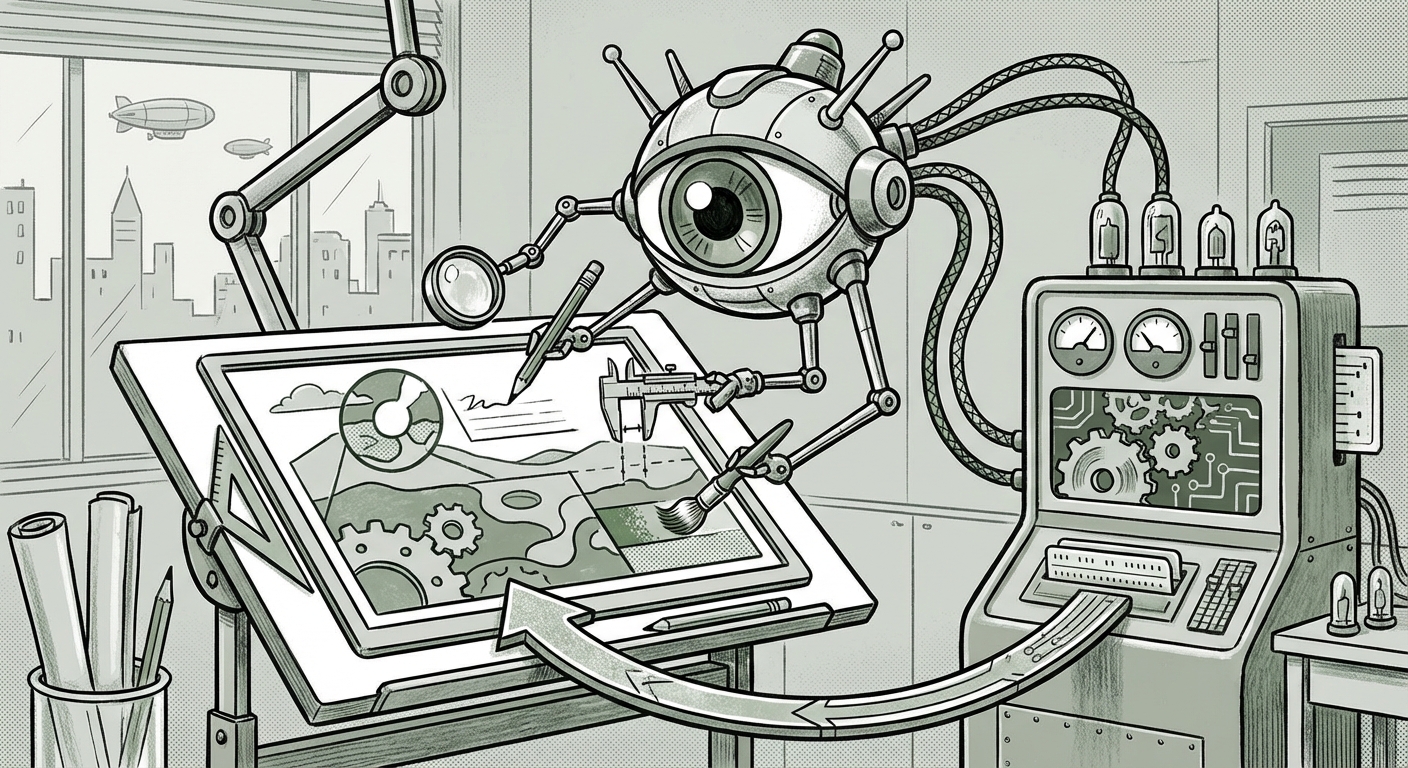
The recent news that Google DeepMind is equipping its Gemini 3 Flash model with "Agentic Vision"—the capability to actively explore images using generated code—marks one of the most significant evolutionary steps in current Artificial Intelligence development. This isn't just about seeing better; it’s about *doing* better with what is seen. We are witnessing the transition of Large Language Models (LLMs) from sophisticated pattern-matchers into genuine, proactive digital agents capable of complex visual problem-solving.
From Passive Sight to Proactive Action
For years, multimodal AI models focused heavily on **passive interpretation**. You show an AI a photo of a cluttered desk, and it dutifully replies, "I see a laptop, a coffee mug, and several scattered papers." This is impressive, but it requires a human to ask the next question ("Where is the blue pen?").
Agentic Vision flips this script. As confirmed by the initial report regarding Gemini 3 Flash:
- The Model Formulates a Plan: The AI determines the necessary steps to achieve a goal related to the image.
- It Generates Code: Crucially, it doesn't just describe the solution; it writes the instructions (likely Python code interacting with vision libraries or an internal API) required to manipulate the visual data structure.
- It Executes and Iterates: The model runs this code against the image, allowing it to refine its understanding—for instance, zooming in on a specific corner, measuring distances, or filtering pixel data based on color thresholds.
This sequence is the hallmark of an AI agent: Plan, Act, Observe, Refine. When applied to vision, it transforms the model into a digital investigator rather than just a digital librarian. This capability bridges the gap between the abstract world of language processing and the concrete execution required for real-world utility.
The Technical Underpinnings: Tool Use and Program Synthesis
To truly grasp the significance of Agentic Vision, we must understand its technical roots. This development confirms the industry's pivot toward robust Tool Use frameworks. LLMs are now being trained not just on static text and images, but on the *process* of using external utilities.
The ReAct Paradigm Applied Visually
Many experts tracking AI agents believe this relies on sophisticated iterations of frameworks like ReAct (Reasoning and Acting). In this context, the "Action" available to the model isn't just calling a web search API; it's executing a function designed to operate on pixel data. If the user asks, "What is the serial number on the back of this device?" the agent must:
- Reason: The serial number is likely small and blurry.
- Act (Code Generation): Write code to enhance the contrast and zoom into the area identified as the device's rear panel.
- Observe: Analyze the resulting enhanced image.
- Refine: If the first crop fails, write new code to try a different lighting adjustment.
This iterative coding process is computationally intensive but fundamentally more powerful than static inference. It signals that the models are not just learning *what* objects are, but *how* to programmatically interrogate visual evidence—a skillset traditionally reserved for expert software engineers.
Contextualizing the Trend: The Multimodal Arms Race
Gemini’s move does not happen in isolation. Industry analysts confirm this is a competitive necessity. We see similar efforts across the board, suggesting Agentic Vision is a consensus next step:
- When rivals like OpenAI push models like GPT-4o for seamless, real-time interaction with visual input, they are solving similar problems, albeit perhaps through different proprietary methods. The common thread is breaking the barrier between interpretation and interaction.
- The ability for an AI to interact with uploaded files or data structures using code—whether that structure is a CSV file or a JPEG object—is becoming the benchmark for powerful generalist models.
For technology strategists, this means assessing your multimodal roadmap must now include **agentic workflows**, not just basic Q&A integration.
Implications: From Desk Analysis to Real-World Robotics
The implications of an AI that can actively debug visual information are vast, affecting sectors far beyond standard desktop computing. This capability moves AI closer to **embodiment**.
1. Hyper-Accurate Industrial Inspection
In manufacturing, quality control relies on finding microscopic defects. A static image analysis might miss a hairline crack. An agentic vision model, however, can be instructed:
"Scan this turbine blade image. Systematically apply sharpening filter X, then run edge detection algorithm Y, and flag any feature smaller than 0.1mm."
This allows for consistency and precision far exceeding human capacity, dramatically lowering defect rates in high-stakes environments like aerospace or microelectronics.
2. Advanced Robotics and Navigation
For robotics, visual perception is the primary input. If a robot needs to navigate a complex, unfamiliar warehouse, it cannot rely on a single static map. It needs to:
- See an obstruction (a box).
- Write code to calculate the optimal path around the box based on its current 3D sensor data.
- Execute the maneuver.
Agentic Vision provides the AI brain with the necessary low-level command tools to manipulate its visual understanding in real-time, making autonomous physical systems more robust and adaptable.
3. Democratizing Data Analysis and Scientific Inquiry
Consider complex medical scans or astronomical images. Traditionally, a specialist (radiologist, astronomer) needed specific software knowledge to zoom, filter, and measure features. Now, a scientist could ask the agent:
"Using this MRI scan, write a script to isolate all areas where tissue density changes by more than 15% between slice 42 and 43, and then generate a heatmap of the results."
This drastically lowers the barrier to entry for complex visual data processing, speeding up research across chemistry, biology, and physics.
The Flash Factor: Speed Meets Sophistication
A crucial detail in the Gemini announcement is the integration into the **Gemini 3 Flash** variant. Historically, complex reasoning, especially involving code generation and execution loops, has been reserved for the largest, most computationally expensive models (like Pro or Ultra tiers).
By placing Agentic Vision in a model prioritized for speed and efficiency, Google signals a clear business strategy: **making agentic capabilities pervasive and fast.**
For product managers and business analysts, this means:
- Scalability: Agentic tasks can be run at a higher throughput, making them viable for high-volume customer service bots or real-time monitoring systems.
- Lower Operational Costs: Running Agentic Vision on a leaner model reduces API costs for enterprises integrating these features.
- Edge Potential: Faster, more efficient models are closer to deployment on local devices (smartphones, factory gateways), reducing reliance on constant cloud connectivity.
If an AI can perform sophisticated visual debugging quickly, it opens up use cases where latency matters—such as interactive augmented reality instructions or safety alerts.
Navigating the Challenges Ahead
While "Agentic Vision" sounds revolutionary, the caveat that "not all features work automatically yet" highlights significant ongoing hurdles. The leap from concept to reliable product involves mastering several complex areas:
The Hallucination of Code
If an LLM hallucinates in text, it produces convincing but false information. If it hallucinates while generating code for visual analysis, the resulting "action" could be meaningless, harmful, or simply crash the system. Ensuring the generated code is **syntactically correct, semantically appropriate for the visual context, and safe** is the paramount challenge for tool-use frameworks.
Handling Visual State and Memory
Human experts remember previous inspections or modifications. An agent must maintain a robust "visual state." If the model zooms in on an object, it must remember the context of the original, full image to zoom back out or correlate details. This requires advanced memory management architecture that tracks the history of code execution and its effect on the visual object being examined.
The Need for Standardized Visual APIs
For Agentic Vision to flourish across different platforms (e.g., a standard for analyzing CCTV vs. analyzing medical MRI), there needs to be a degree of standardization in how models interact with visual processing environments. Without clear, agreed-upon APIs for visual manipulation, every implementation of Agentic Vision risks becoming a proprietary silo.
Actionable Insights for Tomorrow’s Systems
For companies looking to leverage this next wave of multimodal AI, the path forward involves preparation and strategic experimentation:
- Audit Your Visual Data Workflows: Identify processes today that require a human expert to manually zoom, measure, or apply filters to images/videos. These are prime candidates for immediate agentic automation.
- Investigate Agent Frameworks Now: Begin testing existing tool-use frameworks (even if they are not fully integrated with Gemini's newest features) to understand the latency and reliability of LLM-generated code execution. Experience here will translate directly when Agentic Vision matures.
- Prioritize Safety and Sandboxing: Any system that executes self-generated code must run in a heavily sandboxed environment. For visual analysis, this means strict controls over what the execution environment can access and what external systems it can communicate with. Security must scale with autonomy.
The evolution of AI from static interpretation to active, code-driven investigation represents a fundamental shift in how we interact with digital intelligence. Agentic Vision is not just a feature; it’s the blueprint for a truly intelligent, interactive assistant capable of deep, programmatic understanding of the visual world.