The AI Unification Engine: How OpenAI’s Prism Signals the End of Modular Software for Experts
The technological landscape is rapidly moving past the era of "one tool for one job." For years, complex professions—from engineering and law to scientific research—have relied on specialized software suites: one program for writing, another for citing references, and often a third for handling complex formatting. OpenAI’s introduction of Prism—an integrated workspace combining a LaTeX editor, a reference manager, and the power of an advanced model, GPT-5.2—is not just a product launch; it is a manifesto for the next phase of applied AI.
This development forces us to look beyond chatbots and into the core of knowledge work automation. Prism targets the high-friction zones of academic and technical writing, where precision, citation integrity, and complex typesetting matter immensely. To understand the profound implications of this move, we must analyze three interlocking trends it embodies: the consolidation of professional tools, the evolution toward specialized, high-fidelity LLMs, and the unavoidable integration of AI into the formal publishing ecosystem.
Trend 1: The Great Consolidation—AI as the Unifying Layer
Historically, expert workflows are fragmented. A researcher might use Zotero or EndNote for citations, Overleaf or a local TeX distribution for document structure (LaTeX), and then leverage a separate tool like Grammarly or ChatGPT for prose refinement. Each hand-off introduces friction, potential errors, and context loss.
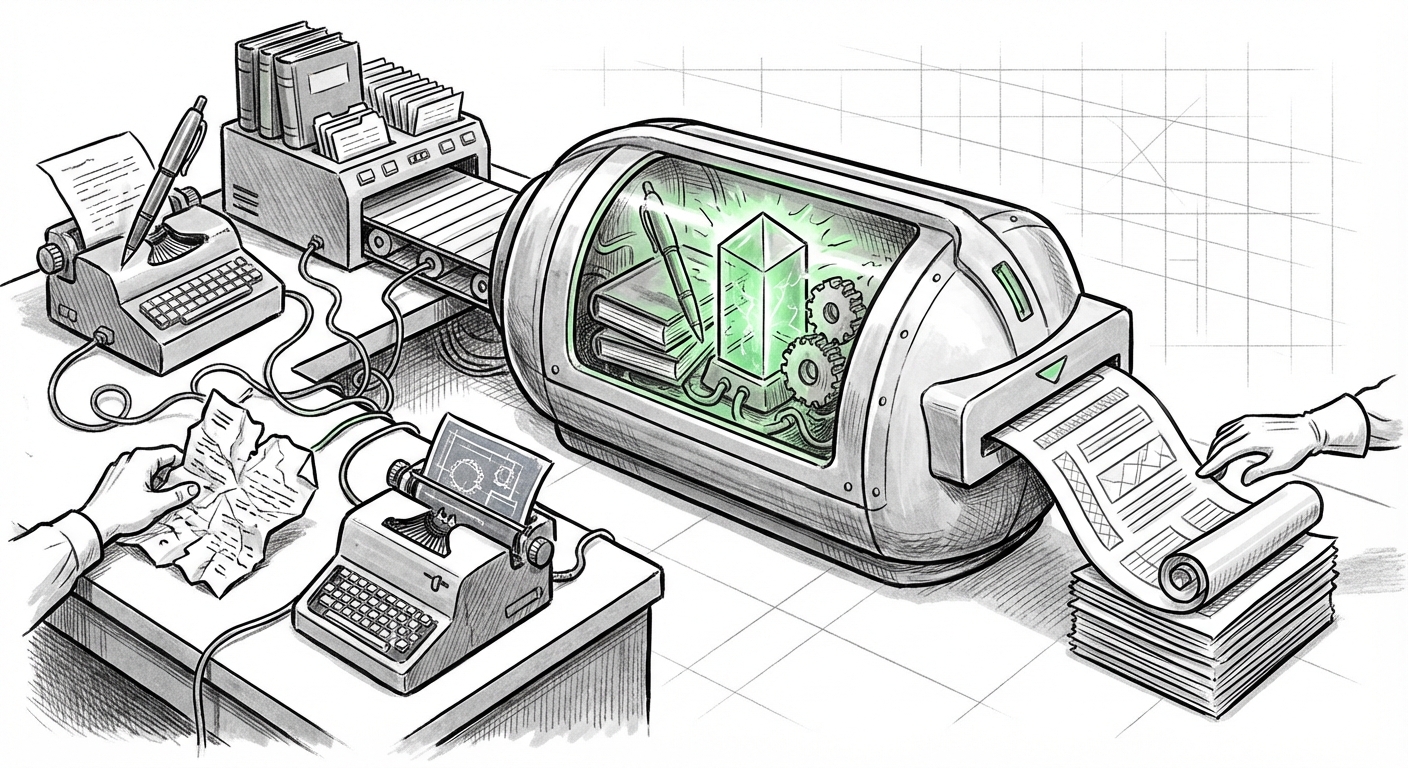
Prism seeks to erase those hand-offs. It positions the LLM as the central, intelligent operating system that manages the inputs, the output format (LaTeX), and the necessary scaffolding (references). This mirrors a broader pattern across enterprise software, where dominant players like Microsoft and Adobe are aggressively acquiring or building features to integrate niche capabilities into single, cohesive platforms. When searching for corroboration on this shift, we look for evidence that experts are demanding unified environments, as highlighted by discussions on "AI tools consolidating academic workflow LaTeX reference manager."
Implications for Workflow and Efficiency
For the end-user—the PhD student, the R&D engineer, or the technical report writer—the benefit is immediate: time saved context-switching. The AI can now dynamically update citations *while* restructuring a complex mathematical proof within the LaTeX environment, something impossible when these functions lived in separate silos. This is the death knell for modular, single-function SaaS tools that do not incorporate deep, functional AI integration.
Actionable Insight for Businesses: If your company relies on specialized, multi-step approval or creation processes (e.g., legal contract drafting, financial modeling reports), the competitive advantage will shift to those who can leverage AI to create a single, intelligent platform that bypasses traditional tool chaining.
Trend 2: Beyond General Knowledge—The Rise of Specialized, Expert LLMs (GPT-5.2)
The success of Prism hinges not just on integrating tools, but on the capability of its underlying model, referenced here as GPT-5.2. This iteration signals a clear departure from the general-purpose assistants of the past toward models trained and tuned for extreme precision in specific domains.
LaTeX is unforgiving. A single misplaced brace or an incorrect command can break an entire document. A general-purpose LLM often struggles with this level of structural fidelity. Therefore, the mere announcement of Prism implies that GPT-5.2 possesses superior symbolic reasoning and *formatting adherence* compared to its predecessors. This aligns with expert analysis concerning the "Future of technical writing LLMs specialized domain knowledge," suggesting models are becoming deeper, rather than just wider.
The Shift from "Smart Writer" to "Expert Modeler"
When an LLM masters LaTeX, it suggests it has mastered the underlying logic of structured document representation. This capability is transferable. If GPT-5.2 can reliably structure a journal article in LaTeX, it theoretically can be adapted to reliably structure complex code in an IDE, design accurate circuit diagrams using specialized description languages, or generate complex database schemas. It transitions from being a summarizer to a modeler of highly structured information.
For AI Developers: The focus must shift from maximizing parameter count to maximizing accuracy and adherence to esoteric domain rules. Fidelity in high-stakes environments (like mathematical proofs or regulatory filings) is the new benchmark for commercial LLM success.
Trend 3: Navigating the Ecosystem—AI Adoption in Scholarly Publishing
A brilliant writing tool is useless if the industry it serves rejects its output. Scientific publishing operates on centuries of tradition regarding authorship, citation, and presentation. Prism’s debut forces an immediate reckoning regarding the "AI adoption in scientific publishing and peer review platforms."
Currently, many journals have strict rules against attributing authorship to AI. However, Prism positions the AI as a powerful co-pilot woven into the fabric of the document from the beginning, handling formatting and bibliography compilation—tasks traditionally seen as tedious administrative burdens, not core intellectual contribution. If Prism can guarantee perfectly formatted, correctly cited manuscripts that pass plagiarism checks, the conversation shifts from "Is this AI-written?" to "Is the human author maintaining intellectual oversight?"
The Race for Institutional Acceptance
If major publishers (like Elsevier or Springer Nature) or university repositories do not adapt their ingestion systems to easily handle AI-generated, high-fidelity LaTeX, Prism’s immediate value is capped at the pre-submission draft stage. The competitive response from established platforms, such as rumored AI partnerships by Overleaf (as explored via queries regarding "Review of current AI integration in Overleaf or ShareLaTeX alternatives"), will be critical. If competitors match the fidelity, the market will settle on user preference; if they lag, OpenAI gains a powerful foothold in academia.
Societal Implication: The Devaluation of Labor vs. The Acceleration of Discovery
This consolidation presents a dual challenge. On one hand, it dramatically lowers the barrier to producing polished, professional-grade technical documentation, accelerating the pace of research dissemination. On the other, it threatens the role of technical editors, professional typesetters, and administrative staff whose primary value was managing the complexity that Prism is designed to eliminate.
Future Implications: Where Do We Go From Here?
OpenAI’s Prism is a powerful bellwether. It demonstrates a strategic understanding that the next monetization frontier for Generative AI lies not in novelty, but in necessity—by embedding itself into the most structurally demanding workflows.
The "Expert AI Persona" Framework
We can project this model outward. We should anticipate the next wave of AI launches targeting specific professional personas, each integrating the model with necessary domain-specific software equivalents:
- Legal AI: Integrating LLMs with complex contract templating systems (like specialized CLM software) and case law databases, ensuring perfect Bluebook citation adherence in native formats.
- Financial AI: Combining models with robust spreadsheet environments (beyond Excel’s current Copilot), capable of generating auditable, complex financial models complete with integrated explanatory notes and regulatory cross-references.
- Design AI: Fusing generative models with vector graphics software (like the Adobe suite), ensuring that generated designs adhere not just to aesthetic principles, but to strict engineering tolerances or brand guidelines encoded as format rules.
The core lesson is that AI is evolving from being a source of *content* to becoming the *scaffolding* upon which that content is built, validated, and delivered within the required professional constraints.
Actionable Insight for Researchers and Professionals
Do not wait for your institution to adopt Prism; begin testing how deeply you can integrate AI into your current documentation stack. Understand the "seams" in your current workflow—the points where you switch applications—as these are the exact vulnerabilities OpenAI is targeting for disruption. Mastery of the next generation of AI will require fluency not just in prompting, but in managing the toolchain it seeks to consolidate.
Prism is more than a writing assistant; it is a blueprint for the AI-powered expert workspace. By solving the high-friction problem of technical writing through unification, OpenAI is setting a new bar for specialized AI integration, making the promise of accelerated, high-fidelity knowledge work a tangible reality.