The Anthropic Alliance: Why the UK Government’s AI Move Signals a New Era for Public Sector Tech
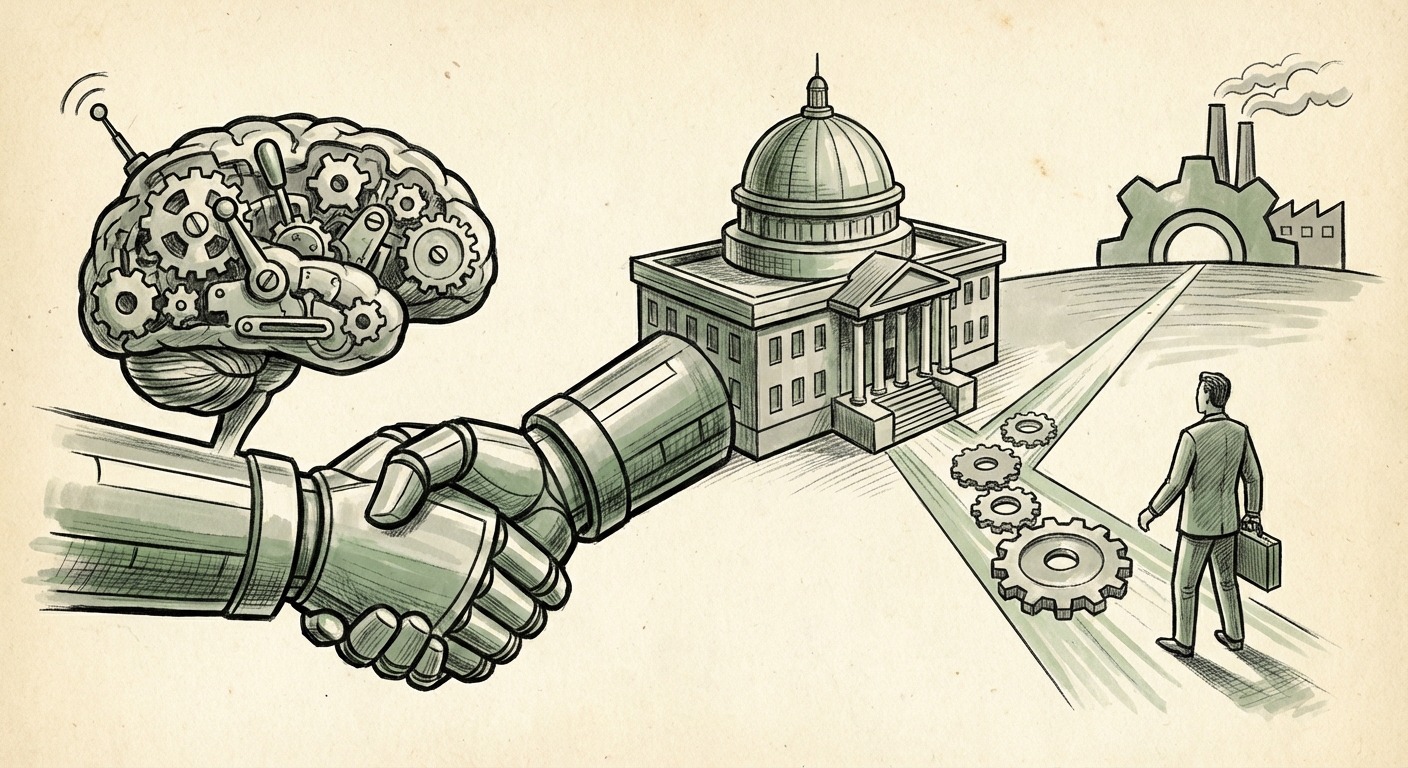
The announcement that the UK government has chosen Anthropic to power a new AI assistant on the GOV.UK website—specifically aimed at helping citizens find jobs—is far more than just another technology upgrade. It’s a calculated strategic pivot that reveals deep underlying trends in how governments view frontier artificial intelligence. This partnership is a bellwether for the future of public sector technology, indicating a significant shift toward prioritizing safety, alignment, and regulatory compliance in critical citizen services.
To fully grasp the implications of this move, we must look beyond the headline and analyze the context: the competitive landscape of Large Language Models (LLMs), the UK’s evolving digital procurement strategy, and the inherent risks associated with deploying powerful AI tools where accuracy is non-negotiable.
The Strategic Pivot: Safety Over Speed
In the current AI race, there are several dominant players, most notably OpenAI (backed by Microsoft) and Google DeepMind. For a critical national service like a job-matching assistant, which handles sensitive personal data and requires high levels of reliability, the choice of vendor speaks volumes.
The selection of Anthropic—a company founded by former OpenAI leaders with a core mission centered on developing safe and beneficial AI—suggests the UK government is heavily weighting risk mitigation above raw capability scores, at least for this initial deployment. This aligns with findings in industry analysis suggesting that governments conducting thorough evaluations often favor models marketed for their stability and ethical frameworks.
For non-technical audiences, imagine choosing a contractor for a major construction project. You could choose the cheapest or the fastest, but for a vital public building, you choose the one with the best safety record and proven adherence to building codes. Anthropic’s emphasis on Constitutional AI—training models to adhere to a set of explicit ethical principles—is essentially the "building code" that appeals to risk-averse government agencies.
What is Constitutional AI? (A Simplified View)
At its heart, Constitutional AI (CAI) is a method to steer an AI model. Instead of just learning from human feedback (which can be inconsistent), the model is trained against a set of written rules or principles (a 'Constitution'). For a job-matching assistant, this Constitution might explicitly forbid giving political advice, recommending illegal actions, or providing deliberately misleading salary information. This makes the model’s behavior more predictable and auditable—a necessity when dealing with millions of citizens.
Decoding the Procurement Context: The GDS Framework
This deployment is not happening in a vacuum. As detailed in analyses of the Government Digital Service (GDS) framework, the UK has been attempting to standardize how technology is bought and deployed across Whitehall. The choice of Anthropic likely stems from a structured procurement process designed to test vendors not just on performance, but on adherence to UK digital standards and responsible AI guidelines.
This points toward a crucial trend: the move away from bespoke, custom-built government software toward leveraging secure, enterprise-grade APIs from established, vetted providers. For technology leaders and procurement officers, the lesson here is clear: Trust is the new currency in government tech contracts. Vendors who can demonstrate established security protocols and ethical alignment will win the high-value public sector work.
Furthermore, as we examine the regulatory environment, particularly the looming influence of the European AI Act, governments globally are bracing for stricter compliance requirements. Even though the UK is no longer bound by EU law, interoperability and adherence to emerging global safety benchmarks are highly valuable. Partnering with Anthropic, which is deeply invested in meeting high global safety standards, preemptively positions the GOV.UK service for future regulatory scrutiny.
The Practical Implications: Efficiency and Augmentation
The immediate goal for this specific AI assistant is efficiency. Citizens trying to navigate job boards, understand benefit requirements, or find the right training schemes often face clunky interfaces and slow response times. The LLM assistant is designed to transform this experience from navigating a labyrinth of links to having a direct, instantaneous conversation.
Beyond the Chatbot: Deeper Integration
While the interface will be a chatbot, the true implication, as suggested by foresight reports on AI in public services, lies in the potential for deep data integration. Imagine the future iteration hinted at: the AI doesn't just answer questions; it actively analyzes the user’s declared skills against real-time national skills gaps identified in massive labor datasets.
- Personalized Pathways: Instead of general advice, the AI recommends highly specific, localized training courses known to lead to employment in growing sectors.
- Reduced Bureaucracy: The AI can pre-fill complex forms or triage urgent cases directly to human advisors, drastically reducing processing times for benefits or job applications.
- Proactive Intervention: If the AI spots a pattern (e.g., a local industry is downsizing), it can proactively notify affected citizens with retraining options before job loss occurs.
This moves AI from being a mere cost-saving automation tool to an augmentation engine for human civil servants. The AI handles the 80% of routine queries, freeing up experienced staff to focus on the complex 20% that requires genuine empathy, nuanced judgment, and high-stakes negotiation.
Future Trajectories: What This Means for AI Development
The UK-Anthropic alliance signals a clear trend that will define the next phase of AI adoption: the bifurcation of the market based on use case.
1. The Rise of the 'Trustworthy AI' Stack
We are moving past the era where the "biggest" or "fastest" model wins every contract. For sensitive sectors like healthcare, finance, and government, the market will increasingly reward providers who can offer transparency in their safety training and alignment methodologies. Anthropic is currently leading this narrative, and this public contract provides them with invaluable validation.
2. Sovereign Capabilities and Geopolitics
While Anthropic is a US-based company, its deep focus on safety and its relatively recent funding from major European players (like Google, ironically, but also significant UK investment interest) positions it as a politically viable partner for Western governments seeking alternatives to singular reliance on other tech giants. This suggests a move toward building a "trusted technological sphere" for critical infrastructure.
3. The Auditing Imperative
For businesses watching this space, the key takeaway is the need for internal auditing tools. If the UK government requires Anthropic to demonstrate *how* the safety constitution works, businesses implementing LLMs for customer service or HR compliance will soon face similar demands from regulators or internal compliance teams. Being able to prove *why* the AI gave a specific answer is becoming as important as the answer itself.
Actionable Insights for Business and Society
This development is not just for Whitehall watchers; it has direct relevance for private sector technology adoption and societal readiness.
- For Business Leaders: Re-evaluate Your LLM Strategy. If your organization handles customer data, compliance documents, or sensitive financial information, stop defaulting to the most popular model. Start auditing LLM outputs against your internal governance policies. Look for vendors that specialize in verifiable safety layers, not just raw performance benchmarks.
- For Public Sector Technologists: Focus on Integration, Not Just Procurement. The real value will be in integrating the AI assistant with legacy government databases securely. Success won't be measured by how good the chatbot *sounds*, but by the measurable reduction in case backlog and the improvement in citizen satisfaction scores (the efficiency metrics mentioned earlier).
- For the Public: Demanding Transparency. Citizens should expect, and advocate for, transparency regarding the guardrails placed on public-facing AI. When interacting with the GOV.UK assistant, knowing that it adheres to a public set of safety principles helps build the necessary trust for widespread AI adoption.
Conclusion: Trust as the Ultimate AI Frontier
The UK government’s commitment to Anthropic for its GOV.UK job assistant is a powerful statement. It signals that in the high-stakes arena of public service delivery, the future of AI is inextricably linked to trustworthiness. This partnership elevates safety alignment from an academic talking point to a mandatory feature for deploying frontier technology in the real world.
As we move forward, expect more governments and highly regulated industries to follow this path, favoring verifiable safety over unbridled speed. The real competition among AI labs will no longer just be about achieving AGI; it will be about achieving auditable, reliable, and publicly accountable intelligence. The GOV.UK job assistant is our first major glimpse into that rigorously governed future.