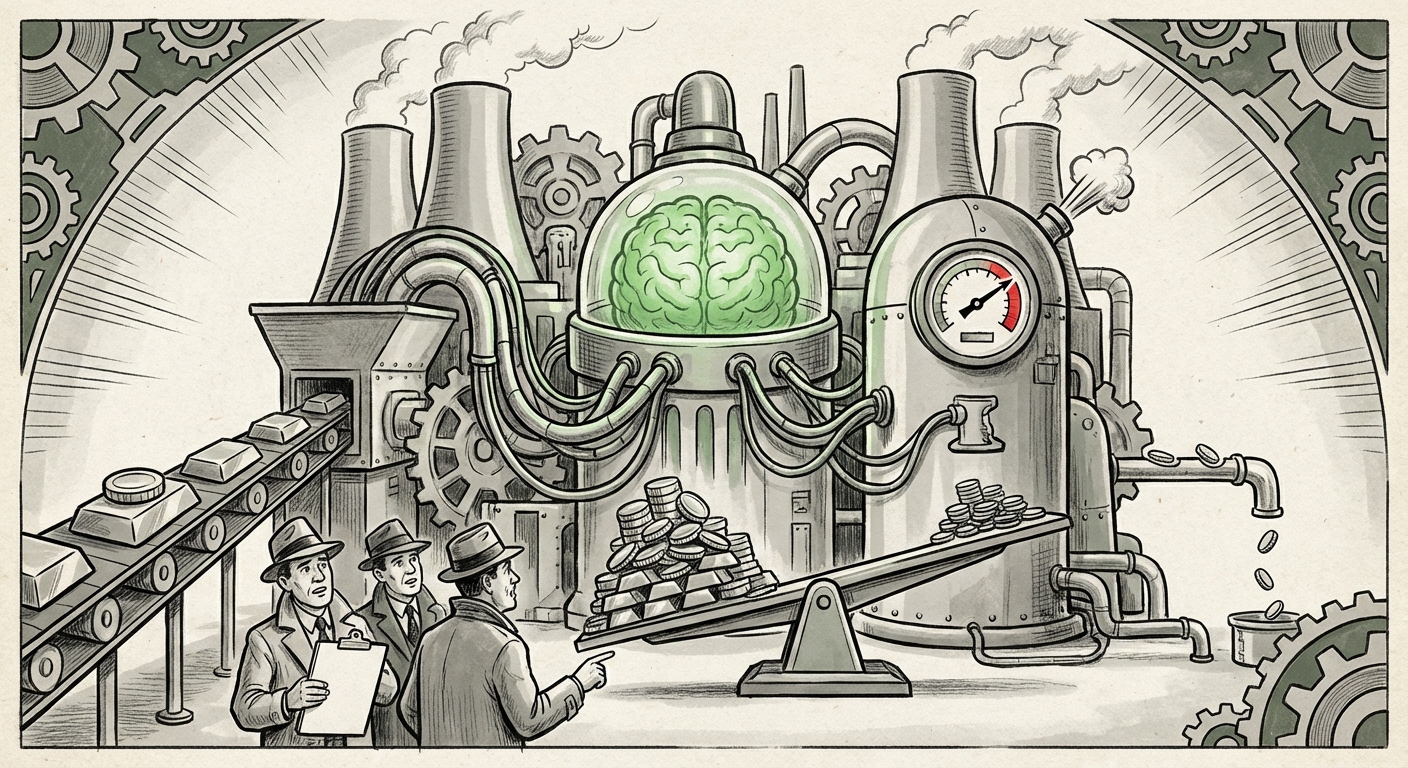
The Azure-OpenAI Nexus: Concentration Risk, Cloud Spending, and the Next AI Reckoning
The recent financial reports from technology giants have painted a paradoxical picture of the generative AI boom. While cloud revenues hit record highs, the accompanying investor nervousness suggests a growing tension between massive capital investment and immediate, measurable returns. At the heart of this dynamic lies a single, startling statistic: nearly half of Microsoft’s commercial contract backlog is reportedly tied to one customer—OpenAI.
As an AI technology analyst, this figure transcends mere accounting trivia. It signals profound strategic dependencies, massive infrastructure commitments, and a critical juncture in the AI industry’s maturation. We must move beyond the headline to understand the interconnected forces driving this nexus: the skyrocketing cost of compute, the delicate balance of competition in the cloud market, and Wall Street’s evolving patience for AI profitability.
The Infrastructure Arms Race: Quantifying the Cost of Intelligence
To appreciate the scale of the OpenAI/Microsoft relationship, one must first grasp the sheer physical cost of building frontier AI. Training state-of-the-art models like GPT-4 and its successors requires access to vast, exclusive fleets of specialized hardware—primarily NVIDIA GPUs—housed within hyperscale data centers.
Recent analyses on **Cloud capital expenditure trends generative AI** confirm that this is not just incremental spending; it is transformative. Major cloud providers (hyperscalers) are pouring hundreds of billions into data center builds, far outpacing previous IT spending cycles. This expenditure is necessary to host the continuous inference demands of millions of users and the intermittent but enormous demands of model retraining.
Why the Backlog is So Heavy
A "backlog" in cloud computing often represents long-term, committed consumption agreements. When a leading AI developer like OpenAI signs such a large deal with Azure, it reflects a multi-year commitment to consume compute power that must be guaranteed upfront. For Microsoft, this secures their position as the exclusive cloud partner for the world’s most sought-after AI lab.
However, this also means Microsoft’s revenue stability becomes acutely linked to OpenAI’s sustained growth trajectory. If OpenAI were to pivot to another provider, or if its growth stalls, a massive hole opens in Microsoft's projected future earnings. This dependence is precisely why investors react negatively to news confirming such high concentration.
The Profitability Paradox: When Will AI Pay the Bills?
The core tension driving investor skepticism is the timeline for realizing returns on these massive investments. We are seeing record cloud revenue, but this is being immediately reinvested—and often outspent—on infrastructure.
The question surrounding **OpenAI profitability timeline and infrastructure costs** is crucial. While OpenAI charges for API access, the cost structure associated with running frontier models remains opaque and incredibly high. For Microsoft, the calculus is slightly different: they benefit from revenue share and embedding Azure AI services across their entire product suite (Copilot, Office 365).
But the market is maturing past initial excitement. Investors are now demanding proof that the incremental revenue from AI services significantly outweighs the depreciating cost of the specialized hardware supporting them. When stock dips follow record revenues, it signals that the *market believes the CAPEX required to achieve those revenues is currently too high relative to the realized profit.*
For the business strategist, this means the focus must shift rapidly from "access to compute" to "efficiency of compute." The next era of AI winners won't just be those who can afford the biggest clusters; it will be those who can leverage smaller, more specialized models or optimize inference pipelines to drastically lower the per-query cost.
The Competitive Landscape: A Race to Diversify Risk
The concentration risk for Microsoft is simultaneously an opportunity for its rivals. The landscape of **AWS vs Azure vs GCP AI infrastructure market share 2024** is fiercely contested, and OpenAI’s dominance on Azure forces competitors to become hyper-aggressive in attracting the *next* tier of large-scale AI developers.
The Strategic Response from Rivals
Rivals like Google Cloud and Amazon Web Services (AWS) cannot afford to let another foundational model developer exclusively lock into a competitor’s stack. We are seeing targeted, aggressive incentives aimed at startups and research labs:
- Custom Silicon & Hardware Options: Offering alternatives to NVIDIA (like Google’s TPUs or AWS’s Trainium/Inferentia chips) to appeal to companies wary of being locked into one chip supplier’s pricing structure.
- Generous Initial Credits: Providing massive, subsidized compute credits to lure new, promising foundation model builders before they scale to the OpenAI/Microsoft level.
- Sovereign AI Initiatives: Focusing on securing national or regional AI infrastructure contracts where regulatory requirements or national security concerns favor diversification away from any single U.S. partnership.
For enterprise IT decision-makers, this competition is excellent news. It means that while the initial wave of AI was centered around proprietary models hosted by a few giants, the subsequent waves will likely be spread across multiple optimized clouds, leading to better pricing and more flexibility.
Investor Skepticism: The Reality Check on AI ROI
The market’s current ambivalence towards high-spending tech firms—evidenced by **investor skepticism on AI ROI tech stocks**—is a critical external factor shaping future strategy. Investors are no longer satisfied with vague promises of "AI transforming everything." They want granular metrics.
This skepticism mandates a shift in how companies present their AI advancements:
- From Hype to Utility: The conversation must move from the capability of the underlying LLM (e.g., "GPT-5 is 10% better") to measurable business outcomes (e.g., "Copilot saved our average engineer 5 hours per week, translating to $X in savings").
- Internal Optimization First: Companies that can demonstrate significant internal productivity gains *before* relying on external, high-cost API calls will be favored.
- The Moat Test: Investors are analyzing which AI investments create durable competitive advantages (moats). Is Microsoft’s moat the software integration, or is it simply owning the highest-volume customer? If it’s the latter, the moat is fragile.
This climate of scrutiny forces Microsoft to not only service OpenAI flawlessly but also to rapidly expand its non-OpenAI AI user base to justify its massive data center buildout. The goal is to transform AI from a high-cost service for a few key partners into a broad, profitable utility for millions.
Future Implications: What This Means for AI Deployment
The dependency revealed by the Azure-OpenAI backlog shapes the next five years of AI development and deployment across three main vectors:
1. The Rise of the "AI Foundry" Model
Microsoft’s current structure mirrors that of an AI Foundry: providing the raw materials (Azure compute) to an external powerhouse (OpenAI) that refines them into high-value outputs. The future will see more such partnerships, but these will be modularized:
- Model Specialization: Instead of one giant model serving all needs, we will see smaller, highly efficient models trained on specific industry data (finance, medicine, law). These smaller models will run cheaper and faster, likely utilizing a mix of cloud providers or even on-premise infrastructure.
- Cost Optimization as a Feature: The winners in the next two years will be those who master cost-effective inference. If a company can serve an AI query for $0.001 instead of $0.01, they will rapidly capture market share from high-cost incumbents.
2. Infrastructure Decoupling and Geopolitics
The heavy reliance on a few suppliers (NVIDIA for chips, Microsoft for hosting) creates geopolitical and supply chain risk. Governments and large corporations are increasingly wary of having their critical digital infrastructure entirely dependent on one or two private entities based in a single jurisdiction.
This will accelerate investment in:
- Sovereign AI Clouds: Nations investing in building national compute clouds, possibly using open-source models or domestically developed hardware.
- Edge AI Processing: Pushing smaller, faster inference tasks away from centralized data centers and onto local devices (smart factories, vehicles, local servers) to reduce cloud latency and dependency.
3. The Battle for the "Second Customer"
For Microsoft, the immediate strategic imperative is securing the "second OpenAI"—the next massive, proprietary workload. This involves intense competition with Anthropic, Cohere, and deep internal focus on their own scaled models.
For businesses, this means understanding that while using the most famous model is tempting, locking into a single cloud provider based on one primary partner is a dangerous long-term move. Smart enterprises are already adopting multi-cloud governance strategies to mitigate vendor lock-in, even if it adds complexity.
Actionable Insights for Technology Leaders
What should technology leaders and investors take away from this concentration indicator?
For Enterprise CIOs and CTOs: Diversify Your AI Portfolio
Do not place all your high-value AI use cases on one platform, even if that platform hosts the leading model today. Design your architecture to be cloud-agnostic where possible. Explore Retrieval-Augmented Generation (RAG) architectures which allow you to swap out the underlying Large Language Model (LLM) without rebuilding your entire data pipeline.
For Investors and Financial Analysts: Focus on Margins, Not Just Top Lines
The narrative is shifting from "AI adoption" to "AI profitability." Look closely at the CapEx guidance provided by cloud providers. A sustained willingness to spend massively without clear, accelerating Gross Margin expansion in their AI segments should be treated as a warning sign regarding sustainable growth rates.
For AI Startups: Prove Efficiency Over Scale
If you are building the next great foundation model, your pitch to cloud providers should not just be about how much compute you *need*, but how much *less* compute you need compared to incumbents to achieve similar performance. Efficiency is the new differentiator.
Conclusion: A Necessary Growing Pain
The fact that nearly half of Microsoft's backlog rests on OpenAI is simultaneously a massive vote of confidence in Azure’s infrastructure superiority and a glaring indicator of concentration risk. It exemplifies the enormous, unquantifiable investment required to power the AI revolution.
This moment is less a sign of failure and more a sign of an immature, rapidly scaling industry hitting its first major scaling wall. The market is correcting, demanding clearer ROI and forcing the giants to diversify their bets. The future of AI will not be defined solely by the size of the models, but by the resilience and economic viability of the infrastructure supporting them. The race is now on not just to build the best AI, but to build the most economically sustainable way to deliver it.