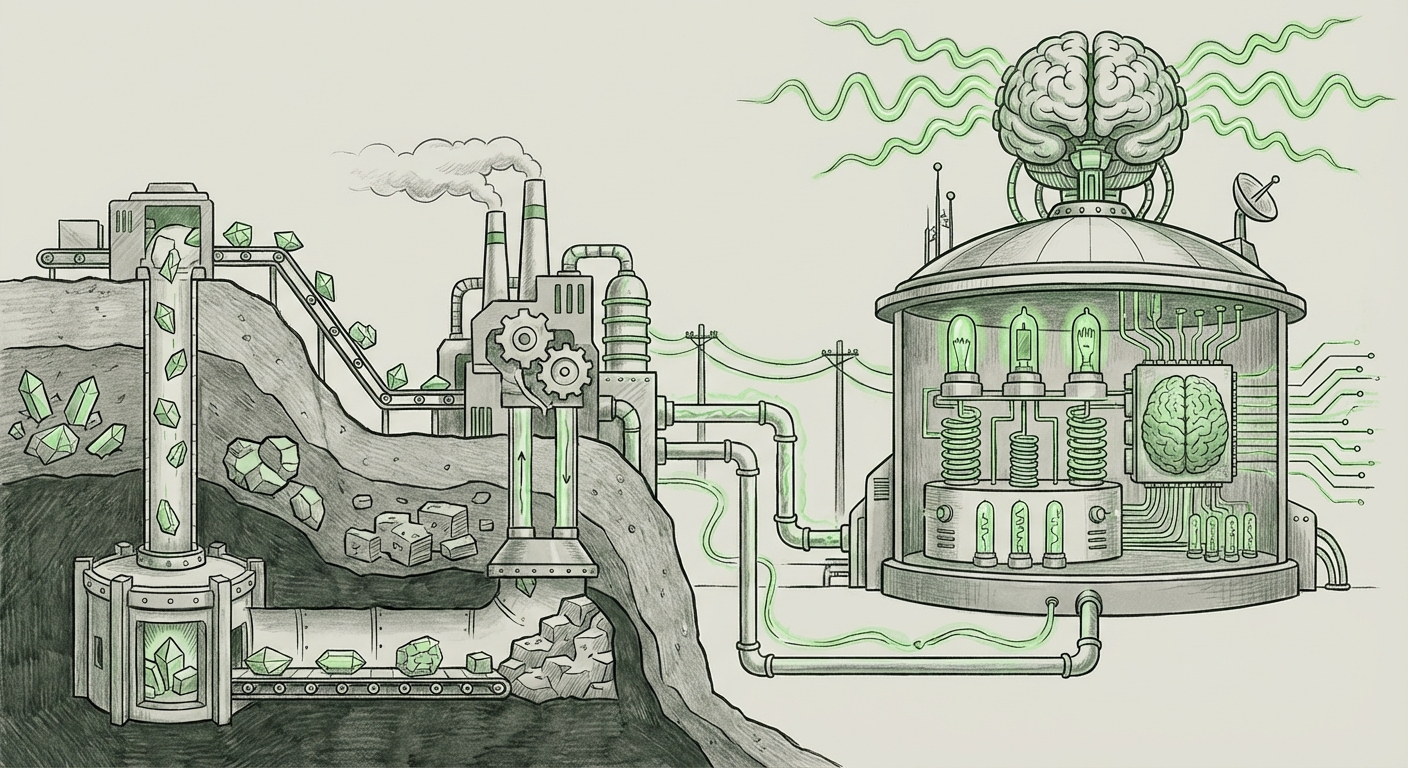
The AI Arms Race Goes Underground: Why the $12B Mineral Reserve is Key to Future Computing Power
Artificial Intelligence is reshaping our world at an unprecedented pace. From generating complex code to driving autonomous systems, the engine behind this transformation is specialized hardware—the GPUs, TPUs, and memory chips that power modern data centers. But what happens when the very raw ingredients needed to build those engines become a global choke point? This is the reality forcing nations to look deep underground, as evidenced by the US government’s recent commitment to a **$12 billion strategic mineral reserve**, dubbed "Project Vault."
As an AI technology analyst, I see this move not merely as smart procurement, but as a defining geopolitical pivot. Project Vault is a direct acknowledgment that supply chain security equals AI supremacy. The future of technology is being decided not just in the cleanrooms of chip fabs, but in the mines that supply the elements essential for them.
The Invisible Foundation of Intelligence: Minerals and AI
When we talk about AI hardware, most attention is rightly focused on the software layers—the algorithms and the models like GPT-4 or Llama. However, these algorithms require immense processing power, supplied by highly complex semiconductors. These semiconductors, along with the specialized magnets in advanced sensors and cooling systems, depend on a specific, often rare, suite of materials.
The Critical Ingredients
Rare Earth Elements (REEs) are not all "rare," but their extraction and, more importantly, their refinement into usable industrial materials are concentrated in very few locations globally. These elements are vital for:
- High-Performance Magnets: Neodymium and Dysprosium are essential for the powerful, lightweight motors in robotics and advanced actuators used in drone swarms and factory automation—key AI deployment vectors.
- Advanced Electronics: Elements like Europium and Yttrium are used in phosphors and specialized components in high-resolution displays and sensor arrays necessary for computer vision and autonomous navigation.
- Semiconductor Manufacturing: Though not always REEs, the broader category of 'critical minerals' required for etching, polishing, and creating the precise layers of a modern GPU requires specialized inputs that face similar supply risks.
The establishment of Project Vault is a national hedge against a disruption in the flow of these materials. It signals that the US government views uninterrupted access to these inputs as essential infrastructure for national security and economic competitiveness in the AI domain.
The Demand Surge: Fueling the AI Machine
Why the sudden, massive governmental investment now? The answer lies in the exponential scaling of AI. Training large language models (LLMs) demands exponentially more compute power year over year. This demand spike is the primary driver forcing the strategic reserve decision.
By querying industry forecasts, we see the explicit link between our need for processing power and mineral demand (Search Query 1: "Rare Earth Elements" demand forecast AI chip manufacturing). Analysts consistently project that the computational requirements for cutting-edge AI models will continue to double every 6-12 months. This relentless growth means that the number of advanced AI accelerators needed—and thus, the underlying materials—will quickly outstrip current, easily accessible reserves.
For hardware manufacturers, this translates into risk: **higher procurement costs, longer lead times, and the potential inability to meet scheduled deployment targets for next-generation AI systems.** Project Vault acts as an immediate buffer, allowing the industrial base time to catch up to the market’s insatiable appetite for intelligence.
Resource Nationalism and the Geopolitical Landscape
The need for Project Vault does not exist in a vacuum; it is a direct reaction to global geopolitical shifts. For decades, a significant portion of the world’s REE processing capacity has been consolidated geographically. This concentration creates a single point of failure, exploited through what we call resource nationalism—where a nation uses its control over a critical resource for political leverage.
Research into global competition (Search Query 2: Geopolitical competition critical minerals China US EU) consistently highlights that control over these materials is viewed as a core component of technological dominance. When the foundational materials for AI chips become subject to export restrictions, the implications for American and European AI development are immediate and severe. Project Vault, therefore, is less about commerce and more about **de-risking technological innovation**. It is an infrastructure project disguised as a stockpile.
From Stockpiling to Sovereignty: Actionable Government Levers
Furthermore, the government's activity extends beyond just stockpiling. We are seeing legislative mandates to actually build capacity domestically. By leveraging tools like the Defense Production Act (DPA) (Search Query 4: US defense production act funding critical minerals AI), funds are being channeled to restart or expand domestic mining, separation, and recycling plants. This strategy aims to create a resilient, end-to-end supply chain for AI hardware, from the earth to the integrated circuit.
The Long-Term Fix: Innovation Over Hoarding
While Project Vault offers vital short-term security, true resilience in the AI sector requires technological innovation that bypasses the dependency entirely. Governments and private industry must aggressively fund R&D focused on material substitution.
Analysis of materials science breakthroughs (Search Query 3: Technological alternatives to rare earth magnets in advanced motors and sensors) shows promising avenues. Researchers are developing high-efficiency magnets based on iron nitride or exploring sophisticated amorphous alloys that reduce or eliminate the need for the most strategically vulnerable REEs like Neodymium and Dysprosium in certain applications. If successful, these alternatives could render even the most robust mineral reserves strategically less vital over the next decade.
Similarly, advancements in **AI-driven materials discovery** and advanced **urban mining (recycling)** are crucial. AI itself can accelerate the identification of new, abundant, and less toxic materials suitable for chip fabrication, effectively turning today's electronic waste into tomorrow's strategic asset.
Implications for Business: Navigating the New Reality
For businesses operating in the AI ecosystem—from startups developing niche software to massive cloud providers—the landscape is changing from a purely commercial one to a hybridized, geopolitically informed one.
1. Hardware Procurement Strategy
Businesses can no longer rely solely on just-in-time inventory for critical hardware components. They must now factor in government security buffers. Companies should actively align their long-term hardware roadmaps with government initiatives supporting domestic or allied sourcing. Those who secure preferred access to these newly stabilized supply lines will have a significant competitive advantage in scaling AI deployment.
2. Investment in Resilience (The 'Build It Here' Mandate)
Venture Capital and corporate R&D budgets must increasingly prioritize ventures focused on decoupling production from high-risk geographies. This means investing in:
- Next-generation semiconductor fabrication techniques that use fewer critical materials.
- Advanced battery technology that relies on less contested elements.
- Scalable, cost-effective mineral recycling technologies.
3. Geopolitical Awareness as a Core Competency
For C-suite executives, understanding the material basis of their technology is now as important as understanding software licensing. Supply chain risk modeling must explicitly incorporate mineral availability scenarios. A product launch schedule that ignores potential trade friction around REEs is now inherently fragile.
Actionable Insights: Securing the AI Horizon
Project Vault is a declaration of intent. The competition for technological leadership is now inextricably linked to the competition for subterranean resources. Here are immediate insights for leaders looking to thrive in this mineral-aware AI future:
- Audit Material Dependencies: Immediately map every critical mineral used in your primary hardware stack against current, projected geopolitical risk scores. Do not wait for a shortage to begin this process.
- Dual-Source Critical Components: Where possible, build vendor relationships that span different continents and political spheres, even if the short-term cost is slightly higher. Diversification buys time.
- Engage with Government Initiatives: Actively seek out DPA funding opportunities or grants aimed at domestic processing and recycling. Government programs are explicitly designed to de-risk private sector investment in these strategic areas.
- Fund Substitutes Aggressively: If your product line depends heavily on high-performance magnets or specialized conductors, dedicate significant R&D resources to developing a V2 product based on non-critical materials.
Conclusion: The Ground War for AI Dominance
The race for Artificial Intelligence has always been framed as a race for talent, data, and algorithms. However, Project Vault forces us to acknowledge the ground war—the literal struggle over the physical elements required to build the machines that run the algorithms. The $12 billion reserve signals a crucial shift: nations are no longer willing to leave the foundation of their future technological power to chance or the goodwill of foreign suppliers.
For the AI industry, this means a new era of strategic planning where geological constraints meet algorithmic ambition. The companies that succeed will be those that not only write the best code but also secure the most resilient supply chains, turning material scarcity into a solvable engineering challenge.