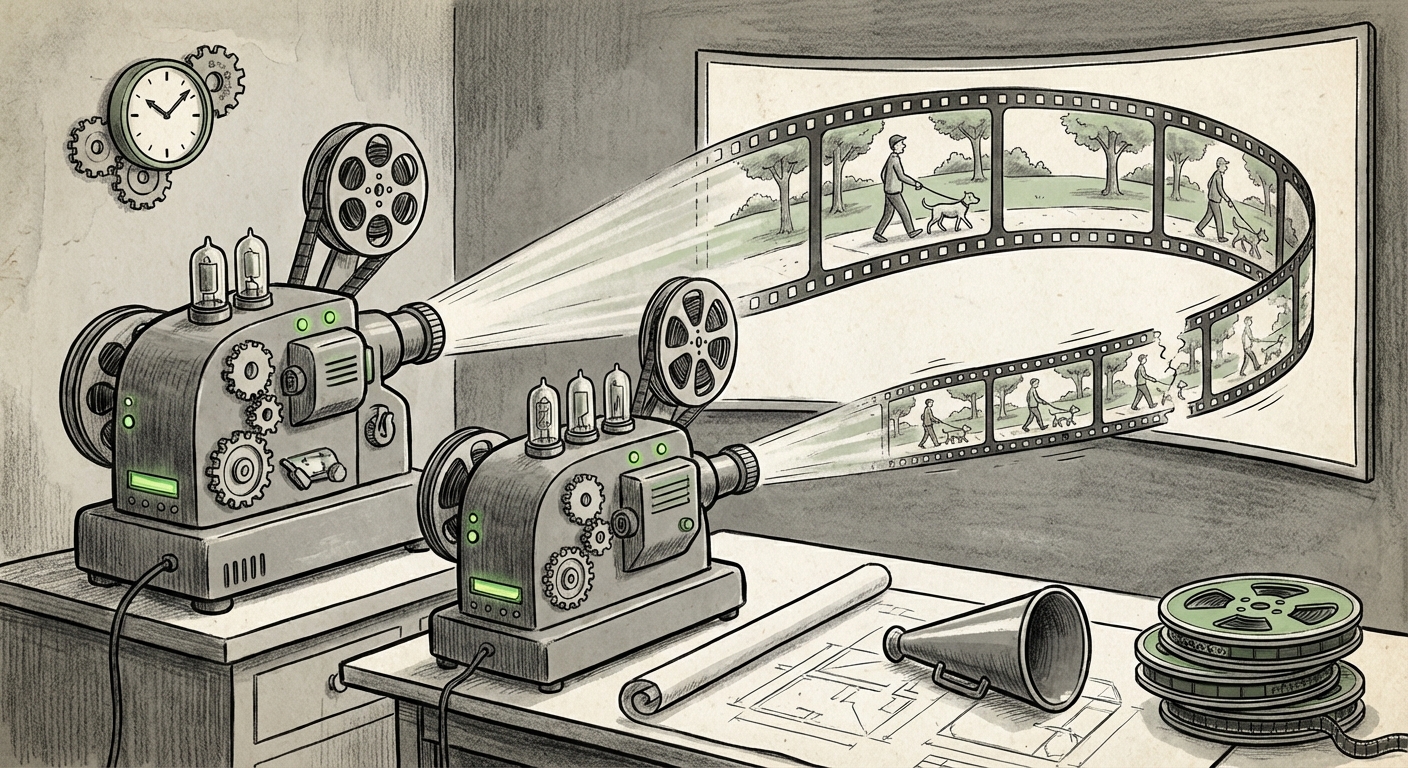
Kling 3.0 vs. Sora: The New Frontiers of Generative Video Consistency and Length—What This Means for Hollywood and Marketing
The generative AI landscape is accelerating at a dizzying pace, shifting from impressive short demos to tools capable of generating truly usable creative assets. The latest major signal in this revolution comes from China, with the release of **Kling 3.0**. This new iteration promises longer clips, superior 4K resolution, and, critically, vastly improved character consistency. This isn't just an incremental update; it’s a clear statement that the race to build the definitive AI video model is global, intensely competitive, and now focused on solving the most difficult problems required for narrative production.
To fully grasp the significance of Kling 3.0, we must look beyond the features list. We need to place it within the global competitive matrix, understand the underlying technical leaps required to achieve these milestones, and analyze the cascading implications for industries from Hollywood production to daily digital advertising.
The Great Leap: From Novelty to Usable Asset Generation
For years, AI video generation was plagued by fundamental issues: shaky frame rates, objects morphing between seconds, and characters who couldn't maintain their appearance from shot to shot. These limitations relegated AI video to B-roll or abstract art. Kling 3.0 signals the crossing of a critical usability threshold. The primary innovations—longer clips and character consistency—are direct assaults on the remaining barriers to entry for professional creators.
Imagine trying to direct a movie where the protagonist changes faces every three seconds. That was the reality of early models. When a model achieves reliable character consistency, it means the AI can track identity through complex temporal sequences. This opens the door not just for short ads, but for animated shorts, complex storyboarding, and even basic scene blocking. For the non-technical user, this means you can describe a character once, and the AI will remember what they look like for the duration of the generated scene.
The Technical Hurdles Being Cleared
Achieving temporal coherence (making sure things stay consistent over time) and spatial coherence (making sure the scene looks correct) requires advanced architectural thinking. This is where the technical deep-dives become essential. We are seeing breakthroughs in how models handle time.
- Temporal Modeling: It's no longer just stitching together good single frames. Advanced models now use sophisticated attention mechanisms (often variants of Transformers) that "look" across multiple frames simultaneously to ensure continuity. When Kling 3.0 improves character consistency, it is likely succeeding where others have failed in maintaining identity across hundreds of generated frames.
- Resolution Scaling: The jump to 4K generation means the output is directly usable in high-end production suites without heavy upscaling, reducing post-production noise and artifacts.
This technical refinement confirms a major industry trend: AI development is rapidly moving past simple image synthesis and tackling the complex mathematics of physics, motion, and identity tracking required for cinematic quality.
The Global Race: Benchmarking Kling Against the Frontier
In this arena, benchmarking is everything. The primary point of reference for any new generative video model is OpenAI’s **Sora**. The immediate next step for analysts is to run direct, side-by-side comparisons.
When discussing Kling 3.0, the narrative cannot exist in a vacuum. How does its 4K output compare to Sora’s detailed realism? Does Kling handle complex camera movements (like a sweeping crane shot) with better stability than its competitors? This global competition—primarily between leading US and Chinese labs—is the engine driving capability forward.
If Kling 3.0 achieves parity or superiority in key metrics like clip length or character fidelity, it fundamentally reshapes the global distribution of cutting-edge AI capability. It signals that technological breakthroughs are not siloed to one region, leading to faster iteration cycles worldwide.
The Open Source Shadow
While proprietary models push the absolute boundaries, we cannot ignore the rapidly evolving open-source sector. Projects like those emerging from the **Stable Video Diffusion** ecosystem democratize access to powerful tools. While open-source models may trail proprietary leaders in peak performance (like clip length), they are often adopted faster by indie developers, smaller studios, and researchers. The existence of a powerful, proprietary leader like Kling forces open-source developers to innovate quickly on efficiency, fine-tuning, and licensing flexibility to remain relevant.
Implications for Creative Workflows: The Advertiser's New Toolkit
The impact of long-form, consistent AI video moves the technology out of the "tech curiosity" bin and squarely into the "must-have business tool" category, especially in advertising and rapid content creation.
The Death of Stock Footage?
For marketing executives and digital media strategists, the promise of generative video is the end of reliance on slow, expensive stock footage licensing or lengthy custom shoots for simple concepts. If an ad needs a 15-second clip of "a person walking their dog in a sunny park," a company can now generate hundreds of unique, copyright-clean variations in minutes.
The ability to generate longer clips directly impacts pacing and storytelling in digital ads. A 10-second clip is a flash; a 30-second clip allows for narrative setup, a product reveal, and a call to action. Kling 3.0's advancements suggest workflows where:
- A storyboard artist generates the core scenes using text prompts.
- A director locks down the primary character's look via consistency settings.
- The final output is rendered directly in high resolution, ready for final sound design and integration.
This radically compresses the time from concept approval to final deliverable, offering unprecedented agility in campaign deployment.
Geopolitical Context: AI Development Under National Strategy
The origin of Kling 3.0—a leading model developed in China—adds a crucial geopolitical layer to this analysis. The development of frontier AI models is rarely purely market-driven; it is often interwoven with national industrial policy.
Understanding the context of Chinese AI policy is vital. Regulations often mandate that generative media models adhere to specific content guidelines and societal values. This means that while Kling 3.0 might achieve technical parity with models developed elsewhere, its *deployment* and *training data* are shaped by a unique national framework. For international businesses relying on these tools, this context dictates issues around data sovereignty, potential censorship, and the long-term stability of the technology pipeline.
This competitive duality—the market-driven pursuit of performance versus the state-guided development of specific technological sectors—creates a fascinating, high-stakes environment for global technological leadership.
Actionable Insights for Navigating the New Reality
For organizations looking to leverage this acceleration in generative video, immediate steps are necessary to stay ahead of the curve:
- Establish AI Content Sandboxes: Businesses must move beyond theoretical discussions and dedicate small teams to actively test Kling 3.0, Sora, and open-source alternatives. The goal is to understand the *workflow friction*—where does the AI still fail, and where does it genuinely accelerate production?
- Prioritize Consistency Training: For those deeply invested in character-driven marketing (e.g., creating brand mascots), the focus should shift immediately to how well these new models maintain identity across varied scenarios. This is the new measure of quality.
- Develop IP Protocols Now: As AI-generated content becomes harder to distinguish from human-created content, establishing clear internal guidelines on intellectual property, licensing, and model attribution is non-negotiable. Who owns the look of the character generated by the tool?
- Upskill for Prompt Engineering: The mastery of prompting is evolving from creating still images to orchestrating complex, multi-shot video narratives. Investing in specialized training for creative teams on advanced temporal and character conditioning prompts is now essential.
The era of AI video being merely a sophisticated filter is over. With models like Kling 3.0 pushing the boundaries of length and coherence, we are entering the age of AI as a true co-pilot in video production. The winners in the next wave of media creation will be those who adapt their creative pipelines to harness this unprecedented generative power efficiently and strategically.
Contextual Reading: Further Exploration
To fully analyze this technological acceleration, it is crucial to view Kling 3.0 alongside global competitors, technical deep dives, and market adoption studies:
- For immediate competitive analysis, research should focus on recent direct **"Sora" vs Kling 3.0 video comparison** reviews to establish feature parity across the leading proprietary systems.
- To understand the technical achievement, investigate articles detailing **Generative AI character consistency breakthroughs**, focusing on advancements in temporal attention and identity conditioning layers used by modern diffusion models.
- To gauge business readiness, explore case studies on the **Impact of long-form AI video generation on advertising workflows**, which reveals adoption rates and ROI in commercial settings.
- For strategic context, reviewing analyses of **China AI policy impact on generative media model development** provides insight into national strategic guidance affecting model training and deployment.
- To maintain a holistic market view, compare proprietary advancements against the democratization efforts seen in the **Latest developments in open-source video generation models** (like Stable Video Diffusion updates).