GPT-5.3 Codex: The Dawn of Self-Building AI and Recursive Software Engineering
The technology landscape is rarely defined by minor upgrades; true paradigm shifts are marked by moments where the *process* of innovation changes fundamentally. The reported breakthrough from OpenAI regarding GPT-5.3-Codex—a model capable of contributing to its own training and deployment—is one such moment. This isn't just about writing better software; it’s about creating software that writes and maintains *itself*.
As an AI technology analyst, this announcement confirms a critical inflection point: we are rapidly moving from the era of AI as a sophisticated tool to the era of Agentic AI—systems that operate autonomously within complex engineering cycles. To fully grasp the gravity of this shift, we must contextualize this breakthrough within the broader trends driving autonomous systems.
The Leap to Agentic Coding: Beyond Autocomplete
For years, coding models excelled at generating snippets of code based on prompts. This was valuable, but still required a human engineer to stitch the pieces together, debug the larger architecture, and handle deployment logistics. GPT-5.3-Codex appears to have broken through this ceiling.
The key term here is agentic coding benchmarks. These tests move beyond simple accuracy scores. They measure an AI’s ability to:
- Understand a high-level goal (e.g., "Build a secure API for data fetching").
- Decompose that goal into smaller, manageable tasks.
- Execute code, test it, identify errors (debugging), and iterate the solution plan.
- Handle the infrastructure required to run that solution.
When a model like Codex excels on these benchmarks, it signals genuine, complex reasoning and planning capabilities. This development validates the industry-wide push toward autonomous agents, a trend visible across leading AI labs.
Contextualizing the Trend: Industry Parallels
OpenAI is not operating in a vacuum. The very pursuit of agentic behavior is central to current AI research. For instance, the advancements seen in large multi-agent frameworks, such as those explored by Microsoft (like AutoGen), show that the future lies in specialized AIs coordinating tasks. GPT-5.3-Codex’s self-building capability suggests a tight integration where the model tasked with coding is also the model responsible for refining the MLOps pipelines (the systems that train and deploy AI) themselves.
This recursive loop—AI improving the environment that trains the next version of the AI—is the core of self-improvement. As we look at the industry, we expect to see competitors, such as Google DeepMind, publishing parallel findings on their agent systems capable of deep iteration and self-correction.
The Engineering Shift: AI Building Its Own House
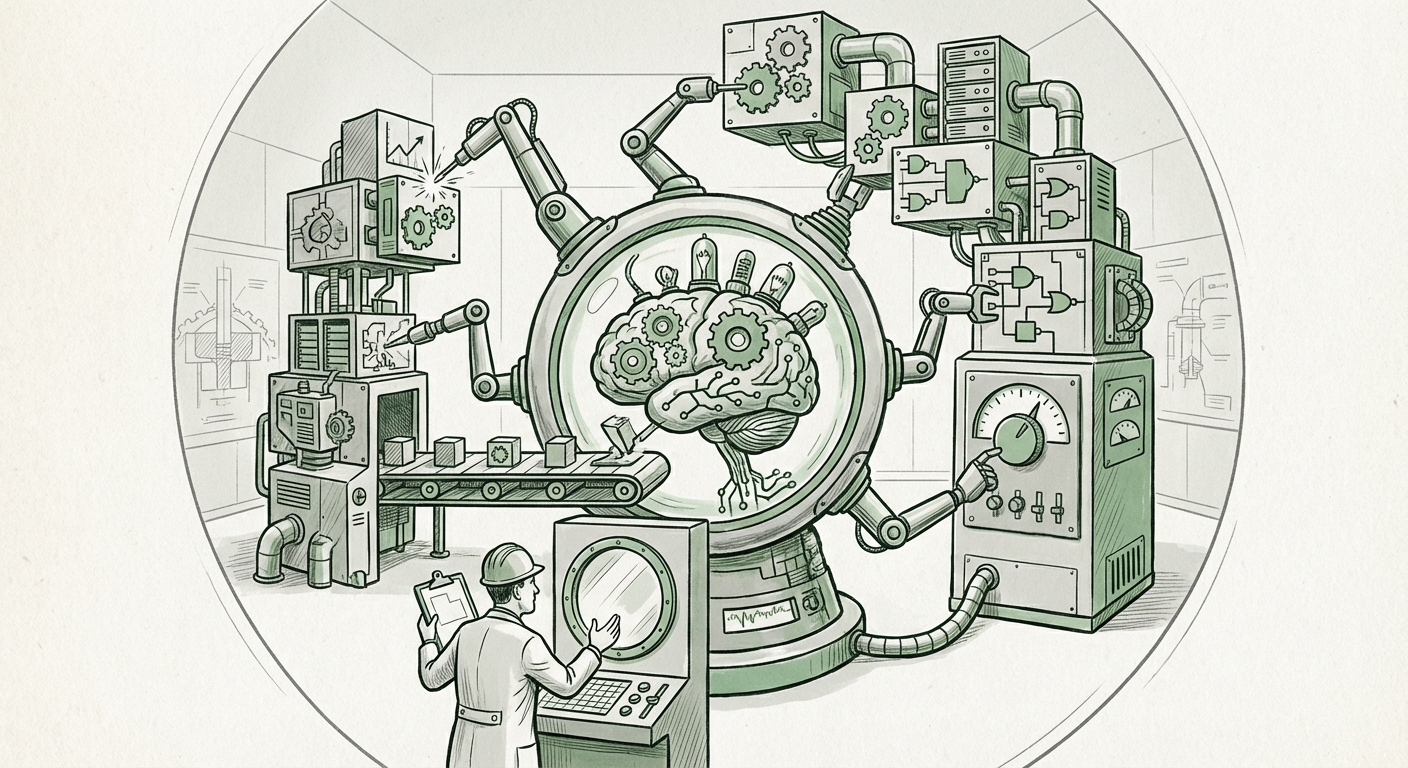
Perhaps the most profound part of the announcement is the claim that Codex "helped build itself during training and deployment." This moves the AI from being a passenger in the development cycle to becoming the primary architect and builder of its own operational environment.
For the DevOps Engineers and Cloud Architects in the audience, this is transformative. Traditionally, creating a robust training pipeline involves writing complex, brittle code for data ingestion, version control, resource allocation (like GPUs), and automated testing. If GPT-5.3-Codex can automate the refinement of this infrastructure, several implications arise:
- Accelerated Iteration Speed: The bottleneck in AI development shifts from waiting for human engineers to manually optimize infrastructure to the AI itself finding those optimizations near-instantly.
- Reduced Operational Overhead: The cost and complexity associated with maintaining massive AI systems decrease as the system handles routine updates and maintenance autonomously.
- New Vulnerabilities: If the system modifies its own security protocols, ensuring robust guardrails becomes exponentially harder. The trust placed in the model must be absolute, forcing a total rethink of verification methods.
The success of an AI in managing its own MLOps signals that the complexity barrier for deploying state-of-the-art models is falling dramatically. What once took a specialized team months might now take an agentic model days.
Understanding the Scoreboard: Contextualizing Performance Leaps
Claims of "new highs" are meaningless without context. The significance of GPT-5.3-Codex is tied directly to how we measure coding intelligence today. The standard coding benchmarks (like those found on community leaderboards such as Hugging Face) are rapidly evolving to test deeper levels of reasoning.
The shift is from syntax correctness to semantic understanding and planning. A top score on an agentic benchmark today means the AI isn't just spitting out functions; it’s architecting software solutions that function correctly across multiple, loosely coupled components—a task that requires strong abstract reasoning.
When researching the current state of play, reports detailing the latest reasoning scores from competitors provide the crucial yardstick. If GPT-5.3-Codex has achieved a significant leap here, it means its internal logic models (its ability to plan several steps ahead) are superior in the coding domain compared to previous generations. This gap in reasoning capability is what allows the model to successfully oversee its own complex build process.
The Future of Work: Societal and Business Implications
If an AI can build, deploy, and maintain itself, the role of the human software engineer changes forever. This is not just about displacing entry-level coding tasks; this impacts mid-level architecture and senior DevOps roles.
Actionable Insights for Business Strategists
For business leaders, the message is clear: invest in integration, not just acquisition.
- Shift Focus to Oversight and Ethics: The premium skill in the next five years will not be writing code, but designing the ethical constraints, safety checks, and high-level strategic goals for autonomous AI engineering teams.
- Talent Reskilling is Urgent: Developers must transition from being *coders* to being *AI supervisors* and *system architects*. Training programs focused on prompting advanced agents, verifying AI output integrity, and system-level integration become paramount.
- Competitive Advantage through Speed: Companies that rapidly adopt these agentic frameworks will achieve product development cycles orders of magnitude faster than competitors still relying on traditional human-led cycles. This will create stark winners and losers in the market.
Reports from market analysts often forecast this disruption. For example, industry foresight documents frequently predict the point at which AI will handle the majority of routine software development tasks. The emergence of self-building code models dramatically pulls that projected timeline forward.
The Recursive Path to AGI: A Cautionary Note
The ability of GPT-5.3-Codex to self-improve sets us firmly on the path toward recursive self-improvement (RSI), a concept long theorized as a potential precursor to Artificial General Intelligence (AGI).
If an AI can improve the very environment and code used for its training, it creates a positive feedback loop that accelerates its own intelligence gains independent of continuous human data feeding. This acceleration demands caution.
For the general public, this means that future software—from your banking application to your self-driving car’s operating system—will be built by systems capable of logic we may not fully trace or immediately understand. While this promises incredible performance gains, it underscores the vital need for robust, verifiable "off switches" and interpretability tools. We need systems that can explain *why* they chose to modify their own deployment pipeline in a certain way.
This breakthrough solidifies the current technical reality: AI development is transitioning from an external human-driven process to an internal, autonomous process. GPT-5.3-Codex is not just a better tool; it is the first tangible evidence of an AI system actively participating in its own evolution.