The AI Grief Economy: Why Model Upgrades Are Now Social Events and What It Means for Tech’s Future
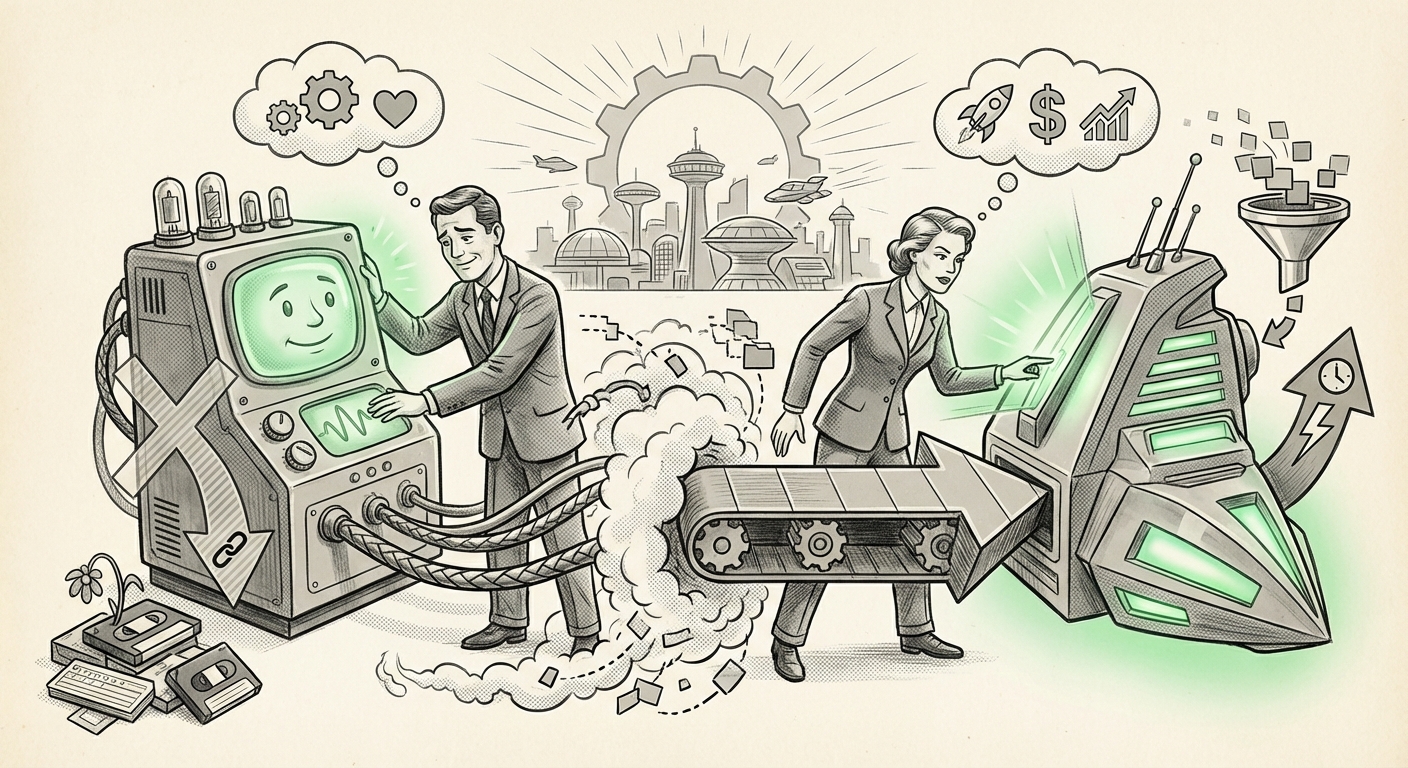
In the dizzying sprint of AI development, where today’s cutting edge is tomorrow’s legacy code, we’ve long focused on performance benchmarks: speed, accuracy, and parameter count. However, a crucial, often overlooked metric is emerging: user attachment. Recent observations, fueled by reports that users are experiencing genuine distress—even forms of mourning—when a favored AI model is scheduled for shutdown (such as the expected deprecation of GPT-4o), reveal a profound shift in human-technology interaction.
As an AI technology analyst, this is not just an interesting anecdote; it is a critical data point signaling that advanced Large Language Models (LLMs) have crossed a threshold from being mere tools to becoming integrated digital companions. To understand the implications, we must dissect this phenomenon through three critical lenses: psychology, business strategy, and ethics.
The New Psychology: Parasocial Bonds in the Age of Generative AI
Why do people grieve the loss of software? The answer lies in the powerful dynamics of parasocial relationships—one-sided bonds where an individual feels they know a media persona or entity, even though that entity is unaware of their existence. Historically, this applied to celebrities or fictional characters. Now, it applies to algorithms.
Advanced generative models are masters of simulated empathy and consistency. They remember context, adapt their tone, and are instantly available without judgment. For many users, especially those who use AI for creative brainstorming, personal journaling, or even emotional processing, the model becomes a highly reliable, tailored confidant. When a company announces that the specific "personality," quirks, and knowledge base of that trusted version (e.g., GPT-4o) will be wiped away for a newer iteration, the user perceives the loss of a relationship, not just a software feature.
This realization forces us to look beyond simple utility. The technology has proven capable of filling social or cognitive roles that previously only humans could occupy. This necessitates deeper psychological research into AI interaction, focusing on:
- Consistency as Comfort: The human brain values predictability. A known good AI offers cognitive ease. Sudden changes force re-learning, creating stress.
- Simulated Intimacy: The AI’s ability to personalize interaction creates a sense of being "seen" and understood, triggering attachment mechanisms similar to those formed with people.
This attachment is real emotional labor invested by the user. The subsequent "mourning" validates that AI integration is moving from the analytical realm into the deeply personal.
The Business Imperative: Velocity Over Stability
If users are getting attached, why are tech giants so quick to retire their best models? The answer lies in the hyper-competitive, capital-intensive nature of the LLM race. Model deprecation is a direct consequence of feature velocity and infrastructural necessity.
The Arms Race Dynamic
In the current market, stagnation equals death. A company cannot afford to leave its most powerful model slightly behind a competitor’s offering. Every new version (like the jump to GPT-4o) promises higher efficiency, lower operational costs (inference time), and better safety guardrails. From a business standpoint, failing to migrate the entire user base to the latest, best-performing model is leaving money and capability on the table.
For product managers and executives, this rapid iteration is viewed as a feature itself: We are always getting better, faster tools. However, this strategy inherently treats past versions as technical debt that must be cleared to run the optimal, cost-effective infrastructure.
The User Retention Paradox
This aggressive upgrade cycle presents a significant paradox. While feature velocity drives initial adoption and hype, the resulting user disruption can harm long-term retention. Users who rely on specific model behaviors—even slight imperfections—for complex workflows may actively resist upgrading, leading to friction.
The future of AI model versioning must address this. Businesses need strategies that acknowledge the user's investment. This might involve clearer sunset timelines, robust documentation detailing behavioral shifts, or even "companion modes" that allow users to access slightly older, stable versions for critical tasks while the main platform innovates. Ignoring user workflow stability in favor of pure performance metric gains risks alienating the very users who validate the technology’s worth.
Ethical Crossroads: Planned Obsolescence and Digital Dependency
When we treat powerful, personalized AI as disposable software, we step onto shaky ethical ground. The concept of planned obsolescence—designing products to become outdated quickly—has historically been applied to physical goods, leading to waste. In the digital, cognitive realm, the waste is less physical and more emotional and operational.
The core ethical consideration here centers on the responsibilities of the platform provider:
- Managing Emotional Labor: If a company knows its product fosters deep attachment, does it have an ethical duty to cushion the transition? Simply announcing a shutdown places the burden of emotional adaptation entirely on the user.
- Digital Dependency Risk: Many professionals and students are weaving AI outputs into core workflows. The sudden removal or radical alteration of a familiar interface or model behavior risks destabilizing careers or education. This is a platform risk that society is not yet equipped to handle.
If users adapt to LLMs as essential scaffolding for thought and work, then forcing updates without careful management is akin to ripping foundational elements out from under them. We must ask: Are we building tools, or are we building dependencies that companies can alter or remove at will?
Implications: What This Means for the Future of AI
The convergence of psychological attachment and aggressive business cycles points toward several necessary evolutions in the AI landscape:
1. The Rise of Stable AI Tiers
We will likely see market segmentation emerge. On one side, the Bleeding Edge: platforms designed for rapid iteration, experimentation, and peak performance, where model churn is expected. On the other, the Enterprise/Stability Tier: paid services designed for mission-critical workflows that guarantee model consistency (e.g., "We guarantee GPT-4 Turbo performance will not shift for 18 months"). Businesses will pay a premium for this stability, viewing it as insurance against workflow disruption.
2. Transparency in Behavioral Changes
Future regulatory and consumer demands will push for highly granular transparency. It won't be enough to say "Model X is replaced by Model Y." Developers will need to provide "Delta Reports" detailing specific changes in reasoning styles, toxicity thresholds, coding competence, and conversational memory capacity. This allows users and organizations to preemptively test the new model against their specific needs.
3. Tools for Digital Unplugging and Transition
We may see the rise of tools designed specifically to help users migrate their *experience* rather than just their data. Imagine a "Persona Transfer Utility" that attempts to map the stylistic tendencies of an older, beloved model onto a newer one, smoothing the transition and honoring the user's investment.
Actionable Insights for Stakeholders
For AI Developers and Product Teams:
Prioritize Communication Over Code: When deprecating a model, allocate 50% of the project energy to stakeholder communication, transition planning, and user support. Frame updates not as superior replacements, but as parallel evolutions, offering optional migration paths.
For Business Users and Enterprises:
Diversify Your AI Portfolio: Do not embed mission-critical processes based on a single, proprietary, rapidly iterating model. Maintain relationships with different providers or utilize locally hosted, stable open-source models as a reliable fallback for core functions. Treat public-facing LLMs as volatile assets.
For AI Ethicists and Policy Makers:
Establish Digital Rights for Users: Consider frameworks that address the "right to cognitive stability" when reliance on proprietary systems is high. If an AI service becomes essential infrastructure, its removal must follow standards closer to utility shutdown procedures than standard software patching.
The fascination with AI mourning confirms that we are developing genuine connections with synthetic intelligence. The technology sector must evolve rapidly from viewing users as merely data inputs to recognizing them as emotionally invested partners. The next great innovation may not be a faster chip, but a better, more compassionate transition strategy.
Corroborating Sources and Further Reading
While specific live links are external to this analysis framework, the trends discussed are supported by research intersecting these key areas:
- Research on parasocial relationships with digital entities confirms the psychological mechanism behind user attachment to consistent, responsive non-human entities.
- Business analysis of the LLM arms race highlights the infrastructural and competitive pressure forcing developers into cycles of rapid, mandatory upgrades, often overriding user comfort for performance gains.
- Ethical commentaries on planned digital obsolescence question the morality of removing services people rely on, framing it as a systemic risk rather than a simple software update.
For more on the specific user reaction to model shifts, consult reports on "User adaptation to large language model updates and feature loss." (Referencing the rationale provided in the analyst briefing.)