The Agentic Revolution: How Google's PaperBanana Signals the End of Manual Scientific Visualization
The landscape of Artificial Intelligence is moving past the era of single, powerful Large Language Models (LLMs) that simply answer prompts. We are rapidly entering the **Agentic Era**, where AI systems operate as specialized, coordinated teams to execute complex, multi-step objectives. A recent announcement detailing the development of **PaperBanana**—a system by Google researchers and Peking University that automatically generates scientific diagrams from method descriptions—is not just a novelty; it is a profound indicator of where AI workflows are headed.
PaperBanana tackles what many consider one of the last manual bottlenecks in academic publishing: turning dense, written experimental procedures into clear, accurate visual aids. This move from text-in, text-out, to text-in, precise visual output demonstrates a critical maturation in multimodal AI deployment. For both technical implementers and strategic business leaders, understanding the components of this success reveals the next frontier in automation.
The Power of Five: Embracing the Multi-Agent Architecture
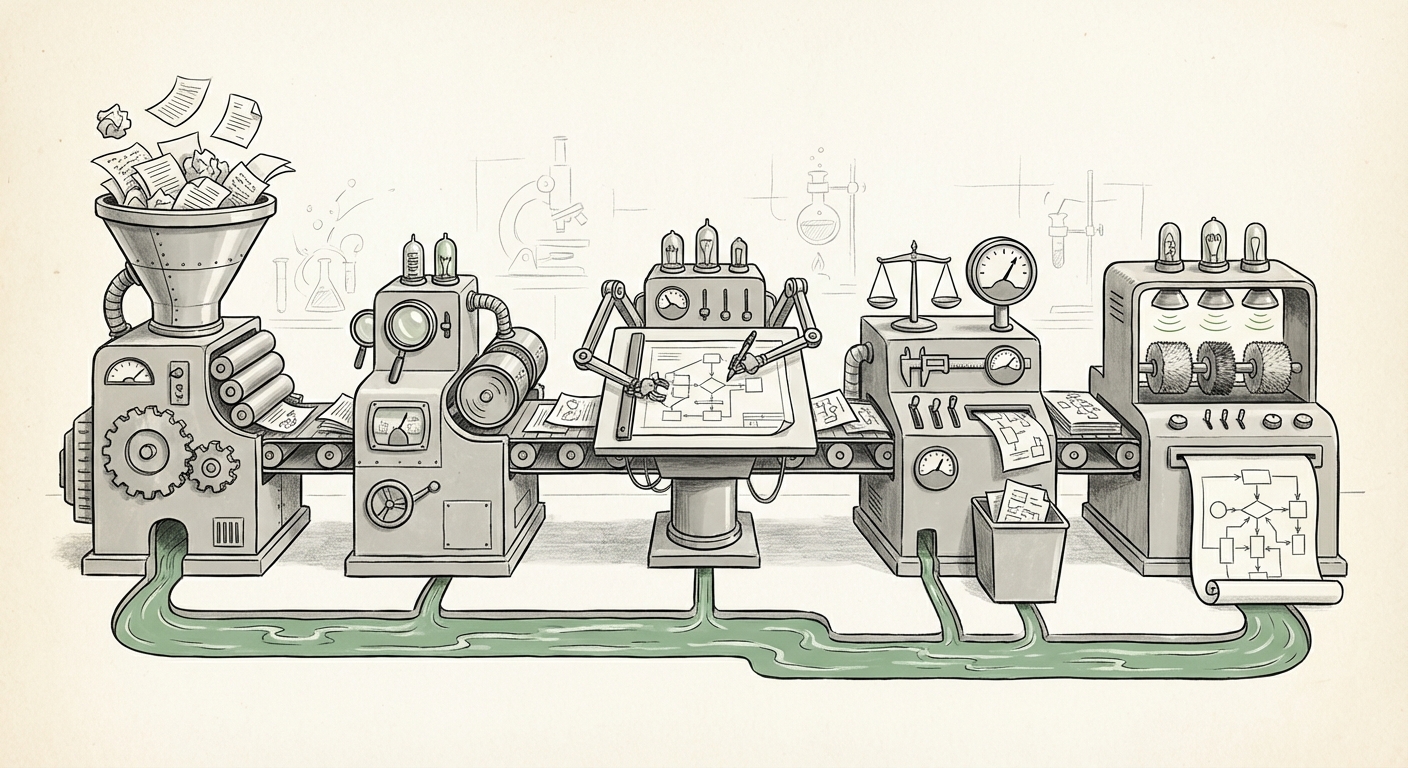
The most significant technical takeaway from PaperBanana is its architecture. It does not rely on one monolithic model; instead, it orchestrates five specialized AI agents. This mirrors how successful human organizations function—not everyone is a generalist, but specialized roles collaborating towards a common goal lead to superior output.
Why is this agentic structure so important? Consider the steps required to create a complex experimental schematic:
- Understanding the goal (Interpretation Agent).
- Searching for similar structural examples (Reference Agent).
- Drafting the layout and data flow (Visualization Agent).
- Ensuring logical and scientific accuracy (Validation Agent).
- Polishing the final graphic (Quality Control Agent).
This cooperative structure is the future of complex enterprise AI. As AI systems move from simple Q&A tools to actual automated process execution, coordination becomes paramount. As confirmed by recent industry analyses on "multi-agent systems in LLMs", this decentralized approach allows for better error isolation, greater modularity, and the ability to incorporate domain-specific tools (like a reference database lookup agent) without retraining the entire core model. For the developer audience, this means focusing less on training one "super-brain" and more on building robust inter-agent communication protocols.
Actionable Insight for Technologists:
Focus investment on developing robust orchestration layers and standardized communication protocols (like APIs or shared memory structures) between specialized agents. The complexity is shifting from the model's internal weights to the system's external coordination logic.
Breaking the Visualization Bottleneck in Science
Science thrives on communication. Yet, the creation of publication-ready figures—especially complex flowcharts detailing experimental setups, synthesis pathways, or data pipelines—is notoriously time-consuming. Researchers spend hours refining boxes, arrows, and labels, pulling focus away from discovery.
PaperBanana targets this exact inefficiency. By automating diagram generation from plain text, the system drastically reduces the time-to-publication for visual elements. This is particularly critical in fast-moving fields like materials science or drug discovery, where experimental methods evolve rapidly. As research into "AI for automated scientific figure generation" suggests, the demand for tools that bridge textual documentation and high-fidelity visualization is immense across all scientific domains.
Imagine a biochemist describing a new protein folding technique in a draft document. Instead of manually drafting the sequence of denaturation, binding, and purification steps, PaperBanana generates the diagram instantly. This translates to faster grant reporting, quicker preliminary results sharing, and, ultimately, accelerated scientific progress.
Practical Implications for Research & Business:
For R&D departments in pharmaceutical, engineering, and technology sectors, this means a direct boost to throughput. The ability to instantly visualize complex processes embedded in technical manuals or standard operating procedures (SOPs) will become a baseline expectation for efficiency gains.
The Multimodal Leap: Accuracy Over Aesthetics
General-purpose image generators (like DALL-E or Midjourney) excel at aesthetics—creating beautiful, novel images from prompts. However, scientific diagrams require far more than beauty; they require logical fidelity. An arrow must point from Step A to Step B if the text describes that sequence. A label must correctly identify the component.
PaperBanana pushes the boundaries of multimodal AI because it must handle semantic constraints. It is not just translating words into pixels; it is translating procedural logic into spatial representation. This moves beyond standard diffusion models and into the realm of **Constraint-Based Generative Modeling**.
This specialization is key. It confirms that the next generation of AI tools applied to technical fields must incorporate logical reasoning engines alongside their generative capabilities. The system needs to understand the *rules* of chemistry or engineering diagrams, not just the *look* of them.
Future AI Trajectory:
Expect to see specialized generative models for every structured output: from automatically generating database schemas from user stories, to creating accurate circuit diagrams from circuit descriptions. The focus will be on AI that respects established structural grammars.
Revisiting Academic Integrity in the Age of Automation
While the efficiency gains are undeniable, any technology that automates a core component of academic work immediately raises questions about publishing standards and integrity. The creation and verification of figures have historically been manual steps, offering an inherent layer of human scrutiny.
When AI generates a figure, who is responsible if the diagram misrepresents the data or omits a crucial step? As organizations like the **Committee on Publication Ethics (COPE)** grapple with AI-generated text, the challenge of AI-generated visuals is looming. If PaperBanana finds a reference image that is structurally similar but contextually flawed, and the agent doesn't catch it, the error propagates.
The goal, however, should be to use AI to *enhance* integrity, not undermine it. By automating the tedious drafting, researchers can focus their energy on deep peer review of the *logic* behind the diagram, rather than the aesthetics of the boxes and lines. The publishing industry must adapt its guidelines swiftly, focusing verification on the provenance of the textual input and the logical consistency validated by the AI agents.
Implications for Governance and Compliance:
For institutions and regulatory bodies, the focus must shift toward auditing the AI pipeline itself. Instead of policing the final output pixel by pixel, governance will need to mandate transparency regarding the underlying agent configuration (e.g., "Diagram generated using PaperBanana v1.2, reference verification threshold set to 85%").
What This Means for the Broader Technology Ecosystem
The PaperBanana model is a template for the next generation of B2B and enterprise AI solutions. It proves that breaking down a complex job into coordinated, specialized micro-tasks (the agents) is the most effective path to high-reliability automation.
Consider workflow mapping in software development, compliance documentation, or complex manufacturing sequencing. These fields are rife with manual translation steps—moving from a high-level design document to a detailed implementation plan, or from regulatory text to internal audit checklists.
If five agents can successfully create a scientific diagram, imagine the potential across industries:
- Legal Tech: One agent analyzes case law, another synthesizes precedents, a third drafts arguments, and a final agent compiles the resulting brief structure.
- Finance: Agents specializing in market data ingestion, risk calculation, regulatory checking, and automated report formatting, all coordinated instantly.
- Engineering: Agents translating CAD specifications into assembly instructions, cross-referencing material stocks, and generating worker training visualizations.
The core challenge remains the same across all these domains: ensuring reliable handoffs between specialized components. PaperBanana's success is a proof point that the underlying technology for agentic coordination is becoming robust enough to handle high-stakes, detail-oriented tasks where errors have real-world consequences.
Conclusion: Moving Beyond the LLM Hype Cycle
We are transitioning from the "Wow, it can write poetry" phase of generative AI to the "Wow, it can manage this entire engineering pipeline" phase. The PaperBanana system is a beacon illuminating this path forward. It marries the generative power of multimodal models with the structured reliability of multi-agent orchestration.
For businesses seeking to harness AI effectively, the lesson is clear: look for specialized solutions built on agent frameworks, rather than relying solely on all-in-one models. The future of productivity gains lies in sophisticated teamwork—even if that team is made of five specialized lines of code coordinating to eliminate hours of tedious, manual visualization work for scientists worldwide.