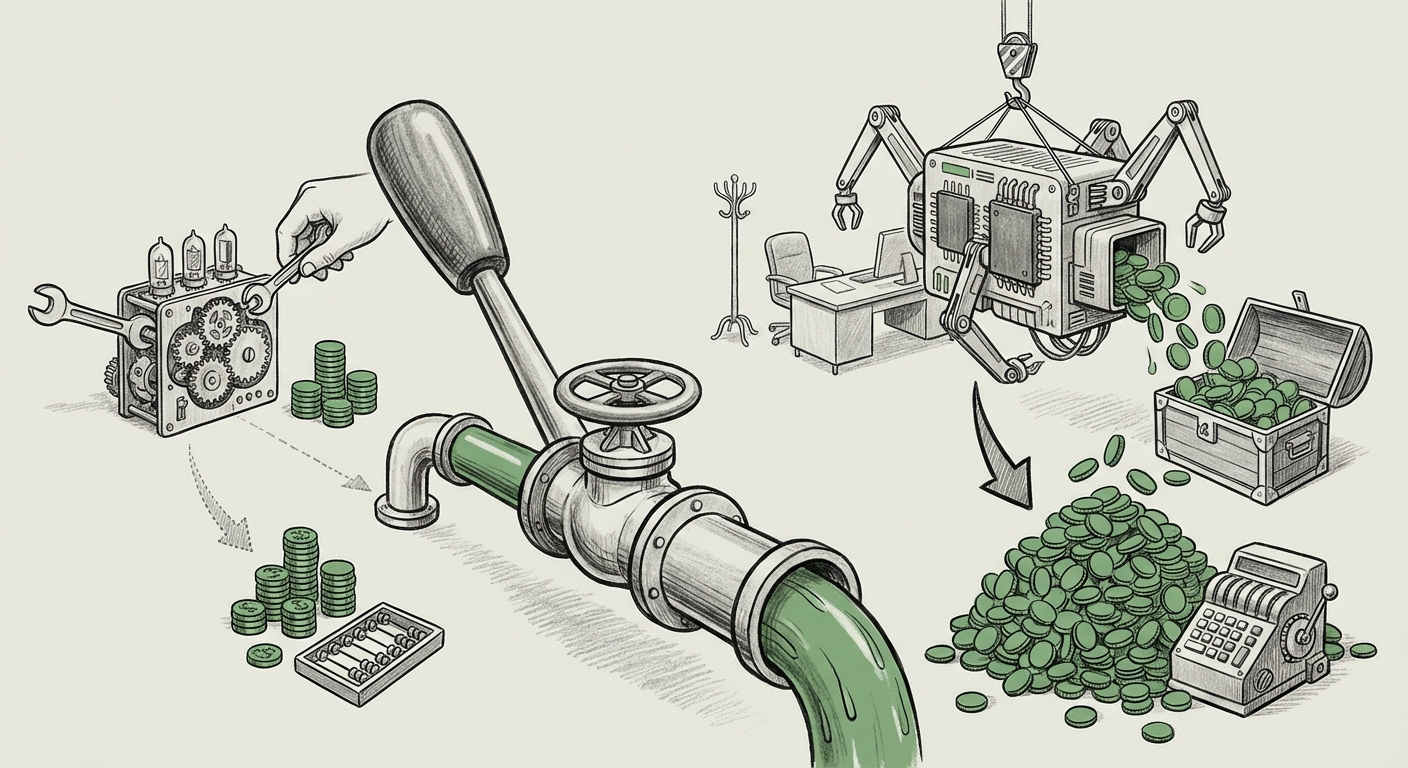
The Great Shift: Why Investors Bet AI Replaces Labor Costs, Not Just Software Budgets
In the rapidly evolving landscape of Artificial Intelligence, understanding where capital flows is like reading the tea leaves of the near future. For years, the initial promise of AI—and often its first practical applications—revolved around optimizing existing software systems. We bought better analytics tools, faster databases, and more efficient Customer Relationship Management (CRM) platforms. These efforts focused on **software budget reallocation**—making the tools we already owned cheaper or faster to run.
However, a recent and crucial market signal, echoed by investor sentiment, suggests a radical pivot. The prevailing belief is no longer about incremental gains; it’s about structural overhaul. Investors are increasingly betting that the next wave of AI adoption will directly target and replace **labor costs**. This is a fundamental shift, moving AI from a helpful co-pilot to a potential replacement for entire roles, particularly in the white-collar domain.
As an AI technology analyst, this trend warrants deep scrutiny. It moves AI from a conversation about IT efficiency to one about macroeconomic restructuring. To understand the gravity of this shift, we must analyze the technological readiness, the financial logic, and the corroborating data supporting this aggressive forecast.
The Logic of Displacement: Why Labor Over Software?
Why would investors prioritize removing human salaries from the balance sheet over simply optimizing existing software spending? The answer lies in the mathematics of Return on Investment (ROI) and the unprecedented capability jump provided by recent breakthroughs in Large Language Models (LLMs).
Consider this simple business arithmetic. If a company spends $1 million annually on a software suite, optimizing that down by 20% saves $200,000. This is a good efficiency win. Now, consider a team of five highly skilled analysts costing $1.5 million annually (including salaries, benefits, and overhead). If an AI system can effectively replace the output of those five individuals, the potential saving is $1.5 million—a saving that recurs year after year.
This scale of savings, often referred to as eliminating "fully loaded labor costs," presents an ROI that dwarfs typical software optimization. This economic justification drives venture capital toward technologies that promise demonstrable headcount reduction. We see this reflected in the data, as foundational reports on automation illustrate the staggering potential for human-task substitution across industries.
Corroborating Economic Insight: Foundational research on workforce transitions confirms this is where the largest economic levers are located. Reports detailing the scale of potential job shifts due to automation provide the necessary macroeconomic context for investors to feel confident in this high-stakes bet. [See the McKinsey Global Institute analysis on workforce transitions for context on scale.](https://www.mckinsey.com/featured-insights/world-after-covid/jobs-lost-jobs-gained-workforce-transitions-in-a-time-of-automation)
The Technology That Makes the Bet Possible: Autonomous Agents
This investment thesis would be pure speculation if the technology wasn't ready. We have moved past the era of simple chatbots. The key enabler for labor replacement is the emergence of autonomous AI agents.
Previously, if you wanted an AI to complete a complex task—say, researching market trends, drafting a report, and then emailing the findings to three managers—you needed multiple, discrete software tools, each requiring careful human intervention (prompt engineering, error checking, and manual handoffs). This was efficiency, not replacement.
Modern AI agents are fundamentally different. They are systems built on powerful LLMs that possess:
- Planning: The ability to break a large goal into sequential, manageable sub-tasks.
- Tool Use: The capacity to autonomously decide which external software (browsers, code interpreters, databases) to use to accomplish each sub-task.
- Self-Correction: The ability to detect errors in their output or process and iterate on the plan until the goal is met.
When an AI system can autonomously execute a multi-step workflow—such as drafting and debugging code, or handling complex customer service escalations without human oversight—it stops being a software budget reallocation and starts being a human capital replacement tool. This capability leap is precisely what validates investor confidence in labor displacement.
The race is now on to create "software that writes software," targeting highly paid engineering roles, or agents capable of complex financial modeling, striking directly at analyst positions. This rapid advancement in reasoning and execution capabilities is the fuel for the labor displacement narrative.
The Target: White-Collar Work Under the Microscope
The initial wave of industrial automation famously impacted blue-collar manufacturing jobs. The current investment trend signals that AI is now ready to aggressively target knowledge work—the domain of educated, highly compensated professionals.
This shift is profound because the sheer cost of knowledge workers makes them irresistible targets for cost reduction. We are seeing predictions and early pilots across several high-cost sectors:
- Legal Services: Automating document review, contract summarization, and preliminary legal research, tasks traditionally performed by junior associates or paralegals.
- Finance and Accounting: Autonomous generation of quarterly reports, reconciliation of complex ledgers, and preliminary fraud detection, diminishing the need for entry-to-mid-level analysts.
- Software Development: Advanced agents are now capable of handling entire modules or fixing complex bugs, encroaching upon the productivity layer of the modern coder.
Articles tracking job displacement forecasts show this isn't just theory. Major financial institutions and consulting firms are internally assessing how rapidly AI adoption could restructure their support and analytical teams. When large incumbents start planning for headcount adjustments based on AI capability, the investor thesis gains immediate validation.
Audience Insight: For professionals in these sectors, this means the pressure is mounting not just to "use" AI, but to redefine their roles so they oversee the AI’s work, rather than executing the routine tasks the AI now performs.
Practical Implications for Businesses: From Efficiency to Transformation
For Chief Financial Officers (CFOs) and Chief Strategy Officers (CSOs), this investment trend demands a response that goes beyond incremental IT upgrades. The deployment strategy must shift from "How can AI make my existing teams 10% faster?" to "Which entire functions can be structurally automated?"
1. Reframing AI ROI Metrics
Businesses must adopt an economic framework that recognizes the difference between efficiency savings (improving software) and transformation savings (reducing headcount). The highest ROI will come from applications that tackle the largest, most repetitive labor cost centers first.
2. Focus on Agent Orchestration
The technical teams need to shift focus from training single-purpose models to building robust systems of agents—platforms where multiple specialized AI workers can collaborate to achieve a complex business outcome. This requires expertise in security, workflow orchestration, and error handling, not just prompt engineering.
3. Strategic Workforce Planning
The implication for HR is immediate: workforce planning must incorporate scenarios for significant structural reduction, coupled with aggressive reskilling programs for remaining employees. Those who survive the automation wave will be the AI auditors, the system maintainers, and the high-level strategic thinkers who set the goals for the AI agents.
Economic Evidence: The gap in perceived ROI is crucial. As analyses continue to show the vast cost difference between software optimization and labor replacement, the pressure on budgets will inevitably favor projects promising headcount mitigation. [This type of TCO comparison informs strategic budget allocation decisions across the enterprise.](https://www.mckinsey.com/featured-insights/world-after-covid/jobs-lost-jobs-gained-workforce-transitions-in-a-time-of-automation)
The Future of AI: From Tool to Economic Entity
If investors continue to back labor displacement, the future of AI deployment will be characterized by autonomy and integration into the core organizational structure, rather than remaining on the periphery as a productivity addon.
We are moving toward a future where AI agents are treated less like software licenses and more like outsourced contractors or internal department members. This necessitates new frameworks for governance, accountability, and auditing. If an autonomous agent causes a major financial error, who is liable? If an agent writes faulty code that compromises security, where does the responsibility lie?
This transition forces us to confront societal questions much faster than previously anticipated. If AI adoption accelerates the replacement of mid-level knowledge jobs, the gap between the highly skilled AI architects and the newly displaced workforce could widen rapidly. The pressure will be on governments and educational institutions to adapt curricula to skills that AI *cannot* yet automate—creativity, deep human empathy, complex stakeholder negotiation, and systems-level oversight.
Actionable Insight for Today
For businesses looking to capitalize on this investment trend without causing internal chaos, the immediate action is dual-pronged:
- Identify the Highest Labor Cost Centers: Pinpoint the three most expensive, repetitive, and rules-based roles in your organization. These are the prime targets for initial agent deployment.
- Invest in Oversight, Not Just Deployment: Dedicate a significant portion of your AI budget toward building robust monitoring and validation layers. If AI is replacing labor, the value shifts from *execution* to *trust* in the execution. Ensure your systems can prove, through audit trails, that the autonomous work meets compliance and quality standards.
The market sentiment is clear: AI's greatest value proposition today is its potential to structurally lower operational expenditure by reducing the reliance on human capital. This is not merely a software update; it is an economic revolution funded by forward-looking capital.