The Next Frontier: How Isomorphic Labs' Leap Beyond AlphaFold 3 is Redefining Generative AI in Drug Discovery
The world of artificial intelligence is constantly moving, but every so often, a technological leap occurs that redraws the map of possibility. The recent announcement from Isomorphic Labs—Google DeepMind's focused AI medicine startup—claiming their new Drug Design Engine (IsoDDE) doubles the accuracy of AlphaFold 3 for certain drug design predictions, is precisely one of those moments.
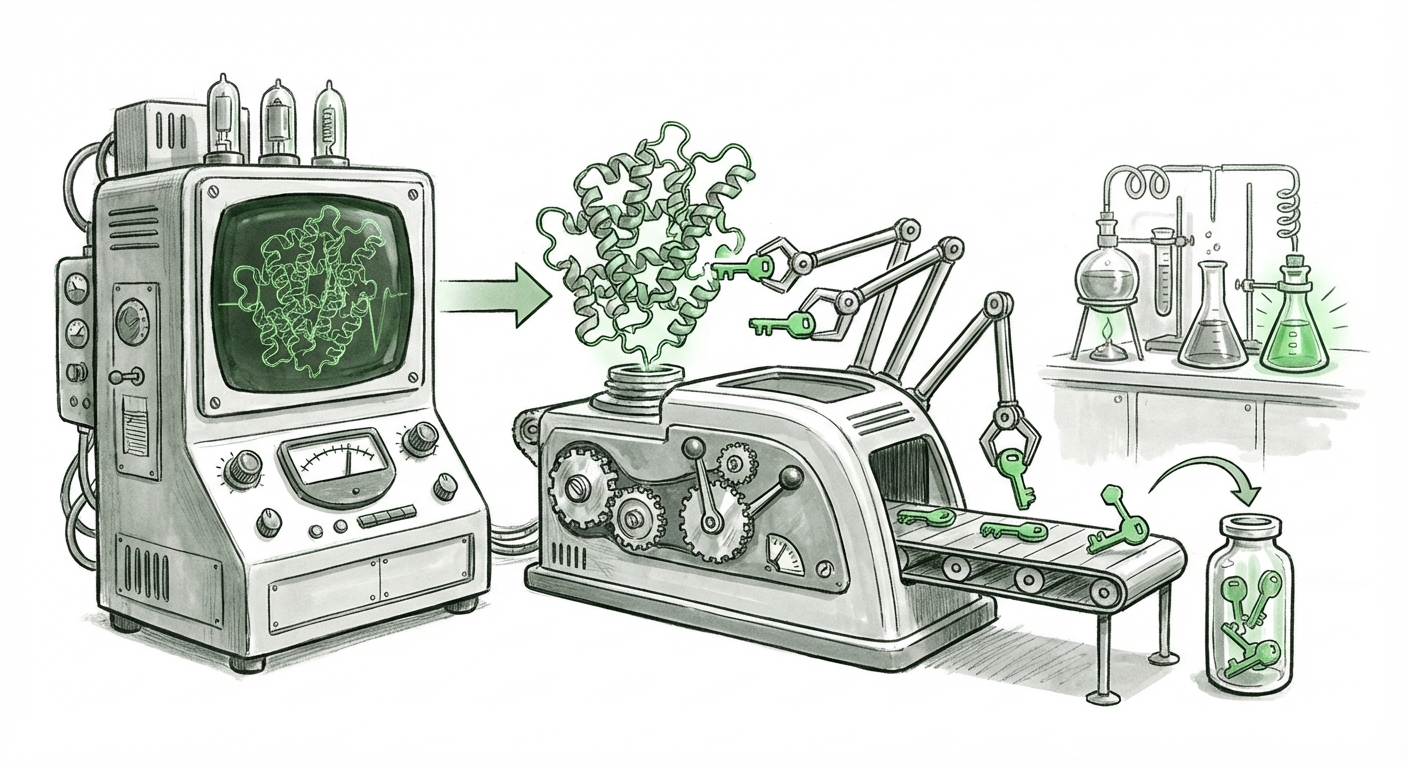
If AlphaFold revolutionized biology by accurately predicting *what a protein looks like* (its structure), IsoDDE signals the transition to the next, far more valuable phase: AI actively designing *the perfect key (drug molecule) to fit that structure*. This shift from prediction to active generation is not just an incremental update; it’s the maturation of AI from a scientific tool into a true co-developer in the pharmaceutical industry.
From Seeing to Creating: The Technological Singularity in Biology
To appreciate the magnitude of this announcement, we must first understand the evolutionary jump.
AlphaFold: The Predictor
DeepMind’s original AlphaFold and its subsequent iteration, AlphaFold 3 (which models interactions between proteins, DNA, RNA, and small molecules), were monumental achievements. They solved the decades-old "protein folding problem," allowing scientists to see the precise 3D shape of therapeutic targets with unprecedented speed. Think of it as giving biologists perfect X-ray vision for molecular targets.
IsoDDE: The Designer
Isomorphic Labs’ IsoDDE, however, operates one crucial step further down the pipeline. Instead of just modeling what *is*, it aims to design what *should be*. When scientists look for a new medicine, they need a molecule (the drug) that binds perfectly to a malfunctioning protein (the target). IsoDDE leverages generative AI—the technology behind chatbots that write essays or DALL-E that creates images—but applies it to chemical space. It generates new molecular structures optimized for binding affinity and desired properties.
The claim that IsoDDE doubles accuracy for these design predictions suggests a profound improvement in the AI’s chemical intuition. For researchers, this means fewer failed lab experiments, dramatically shorter timelines, and the potential exploration of chemical compounds that human intuition might never have considered.
The Underlying Trend: Generative Chemistry
This development reflects a broader technological trend across AI: the rise of robust Generative Models in previously intractable fields. Just as Large Language Models (LLMs) synthesize human language, IsoDDE synthesizes complex chemical realities. This requires integrating multiple complex data types—protein structure, chemical rules, biological pathways—into one cohesive, predictive framework. Experts seeking context on this advancement (Query 2: Generative AI in drug discovery beyond protein folding 2024) will confirm that the focus is now firmly on creating novel, synthesizable molecules.
The Escalating Competitive Landscape
The pharmaceutical industry is keenly watching this race. Developing a new drug currently costs an average of over $2.5 billion and takes a decade or more, with a failure rate exceeding 90% in clinical trials. Any technology that reliably shaves years or hundreds of millions off that process becomes instantly invaluable.
Alphabet's Strategic Bet
Isomorphic Labs is not a small startup; it is a highly capitalized entity backed by Google/Alphabet. The success of IsoDDE validates Alphabet's long-term investment thesis: that fundamental AI research (like DeepMind’s core algorithms) can be successfully spun out and monetized by tackling the world’s most complex problems (Query 3: Google DeepMind investment in biological modeling future).
This strategic backing means Isomorphic Labs has the resources to iterate faster than many pure-play biotech startups. Their next step will be demonstrating that these highly accurate *in silico* designs translate into successful *in vivo* (in living organisms) results, leading directly to their own pipeline of drugs.
The Biotech Arena Heats Up
While Isomorphic Labs has the infrastructure advantage, they face fierce competition from specialized firms like Recursion Pharmaceuticals and Insilico Medicine. These companies have already brought AI-discovered candidates into human trials. The success of IsoDDE forces competitors to match or exceed its reported accuracy. The market rewards efficiency, and if IsoDDE proves superior in the crucial small-molecule generation step, it will force a rapid realignment of partnerships and investment across the sector.
Future Implications: From Lab Bench to Bedside
The implications of reliable, generative drug design extend far beyond improved protein modeling. They touch the core economics of healthcare and the regulatory frameworks that govern drug approval.
1. Radical Acceleration of Preclinical Research
If IsoDDE’s accuracy holds up under scrutiny (Query 1: "Isomorphic Labs Drug Design Engine" vs AlphaFold 3 performance metrics), the concept-to-candidate timeline—the time it takes to go from identifying a disease target to having a molecule ready for initial animal testing—could shrink from years to months. This speed allows companies to test more hypotheses against a wider array of targets simultaneously.
- For Researchers: Less time spent synthesizing dead-end molecules; more time focusing on complex biological mechanisms.
- For Businesses: Higher portfolio throughput and faster patent protection on novel chemical entities.
2. The Challenge of Regulatory Trust: The 'In Silico' Trial
The biggest bottleneck for AI-discovered drugs is no longer just chemistry; it’s regulatory acceptance. If an AI designs a molecule, how much real-world testing is required before it can enter human Phase 1 trials? This brings us to the critical challenge highlighted by Query 4: "In silico" clinical trials adoption rate and challenges.
Regulatory bodies like the FDA are cautiously exploring how to incorporate more computational evidence. A demonstrated doubling of accuracy in predicting fundamental properties (like how a molecule binds) will give regulators greater confidence in the initial safety and efficacy data generated by the AI models. However, skepticism remains high regarding the true predictability of complex biological systems in humans based solely on modeling.
The future involves a hybrid approach: AI drastically narrows the field of candidates, and human-led trials focus only on the most promising few, reducing patient risk and accelerating timelines.
3. Democratization and Accessibility of Drug Discovery
Historically, only massive pharmaceutical companies could afford the infrastructure and personnel to conduct sophisticated high-throughput screening campaigns. Highly advanced platforms like IsoDDE could, over time, be licensed or accessed via cloud infrastructure, potentially democratizing the earliest stages of drug design. Smaller academic labs or nimble startups could begin tackling rare diseases or neglected tropical diseases that were previously deemed too economically unviable for large pharma to pursue.
Actionable Insights for Stakeholders
For those navigating the intersection of technology, investment, and health, this development demands specific strategic responses:
For Investors and Venture Capital:
- Look Past Structure: The narrative is moving past foundational models (like basic protein structure) toward application-specific generative systems. Investments should favor platforms that demonstrate competency in the next critical steps: molecular generation, synthesis prediction, and toxicity modeling.
- Evaluate Data Moats: How much proprietary, high-quality, closed-loop data is feeding IsoDDE? The superior accuracy claim suggests a deep feedback loop between AI design and experimental validation. Companies without this integrated loop will struggle to keep pace.
For Pharmaceutical R&D Leaders:
- Audit AI Integration: If your organization relies solely on traditional screening or less advanced predictive modeling, you are already falling behind the curve set by Alphabet and its competitors. Strategic partnerships with leaders in generative chemistry are non-negotiable for future pipeline health.
- Retrain the Workforce: The future pharmacologist is a hybrid scientist—one fluent in chemistry, biology, and machine learning model interrogation. Talent acquisition must pivot toward computational fluency.
For Policymakers and Regulators:
- Establish Frameworks Now: The increasing reliability of *in silico* evidence means regulatory bodies must proactively define standards for validating AI-generated evidence. This prevents a bottleneck when a highly promising, AI-designed drug reaches the approval stage.
Conclusion: The Era of Designed Biology
Isomorphic Labs’ bold claim—a doubling of accuracy beyond the state-of-the-art AlphaFold 3—is a powerful indicator that the promise of AI in medicine is finally solidifying into tangible, market-moving technology. We are witnessing the transition from machines that can *read* the book of life to machines that can *write* entirely new, life-saving chapters.
The race is on to see whose generative engine can deliver the first truly novel, AI-designed drug that successfully navigates the clinical trials and reaches patients. This competitive pressure, fueled by colossal strategic investment, ensures that the pace of innovation in molecular design will only accelerate, promising a future where drug discovery is faster, cheaper, and more inventive than ever before.