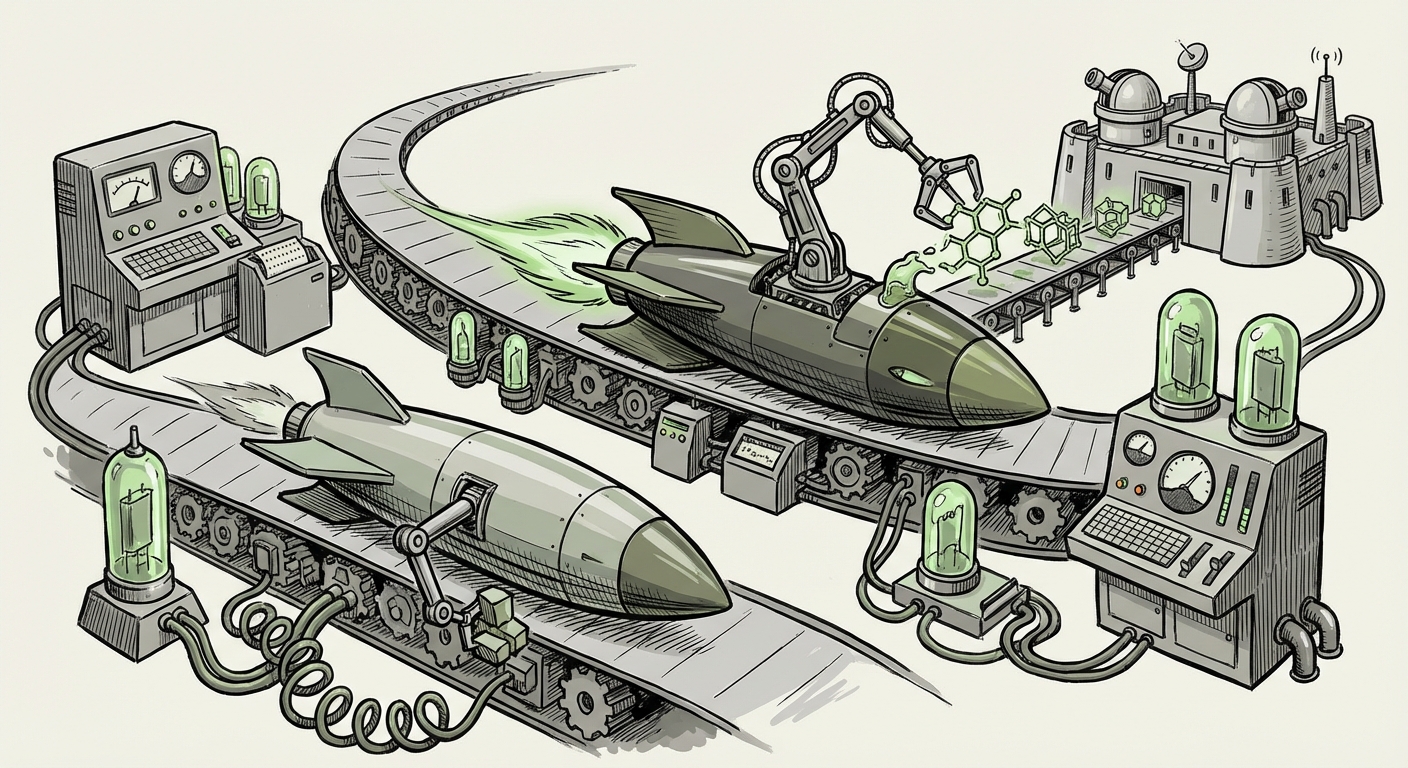
The AI Drug Discovery Arms Race: Why Isomorphic Labs' Leap Beyond AlphaFold 3 Changes Everything
The world of biotechnology is witnessing a seismic shift, fueled not by traditional lab work, but by computational power. For years, DeepMind’s AlphaFold—a system that cracked the foundational problem of protein folding—stood as the undisputed champion in structural biology. Now, its direct offspring, Isomorphic Labs, Google’s dedicated drug discovery spinoff, claims to have taken a monumental step forward with its proprietary system, the Isomorphic Labs Drug Design Engine (IsoDDE). Initial reports suggest IsoDDE can double the accuracy of AlphaFold 3 in specific drug design predictions.
This isn't just an incremental update; it signals a critical evolution in AI application: the transition from foundational scientific understanding to specialized, high-stakes industrial execution. For technology analysts, this development is a profound indicator of where the next wave of AI innovation will occur.
The Evolution from Prediction to Prescription: Understanding the Leap
To appreciate the significance of Isomorphic Labs’ announcement, we must first understand the context of its predecessor. AlphaFold 3, while revolutionary, is primarily a predictive model focused on structure—understanding *what* a protein looks like and *how* it interacts with other molecules (like potential drug candidates). This is foundational knowledge, essential but insufficient for creating a marketable drug.
Isomorphic Labs' IsoDDE appears to bridge the gap between prediction and prescription. If AlphaFold 3 tells us the lock (the target protein) exists, IsoDDE aims to design the perfect key (the drug molecule) to fit that lock, and do so with unprecedented reliability. The claim of doubling accuracy in specific drug design predictions suggests the engine is better at modeling complex chemical dynamics, binding affinities, and potential side effects early in the process.
The Specialization Imperative
This divergence highlights a critical future trend in AI development: the ascent of Specialized AI. While large foundational models (like the ones powering chatbots) are brilliant generalists, fields like drug discovery require deep, nuanced expertise. IsoDDE is likely trained on proprietary, curated datasets of failed and successful drug trials, complex kinetic data, and high-resolution chemical simulations that general models do not possess.
This is analogous to a brilliant college graduate (AlphaFold 3) versus a seasoned specialist surgeon with 20 years of unique case experience (IsoDDE). The specialist, built on the foundation of the generalist’s knowledge, can perform tasks with greater precision and reliability in a high-stakes environment. We anticipate this pattern—foundational models serving as bases for highly specialized, domain-specific applications—to dominate scientific, engineering, and legal AI applications moving forward.
Contextualizing the Breakthrough: The Industry Reaction
For those tracking the technology ecosystem, Isomorphic Labs’ breakthrough does not occur in a vacuum. It is a high-stakes move within a fiercely competitive global landscape. We must examine this claim through the lens of market dynamics and technological validation.
1. The Search for Validation: Technical Scrutiny
The initial reports, such as the initial news coverage found when searching for the specifics of the development, are often preliminary. The true test lies in the technical details. The focus on validating specific accuracy benchmarks (as prompted by searches like "Isomorphic Labs Drug Design Engine" vs AlphaFold 3 accuracy benchmarks) will determine if this is a marketing claim or a true paradigm shift. Computational chemists will be looking closely at metrics related to:
- Binding Affinity Prediction: How accurately does the engine predict how strongly a potential drug will stick to its target?
- De Novo Design: How often can it successfully design a novel molecule from scratch that meets all necessary chemical criteria?
- Toxicity Filtering: Does it more effectively rule out molecules likely to cause harm before costly synthesis?
If the claims hold up under peer review, the implication is clear: the time from target identification to viable drug candidate could be slashed from years to months.
2. The Investment Tsunami
The rapid advancement is directly tied to massive capital infusion. As demonstrated by market analysis into AI in drug discovery market growth and venture capital investment trends 2024, billions are pouring into this sector. Isomorphic Labs, backed by Google/Alphabet, is competing against well-funded rivals. This breakthrough secures Isomorphic’s leading position in the short term.
For the broader industry, this investment pressure means that companies relying solely on traditional, high-throughput screening methods will quickly become uncompetitive. Investment dollars will pivot aggressively toward firms that can demonstrate superior AI prediction capabilities, much like the shift seen in large language models over the past two years.
Future Implications: Reshaping Pharma and Scientific Endeavor
The implications of an engine that doubles accuracy in drug design extend far beyond Google’s internal portfolio. They touch upon the core economics, speed, and ethical considerations of modern medicine.
Impact on R&D Timelines and Cost
The most tangible effect will be on the infamous “valley of death” in drug development—the transition from laboratory discovery to clinical trials. The development of a new drug typically costs billions of dollars and takes over a decade. Failures in early stages, often due to unforeseen toxicity or poor efficacy, are the main culprits of this high cost.
By improving preclinical prediction accuracy, IsoDDE directly attacks these inefficiencies. If we can eliminate 50% of the poorly designed candidates before they ever require expensive wet-lab synthesis or animal testing, the entire R&D pipeline accelerates dramatically. This aligns perfectly with forecasts on the impact of generative AI on preclinical drug candidate identification timelines.
For the pharmaceutical industry, the choice is becoming stark: license the AI power from leaders like Isomorphic, or build competing internal capabilities at immense cost.
The Shift in Required Human Expertise
The skills required to innovate in biomedicine are changing. We are moving from chemists skilled primarily in manual synthesis and wet-lab experimentation to a new cohort of "AI-Fluent Scientists." These individuals won't necessarily need to code the neural networks, but they must possess the deep domain knowledge to:
- Define the right problems for the AI to solve.
- Critically interpret the AI's outputs (understanding potential biases or errors).
- Guide the AI model through iterative refinement cycles.
Universities and pharma training programs must pivot rapidly to produce this cross-disciplinary talent, focusing on computational biology, cheminformatics, and machine learning principles.
Corporate Strategy: Specialization vs. Generalization
The decision by DeepMind to spin off Isomorphic Labs—and the subsequent success of its specialized model—offers a crucial lesson in corporate AI strategy. As noted in analyses concerning Google DeepMind strategy for specialized vs generalized AI models in science, giant tech companies often grapple with how to commercialize broad foundational research.
The Isomorphic model suggests that for highly regulated, domain-specific, and high-value sectors like medicine, creating dedicated, agile entities focused solely on one vertical (drug discovery) allows for faster iteration, clearer commercial paths, and the accumulation of proprietary data necessary to build superior specialized models.
Actionable Insights for Stakeholders
What should key players take away from this rapid escalation in AI capability?
For Pharmaceutical Executives: Acquire, Partner, or Perish
If your pipeline is entirely reliant on legacy screening methods, you are operating on an outdated timeline. The immediate actionable insight is twofold: 1) aggressively seek partnerships or licensing agreements with AI leaders like Isomorphic Labs, or 2) initiate an immediate, large-scale investment in building a competitive internal AI infrastructure focused on molecular dynamics and generative chemistry. Stagnation here is a guaranteed long-term competitive liability.
For AI Researchers and Engineers: Embrace Domain Specificity
The era of building generalized models that impress only through sheer size is maturing. The next major breakthroughs—and the most lucrative commercial opportunities—lie in fine-tuning, specializing, and grounding models in proprietary, complex scientific datasets. Focus your work on solving the hard, measurable problems within a specific vertical, rather than trying to solve everything vaguely.
For Investors: Follow the Data, Not Just the Hype
The AI biotech market is heating up. Investors must look past flashy presentations and demand proof of validation metrics, especially comparative benchmarks against state-of-the-art foundational models like AlphaFold 3. Success in this sector will be determined by models that provide quantifiable, reliable reductions in time-to-clinic, not merely interesting theoretical results.
Conclusion: The New Frontier of Biological Engineering
Isomorphic Labs’ claim represents more than a technical victory; it’s a declaration that AI has moved past understanding biology to actively engineering it at a scale previously unimaginable. AlphaFold 3 gave us the blueprint; IsoDDE promises to become the automated design and manufacturing system.
This specialized acceleration forces us to reconsider not only how quickly we can find treatments for diseases like Alzheimer's or cancer, but also the very structure of scientific exploration itself. We are entering an age where the speed of scientific discovery is limited less by the complexity of the physical world and more by the sophistication and focus of the algorithms we deploy against it. The arms race is on, and the prize is nothing less than the future of human health.