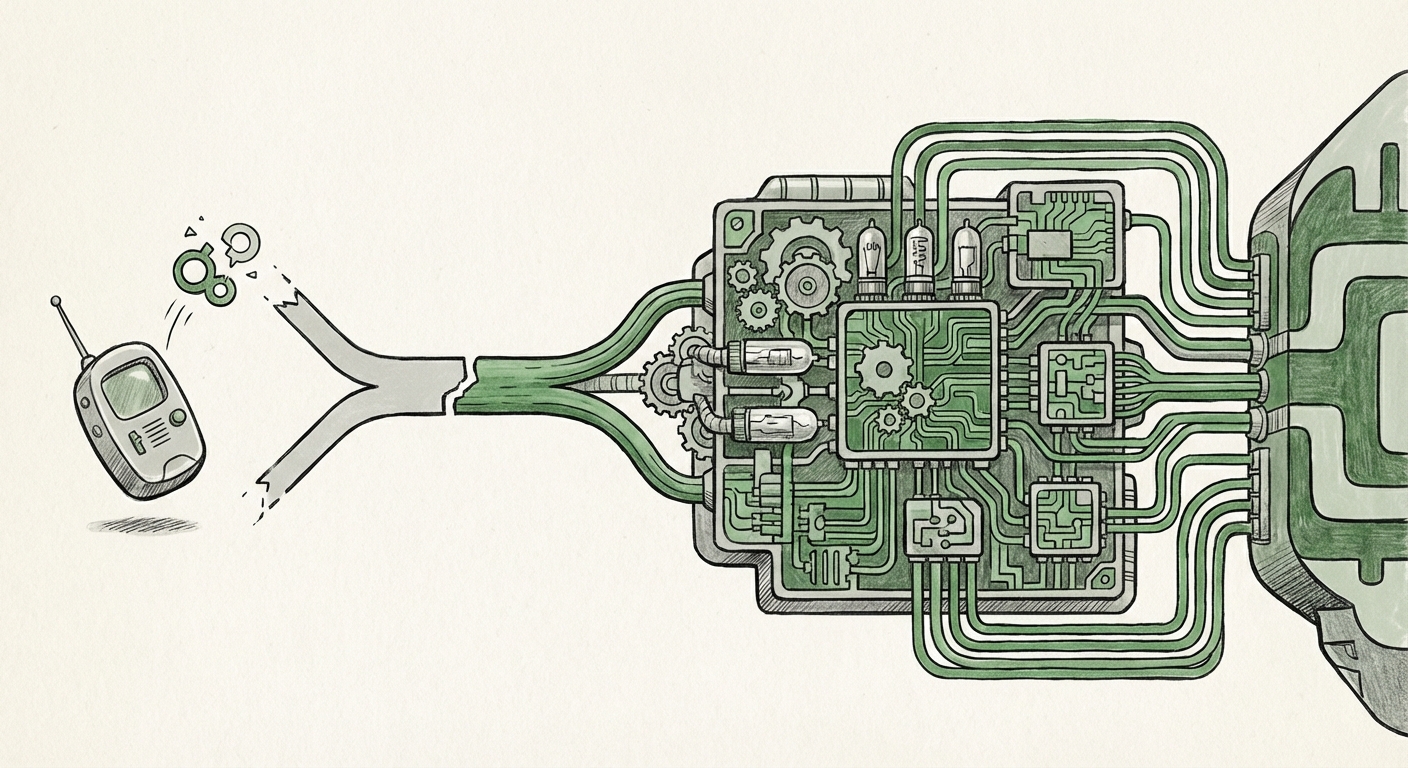
OpenAI's 2027 Hardware Pivot: Why Dropping 'io' Signals a Deeper, Foundational Shift in AI
The world of Artificial Intelligence moves at breakneck speed, often measured in weeks rather than quarters. Therefore, when a giant like OpenAI announces a significant delay—pushing a planned consumer AI hardware device out to 2027 and discarding the evocative "io" branding—it sends shockwaves across the technology landscape. This isn't merely a scheduling hiccup; it signals a profound strategic recalibration. It suggests that the immediate vision for a standalone AI gadget has been replaced by a much more ambitious, perhaps more daunting, long-term goal: foundational hardware mastery.
This delay and rebranding compel us to look past the immediate headlines and investigate the three critical dimensions shaping this pivot: the intensifying race for dedicated AI hardware, OpenAI’s internal strategic evolution, and the complex viability of building AI devices from the ground up.
The Context: The AI Hardware Gold Rush and the Search for the Interface
For years, AI has lived primarily in the cloud. Users access powerful models (like GPT-4) via phones, laptops, or desktops—devices designed primarily for media consumption or productivity, not dedicated AI interaction. The recent flurry of announcements from startups attempting to launch small, voice-first AI gadgets highlights a shared industry belief: the next computing platform requires a dedicated physical interface optimized for AI.
Companies are desperate to move beyond the smartphone screen. This search for the "AI Interface" is fraught with difficulty. Early attempts, such as the much-hyped but quickly criticized dedicated AI assistants, exposed major friction points. One key issue is the technical barrier: running complex, near-human-level LLMs locally requires significant processing power, heat management, and battery life that current consumer chips struggle to provide efficiently.
If OpenAI’s initial concept was similar to these early entrants, the 2027 delay strongly implies they realized the limitations of integrating current technology. As industry watchers often note, the challenges facing these early devices serve as crucial market feedback. They underscore that the true breakthrough device must not just *use* AI; it must feel inherently different and dramatically more capable than a smartphone app. This points directly toward the need for specialized processing power.
Why are companies building dedicated AI hardware devices? The answer is simple: to achieve lower latency, better privacy through local processing, and a dedicated, distraction-free interaction model optimized for conversational AI. However, the failure to launch quickly shows that the existing ecosystem (off-the-shelf components) cannot meet these demands yet.
Strategic Recalibration: The Deep Dive into Custom Silicon
The most compelling explanation for a 2027 target date—four or five years away in technology terms—is a commitment to **custom silicon strategy** (Search Query 1). Building a truly next-generation AI device means refusing to be constrained by the general-purpose chips offered by vendors like Qualcomm or even Apple’s existing Neural Engines.
Imagine building a supercar. You can bolt the best existing engine onto a standard frame, but true performance requires designing the engine, chassis, and transmission specifically for each other. OpenAI seems to be pursuing the latter approach for its hardware. This involves creating bespoke Application-Specific Integrated Circuits (ASICs) or specialized chip architectures designed purely for inference (running the model) and perhaps even lightweight on-device training.
This approach has massive upsides:
- Efficiency: Custom chips can deliver far more AI computation per watt of battery life than general-purpose GPUs or CPUs.
- Integration: They can be tightly coupled with the proprietary AI models being developed, creating an unbeatable performance moat.
- Cost Control: In the long run, designing your own chips for high-volume consumer goods can significantly reduce per-unit costs compared to relying on expensive, high-demand components from external suppliers.
However, building silicon is notoriously difficult, expensive, and time-consuming. It requires billions of dollars in R&D and foundry partnerships, often taking three to five years from design to mass production readiness. The 2027 date aligns perfectly with the typical lifecycle of a major custom semiconductor project. The abandonment of "io" suggests that the initial plans likely relied on integrating existing hardware; realizing the need for true differentiation forced this fundamental strategy pivot.
The Viability Hurdle: Consumer Adoption vs. Foundational R&D
The delay also speaks volumes about the **challenges in consumer AI hardware adoption** (Search Query 3). The market has recently seen cautionary tales from dedicated AI hardware startups. These devices often suffer from the "Why do I need this when my phone does it well enough?" syndrome. For a new device to succeed, the marginal utility must be immense.
If the hardware experience is clunky, unreliable, or doesn't offer a quantum leap in capability, consumers simply won't adopt it. A 2027 launch gives OpenAI ample time not just to engineer the chip, but to perfect the entire user experience (UX). This allows them to integrate their expected multimodal capabilities—vision, voice, perhaps even subtle physical actuation—into a seamless, intuitive package that justifies carrying a second device.
Furthermore, by pushing the timeline out, OpenAI might be positioning its hardware not for today’s LLMs, but for the AGI infrastructure they aim to build. This shifts the focus from selling a gadget to creating the necessary physical endpoint for their future, far more powerful, models.
The Infrastructure Backbone: Keeping Pace with Demand
No hardware discussion in AI is complete without acknowledging the computational bedrock beneath it. The massive appetite for AI processing power is creating an unprecedented strain on the semiconductor supply chain. Articles detailing the intense competition between major cloud providers and AI labs for access to high-end GPUs (like Nvidia’s latest offerings) highlight the scale of the infrastructural battle (Search Query 5).
If OpenAI is betting on custom silicon for 2027, they are making a calculated wager that by that time:
- They will have secured sufficient advanced manufacturing capacity (e.g., through TSMC).
- The competitive landscape for external chip access will have stabilized or shifted, allowing them to focus on optimizing their dedicated hardware ecosystem.
This dual strategy—relying on massive cloud compute for immediate model refinement while building custom, high-efficiency *edge* hardware for the future—is becoming the standard playbook for AI leaders.
Implications for Business and Society: Actionable Insights
OpenAI’s strategic pivot has immediate ripple effects across the technology ecosystem. Businesses and developers must adjust their expectations and strategies accordingly.
For Technology Investors: Prepare for a Long Game
The market should stop viewing OpenAI primarily as a near-term SaaS/API provider and start viewing them as a vertically integrated technology company akin to Apple or Tesla. Investors need to evaluate the company based on its long-term infrastructure build-out potential, not just immediate user growth metrics.
Actionable Insight: Look for signals regarding their partnerships in semiconductor design (EDA tools, foundry capacity) rather than just their latest model performance benchmarks. The real moat in 2027 might be hardware-software co-design.
For Device Manufacturers and Competitors: The Necessity of Specialization
The failure of early, non-specialized AI gadgets reinforces the mandate for competitors (Google, Apple, Meta) to aggressively pursue their own silicon specialization. If you are not optimizing your processors specifically for generative AI tasks, you risk being significantly outpaced in latency and capability once OpenAI’s hardware arrives.
Actionable Insight: Companies must accelerate investments in specialized Neural Processing Units (NPUs) and consider the total power budget required for always-on, context-aware AI features. The smartphone itself may become the hardware platform by 2027, but only if its internal components are fundamentally re-architected.
For Developers and the Ecosystem: Anticipating New Modalities
The delay allows OpenAI to build hardware that supports their evolving roadmap, likely centered on multimodal AI and potentially robotics. A device optimized for 2027 will be built to handle tasks we can barely conceive of today—perhaps instantaneous environmental analysis or complex physical task management.
Actionable Insight: Developers should focus on building applications that are modality-agnostic now, preparing APIs that can handle high-resolution visual and audio inputs alongside text. The eventual hardware endpoint will demand this versatility.
Conclusion: Shifting from Hype Cycle to Foundational Engineering
OpenAI dropping the "io" branding and setting a 2027 release target is less about defeat and more about ambition reaching its natural scale. It signifies a transition from the rapid, sometimes ephemeral, cycles of software hype to the slow, methodical, and capital-intensive world of foundational hardware engineering. They are choosing to build the platform that their future AGI models will run on, rather than fitting those models onto existing, inadequate infrastructure.
This shift demands patience from the market but promises a far more integrated and powerful user experience when the device finally arrives. The race to define the next computing interface is not over; it has simply entered a longer, more complex engineering phase.