The Robotaxi Revolution Accelerates: Why Pony.ai and Toyota's 1,000 EV Fleet Signals a True Turning Point in AI Mobility
For years, the promise of fully autonomous mobility—the robotaxi—has felt like a destination perpetually on the horizon. We have seen countless pilot programs, sophisticated sensor tests, and massive fundraising rounds. But the critical missing piece has always been scale. The recent announcement that Chinese autonomous driving leader Pony.ai is partnering with automotive titan Toyota to roll out 1,000 self-driving electric SUVs for commercial robotaxi duty is not just another press release; it is an inflection point marking the transition from high-cost testing to industrialized, profitable deployment.
This collaboration crystallizes three major technological and business trends shaping the future of Artificial Intelligence applications in transportation. To truly grasp the implications, we must look beyond the vehicle count and analyze the deeper forces at play: the fusion of AI capability with established manufacturing, the mandatory shift to electrification, and the global competitive race for regulatory dominance.
I. The Convergence: AI Expertise Meets Automotive Muscle
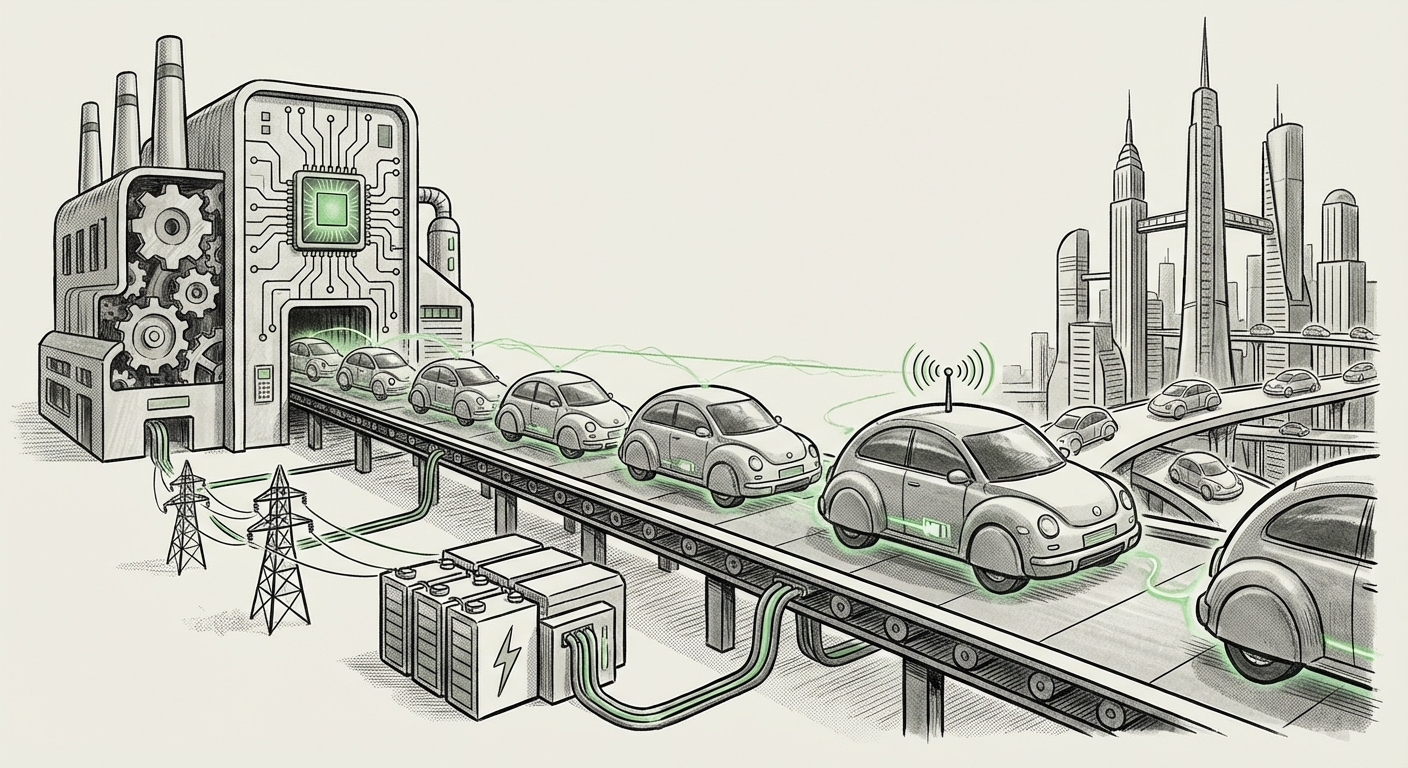
The Pony.ai/Toyota announcement highlights a vital strategic shift in the autonomous vehicle (AV) industry. Autonomous software firms (like Pony.ai) possess the advanced AI algorithms capable of perceiving and navigating complex urban environments. Traditional Original Equipment Manufacturers (OEMs) like Toyota possess the core competency that software companies desperately need: mass-market vehicle engineering, reliable supply chains, and quality manufacturing.
Previously, AV companies often retrofitted existing cars, leading to high costs, non-standardized sensor placement, and reliability issues at scale. This partnership suggests a future where AI is designed into the vehicle architecture, not bolted on afterward. This integration is critical for the 1,000-vehicle goal.
When software meets manufacturing at this scale, the cost of the autonomous stack drops dramatically. This collaboration moves the industry closer to the "production-ready" vehicle required for mass deployment. For the AI ecosystem, this means that the focus shifts from making a handful of cars drive perfectly in one city to deploying thousands of reliably built, predictable vehicles across multiple operating domains.
II. The Mandate of Electrification: Why Every Robotaxi Must Be an EV
The choice of an Electric SUV is not incidental; it is foundational to the business case for robotaxis. Traditional autonomous testing often utilized gasoline-powered vehicles, a model that fails catastrophically when scaled up. Robotaxis operate nearly 24/7, generating significantly higher mileage than privately owned vehicles.
The Economics of Uptime
Analyzing the Total Cost of Ownership (TCO) for autonomous electric vehicles reveals why this move is non-negotiable for profitability. Gasoline vehicles require frequent, costly maintenance (oil changes, transmission services, complex engine diagnostics). Electric powertrains are vastly simpler, requiring less downtime for repairs.
Furthermore, the fuel cost savings are immense. An EV fleet, even with higher upfront battery costs, drastically lowers the operational cost per mile when driven hundreds of thousands of miles annually. As explored in fleet economics discussions, reduced operational expenditure is the primary lever for turning AV testing budgets into genuine revenue streams [https://www.forbes.com/sites/alanohn/2023/11/15/why-fleet-operators-are-pivoting-to-electric-vehicles/].
What this means for AI: The AI systems must be optimized to manage battery health and charging logistics efficiently. Future AI models will need to incorporate real-time energy management, predicting charging needs based on route topography, passenger demand forecasts, and local electricity pricing—making the AI decision-making process inherently more complex and valuable.
III. The Global AI Race: China's Deployment Advantage
This announcement is also a significant indicator in the ongoing geopolitical competition shaping AI deployment timelines, particularly between the US and China. While US firms like Waymo and Cruise have achieved significant milestones, China has fostered an environment where domestic AI leaders, supported by major industrial partners, can scale faster due to different regulatory structures.
As analysts often observe, the Chinese AV landscape is characterized by aggressive governmental support for technological advancement and a more centralized approach to initial testing and operational rollouts [McKinsey on the shifting AV landscape, often highlighting China's role]. The ability of Pony.ai to secure approval for a 1,000-unit commercial fleet demonstrates a significant regulatory runway.
This rapid deployment curve has profound implications for the AI algorithms themselves. More miles driven in real-world, diverse urban conditions lead to faster data ingestion and iteration cycles. If Pony.ai is operating 1,000 vehicles across its operational domains while competitors are restricted to smaller fleets, the gap in real-world operational data—the true fuel for advanced AI training—will widen substantially.
Understanding the Regulatory Green Light
Successful deployment requires navigating complex governmental approvals. Reports detailing China’s recent moves to streamline approvals for robotaxi services in major metropolitan areas are key context here [Reuters article detailing a specific recent approval]. These frameworks allow companies to move beyond limited free-trade zones into areas with higher passenger density and complex traffic patterns [https://www.reuters.com/technology/self-driving/chinas-pony-ai-gets-approval-launch-robotaxi-service-beijing-2023-08-21/].
For the future of AI governance, this success in China sets a benchmark. It shows that governments are willing to grant scale when technological maturity is demonstrated, potentially pressuring other jurisdictions to accelerate their own AV regulatory roadmaps.
IV. Deep Technology: Engineering L4 Scalability
The leap from a limited fleet to 1,000 units demands rigorous engineering across the entire vehicle stack. The collaboration is fundamentally about hardening the Level 4 (L4) system to withstand constant commercial use.
The Hardware Integrity Challenge
While the news may not detail the exact vehicle model, the requirement to seamlessly integrate a proprietary sensor suite (Lidar, high-resolution cameras, custom compute boxes) into a mass-produced Toyota EV chassis is where the technical complexity lies. This requires robust, thermally managed hardware resistant to vibrations, temperature extremes, and constant cycling.
The technical deep dive into how Pony.ai engineers integrate their perception systems—how the AI "sees" the world—onto a standardized platform is crucial for replication. If the integration process can be streamlined and standardized, other companies can adopt similar hardware-software co-design strategies, dramatically lowering the barrier to entry for L4 services.
Essentially, the AI is moving out of the lab and into the factory floor. This process forces software teams to adopt rigorous automotive-grade validation protocols, which ultimately results in a safer, more predictable AI.
V. Practical Implications: What This Means for Business and Society
The scaling of robotaxi fleets impacts far more than just the automotive industry. It reshapes urban planning, labor markets, and consumer expectations.
For Businesses: Data is the New Oil
Any company focused on data collection, mapping, or edge computing should pay close attention. A fleet of 1,000 active, mapping-enabled vehicles generates terabytes of novel data daily. This data informs not just AV safety but also hyper-accurate 3D mapping, infrastructure needs, and predictive maintenance for city planning.
For fleet operators, the message is clear: the competitive advantage will shift rapidly from who *has* the technology to who can *deploy and maintain* it most cheaply. The race is now focused on operational efficiency, not just achieving Level 4 capability.
For Society: Reshaping Urban Mobility
If 1,000 vehicles can operate efficiently in one major Chinese city, the infrastructure challenge shifts from "Will AVs work?" to "How will we manage them?"
- Reduced Congestion (Potentially): If these vehicles are optimized for ride-sharing (high utilization), they could reduce the total number of private vehicles needed on the road.
- Accessibility and Labor: Robotaxis offer mobility solutions to populations unable to drive (elderly, disabled), fundamentally changing accessibility in urban centers. Conversely, this directly pressures professional driving occupations, requiring large-scale upskilling initiatives.
- Infrastructure Demands: Cities will need standardized charging infrastructure optimized for fleet use and smart traffic light systems that can communicate reliably with L4 vehicles.
Actionable Insights for Moving Forward
The Pony.ai/Toyota milestone provides clear direction for stakeholders across the technology and mobility sectors:
- Software Firms: Prioritize industrial partnerships. Pure software play longevity is limited; true scale requires deep integration with established OEMs who control the manufacturing pipeline.
- OEMs: Embrace the "software-defined vehicle" paradigm immediately. The value is no longer just in the hardware but in the recurring revenue potential of the integrated AI service layer.
- Investors: Shift focus from early-stage sensor startups to companies demonstrating clear paths to TCO reduction through electrification and validated regulatory frameworks. Profitability metrics based on cost-per-mile are now more relevant than purely technological demonstrations.
- Regulators: The success in China will accelerate demands for similar regulatory clarity globally. Policymakers must prepare frameworks for high-volume AV deployment focusing on data sharing protocols and liability standards.
The era of the self-driving car moving from controlled test tracks to routine commercial service is here. The 1,000-unit deployment by Pony.ai and Toyota serves as the clearest signal yet that the complex integration of AI, electrification, and scalable manufacturing has finally reached critical mass. The next phase of AI innovation won't just be about smarter algorithms; it will be about deploying those algorithms reliably, profitably, and at massive scale across our streets.