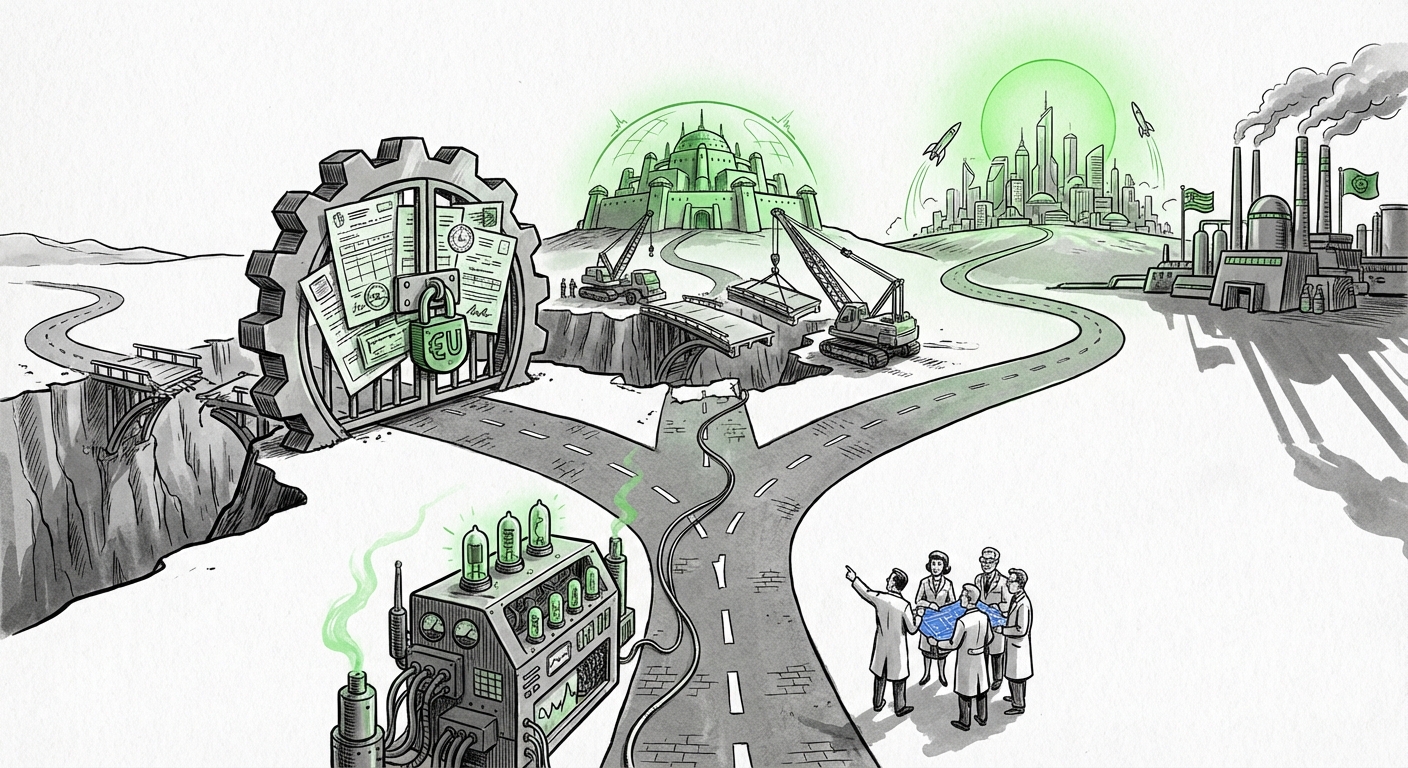
The Great European AI Crossroads: Compute, Regulation, and the Race for Model Sovereignty
The global race for Artificial Intelligence dominance is often framed as a binary contest between the United States and China. However, a crucial third player—the European Union—is navigating a far more complex terrain. Recent assessments from scientific advisory bodies, particularly in Germany, paint a sobering picture: Europe possesses world-class AI *brains* but struggles profoundly with the necessary *muscle* and regulatory framework to compete at the foundational model level.
This tension—between unparalleled research strength, severe operational scaling challenges, and a regulatory environment often perceived as favoring external giants—is the defining narrative for Europe’s technological future. Analyzing these intersecting pressures reveals not just a current lag, but the precise battlegrounds where sovereignty and competitiveness will be won or lost over the next decade.
The "Compute Ceiling": Why Hardware Matters More Than Ever
In the era of Generative AI, the focus has shifted from algorithmic innovation to resource acquisition. Training state-of-the-art models like GPT-4 or Claude requires not just brilliant mathematicians, but enormous clusters of specialized hardware—primarily high-end Graphics Processing Units (GPUs).
The core constraint identified across Europe is this limited compute capacity. Think of it this way: European researchers are designing the world’s most advanced airplane blueprints (the research), but they lack access to the massive, dedicated factories and assembly lines (the compute) required to build the first working prototype at scale. Instead, they must often rent time on US-owned infrastructure.
This deficit has profound implications:
- Slowing Down Innovation: If training a frontier model takes months longer due to waiting for GPU access or using smaller clusters, European researchers fall behind the fast-moving US and Chinese timelines.
- Talent Drain: Top engineering teams often choose to affiliate with or move to companies where they have guaranteed, high-throughput compute access, leading to a brain drain toward Silicon Valley or major domestic hubs like the UK (post-Brexit).
- Loss of Sovereignty: Relying on foreign cloud providers for model training means sensitive data pathways, architectural choices, and even ethical guardrails are effectively decided outside the continent.
In response, the European Commission and national governments are scrambling to accelerate the building of sovereign AI infrastructure, often through initiatives like the EuroHPC Joint Undertaking. The goal is clear: to provide European entities with the necessary *muscle* to move their world-class research (Query 1) into world-leading commercial models.
Future Implication: The Compute Arms Race
The future of AI leadership will be decided by compute access. Nations that fail to secure tens of thousands of cutting-edge AI accelerators risk becoming perpetually reliant on technology dictated by others. For European businesses, this means that until native foundational models mature, they must budget heavily for US cloud services, creating a persistent dependency.
The Regulatory Paradox: Protection vs. Paralyzation
Europe has long championed a values-driven approach to technology governance, epitomized by GDPR and now codified in the sweeping EU AI Act. While these regulations aim to protect fundamental rights, their implementation is creating unintended friction for domestic scaling.
The initial challenge stemmed from GDPR, which, while vital for data privacy, complicated the collation and cleaning of the massive, high-quality datasets necessary for training robust LLMs—a process US firms, often operating under different legal precedents, found easier.
Now, the EU AI Act adds another layer. It introduces a risk-based framework, imposing strict transparency and quality requirements, especially on 'High-Risk' systems. While proponents argue this builds trust, critics (often startup founders and venture capitalists) contend that the compliance overhead disproportionately burdens smaller, domestic developers who lack the legal teams enjoyed by Microsoft or Google.
As suggested by recent analysis (Query 2), the paradox is stark: US-developed models, already trained on vast global datasets, can be deployed across the EU market under fewer immediate constraints than a nascent European competitor building its first model from scratch within the EU framework.
Future Implication: The Compliance Tax
For European businesses, AI adoption will be heavily influenced by regulatory adherence. Companies using foreign models will be navigating the deployment side of the AI Act, while European creators will be burdened by the development and data requirements. This "compliance tax" risks stifling the very innovation the EU seeks to foster, potentially solidifying the market position of non-EU giants who can absorb these costs more easily.
The Commercialization Chasm: Bridging Research to Reality
The German advisory body’s findings highlight a common European malady: a spectacular output in academic papers and foundational research, yet a scarcity of homegrown, large-scale commercial models. This is the infamous "research-to-market" valley of death (Query 3).
Why does this happen? It stems from a complex ecosystem failure:
- Risk Aversion in Capital: European venture capital has traditionally favored less capital-intensive software models over the multi-billion-dollar, decade-long bets required for foundational hardware and large-scale model training.
- Talent Mobility: The best AI talent often seeks environments where they can work on the largest, most cutting-edge problems immediately—which, for now, are usually anchored to high-compute environments in the US.
- Fragmented Market: Scaling a successful German AI startup across France, Italy, and Spain is currently harder than scaling a US startup across 50 states. This fragmentation (Query 4) limits the total addressable market size needed to justify massive initial investment.
Without significant capital flowing into deep-tech scale-ups, the theoretical superiority of European algorithms remains confined to academic journals rather than shaping global commercial infrastructure.
The Call for Structural Reform: Beyond Piecemeal Policy
The proposed solutions—a "28th regime" to harmonize the single market and radical reforms for sectors like defense procurement—signal a recognition that incremental policy tweaks are insufficient. Europe needs tectonic shifts in strategy.
1. The Unified Digital Market Imperative
The concept of a true Digital Single Market must be aggressively pursued for AI. This means standardizing rules on data governance, procurement of AI services by public bodies, and creating cross-border incentives for deep-tech investment. If startups cannot easily access a market of 450 million consumers, they cannot attract the investment needed to compete with firms targeting 330 million in the US.
2. Industrial Policy for Compute
For compute, the strategy must shift from merely *supporting* research to *owning* the means of production. This requires sustained, perhaps state-backed, procurement commitments for AI hardware, ensuring that European research clusters and validated startups receive preferential access to national and EU-funded supercomputers.
3. Rethinking Regulatory Pace
While upholding core values, regulators must ensure the AI Act does not prematurely fossilize the technology. A key challenge is creating fast, regulatory sandboxes or tiered compliance structures that allow European developers to iterate rapidly on foundation models without being immediately crushed by the highest compliance tier meant for global deployers.
Actionable Insights for Businesses and Strategists
The current snapshot requires distinct responses from different stakeholders:
For European AI Startups:
Seek Compute Partnerships Early: Do not wait for national compute infrastructure to be perfectly provisioned. Aggressively partner with academic consortia that have access to EuroHPC clusters or collaborate with established hyperscalers (even US ones) under strict data governance agreements to secure necessary training time.
Prioritize Compliance as a Feature: Reframe AI Act compliance not as a burden, but as a unique selling proposition. Market your models as the world’s most trustworthy, secure, and ethically governed foundational systems. This is the differentiator against US incumbents.
For Large European Enterprises:
Dual Sourcing Strategy: Do not go "all-in" on US models. Maintain a strategic portfolio that includes experimenting with smaller, highly capable European models (even if less performant today) to ensure internal expertise and readiness when European foundation models reach maturity. This mitigates future vendor lock-in risk.
Invest in Talent Retainment: Recognize that your competitors for top AI engineers are often paying salaries benchmarked against the US market. Offer significant R&D autonomy and access to strategic EU-centric projects (like defense or healthcare AI) that US firms cannot easily replicate.
For Policymakers:
The Urgency of Capital Formation: Focus energy on de-risking the truly massive, foundational bets. This may require creating specialized public-private investment vehicles dedicated solely to building and operating large-scale AI training clusters, similar to how countries funded nuclear power or space exploration.
Harmonize Data Access: Aggressively work toward unified, cross-border data trusts or marketplaces that allow European researchers to train models on diverse European data sets (e.g., medical records, industrial telemetry) without falling prey to 27 different national interpretations of data sovereignty.
Conclusion: The Window of Opportunity is Closing
Europe sits at an inflection point. It holds the intellectual spark—the research and the regulatory foresight—but it is dangerously close to missing the critical scaling phase of the AI revolution. The path forward is not about replicating the US venture model but about creating a distinctly European technological ecosystem: one that prizes rigorous governance while aggressively funding the infrastructure needed for deployment.
If the compute gap remains wide, and regulatory complexity prevents rapid scaling, Europe risks becoming the world’s most sophisticated laboratory, producing blueprints that others—equipped with better factories—will build and sell back to the continent. The success of the next decade hinges on whether policy can effectively fuse its strong research heritage with the necessary industrial muscle and market cohesion.