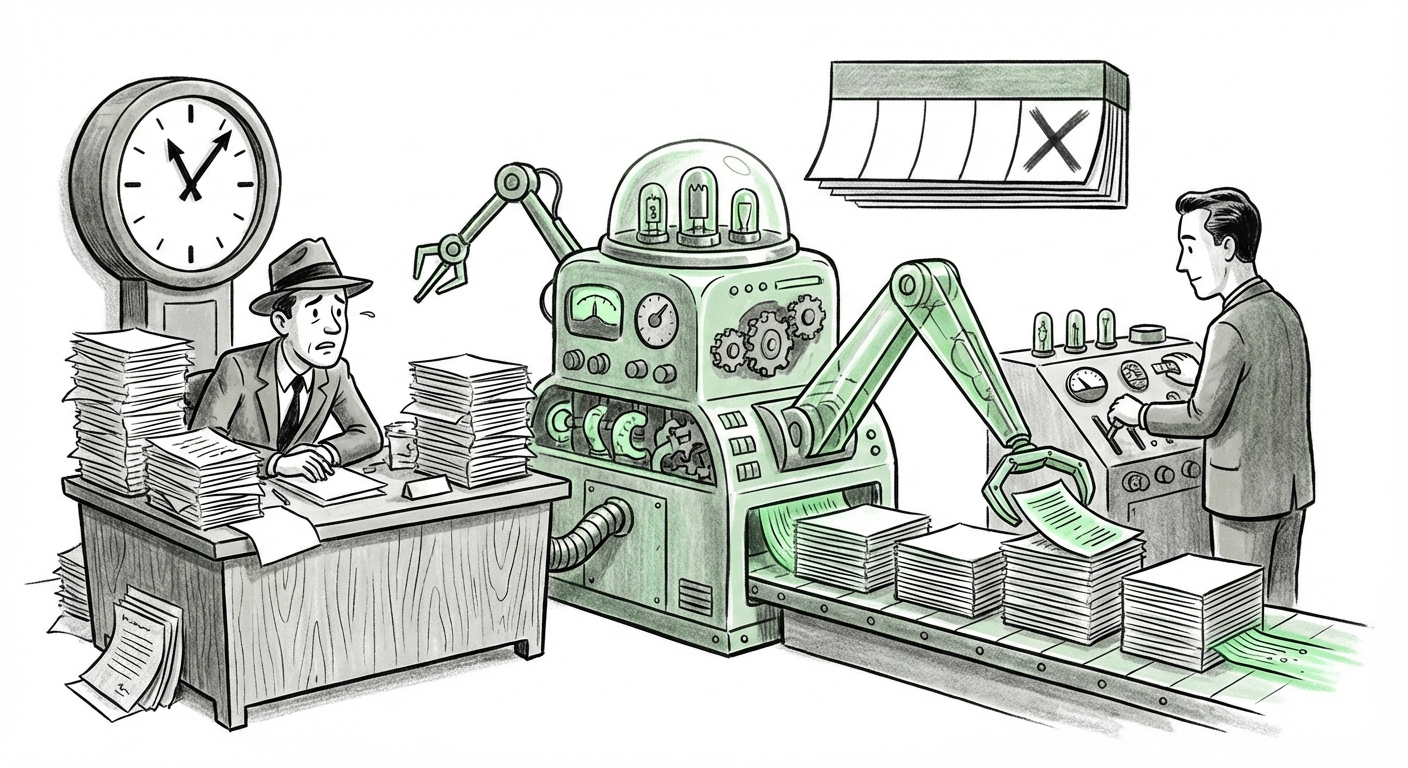
The 18-Month AI Reckoning: Why Microsoft's CEO Predicts The End of Traditional White-Collar Work
The pace of Artificial Intelligence development has officially shifted from a distant technological horizon to an immediate operational challenge. When Mustafa Suleyman, the CEO of Microsoft AI, suggests that most white-collar tasks will be automated within the next 18 months, the industry must stop debating the *if* and start preparing for the *when*.
This is not a forecast about mass unemployment next year; it is a prediction about the fundamental change in how knowledge work is organized and executed. To truly understand the weight of this claim, we must look beyond the headline and examine the data confirming the velocity of AI adoption, the crucial difference between automating tasks versus eliminating jobs, and the macroeconomic shockwaves this speed implies for businesses and society.
Deconstructing the 18-Month Deadline: Velocity Meets Capability
Eighteen months (roughly the end of 2025) is an astonishingly short timeframe for such a massive systemic shift. For context, major technology shifts often take five to ten years to permeate an entire enterprise sector. Suleyman’s confidence stems from the current state of foundation models and the rapid deployment of AI agents capable of chaining multiple steps together—moving beyond simple chatbots to actual work execution.
Corroborating the Pace: What the Experts Say
To validate this aggressive timeline, we look at industry indicators showing how quickly businesses are moving from pilot projects to live deployment:
- Enterprise Productivity Expectations: Analyst firms like Gartner track IT spending and expected returns. Recent forecasts often show CIOs expecting significant, measurable productivity gains from Generative AI within the 2024-2025 window. If businesses anticipate achieving 30-40% productivity boosts from AI tools, it means those tools are actively taking over a substantial fraction of existing work processes, supporting Suleyman's timeline for task automation.
- Platform Readiness: Reports like the Forrester Wave on Enterprise Generative AI Platforms show that the major players (Microsoft, Google, etc.) are focusing intently on building reliable, secure, and scalable internal tooling. This capability—moving AI out of the lab and onto internal company data—is the engine driving the 18-month clock.
In simple terms: the tools are ready, and businesses are ready to deploy them quickly to capture a competitive edge. This urgency creates the 18-month window for *task obsolescence*.
The Crucial Distinction: Task vs. Job Elimination
This is where most public debate misses the mark. Suleyman predicts the automation of tasks, not necessarily the immediate elimination of jobs. To understand this, let’s use an analogy often explored in economic modeling, such as findings documented by institutions like McKinsey:
Imagine an accountant whose job requires 100 distinct tasks. These tasks might include:
- Gathering monthly sales figures (Task A).
- Summarizing performance against budget (Task B).
- Flagging unusual expense reports (Task C).
- Strategizing tax optimization for the next quarter (Task D).
Under today's AI capabilities, Tasks A, B, and C might be 90% automated in 18 months. The AI generates the summaries and flags the anomalies. However, Task D—the nuanced strategic planning that requires deep contextual understanding, negotiation, and judgment—remains inherently human for the foreseeable future.
Economic Modeling and Exposure
Investment bank analysis, such as that from Goldman Sachs concerning the impact on the labor market, often quantifies this exposure. They frequently find that a high percentage of existing roles contain a significant portion of automatable tasks. If 40% of an administrative role’s tasks can be handled by AI agents, that role doesn't necessarily vanish, but the work required of the human shifts dramatically. The time saved is reallocated, ideally, to higher-value, strategic activities (like Task D).
The risk occurs when the ratio tips: if 80% of tasks are automated, the remaining 20% of work is often not enough to justify the salary, leading to job elimination. Suleyman’s bold timeline suggests that for *many* white-collar roles, the 80% automation threshold will be crossed quickly across the economy.
Friction Points: Why Adoption Might Slow Down (The Counter-Argument)
While the technology capability seems present, the real world is messy. Academic studies, such as those emerging from MIT Sloan, often highlight the friction points that can delay widespread, successful adoption, potentially pushing the timeline beyond 18 months for some organizations:
- Data Readiness and Security: AI models are only as good as the proprietary data they train on or access. Many older organizations have siloed, poorly structured, or insecure data environments, making the deployment of advanced internal AI agents slow and risky.
- The Skill Gap in Supervision: If a professional’s job shifts from *doing* the work to *validating* the AI’s output, a new skill emerges: AI supervision, verification, and refinement (often called "prompt engineering" or "AI oversight"). If companies fail to train their workforce in these new validation skills, the promised productivity gains will stall due to errors and mistrust in the output.
- Regulatory and Ethical Hurdles: Fields like finance, law, and healthcare move slowly due to strict compliance requirements. Automating tasks in these areas requires rigorous auditing frameworks that take time to develop and implement, acting as a natural brake on the 18-month clock.
Therefore, the prediction applies most acutely to sectors with high data liquidity and lower regulatory burden—like marketing, entry-level coding, and internal corporate communications—where the automation runway is clearer.
Practical Implications: What This Means for AI Strategy and Careers
Suleyman’s statement acts as a critical wake-up call. Organizations and individuals cannot afford incremental adaptation; rapid transformation is now the baseline requirement for survival.
For Businesses: The Shift to AI-Native Operations
Businesses must move beyond simple adoption of tools like Copilot and begin fundamentally redesigning workflows around AI capabilities.
- Workflow Re-Architecture: Instead of asking, "How can AI help my team complete their report faster?" the question must be, "What parts of this entire business function (e.g., compliance review) can now be handled entirely by an autonomous agent, requiring only human oversight on exceptions?" This requires a top-down process overhaul, not just top-down tool rollout.
- Investment in Data Infrastructure: To utilize high-performing AI agents, investment must pour into cleaning, structuring, and securing the internal data that will serve as the context layer for enterprise AI. This infrastructure investment is the prerequisite for realizing the productivity gains forecast by firms like Gartner.
- Redefining ROI: Return on Investment must be measured not just in reduced headcount, but in accelerated time-to-market, improved decision quality due to AI synthesis, and capacity for innovation that was previously impossible due to resource constraints.
For Professionals: Mastery Over Maintenance
For the white-collar worker, the mandate is clear: stop focusing on tasks that are repetitive, summarizing, or basic drafting. These are the first to be optimized away.
- Embrace the Meta-Skill: The future professional is not the one who writes the best first draft, but the one who can orchestrate five AI agents, integrate their complex outputs, and apply human judgment where uncertainty is highest. This requires skills in critical thinking, complex problem decomposition, and effective AI direction (advanced prompting).
- Focus on Synthesis and Human Interface: Tasks requiring high emotional intelligence, complex stakeholder management, high-stakes negotiation, creativity that defies pattern recognition, and true strategic leadership will retain their value—and likely increase in value, as they are the residual work left after automation.
- Agility as the Ultimate Job Security: The idea of a stable, lifelong career path defined by a set of unchanging technical skills is obsolete. Career security now rests on one's ability to learn and integrate the *next* generation of AI tools—and be ready for the one after that—within a 12-month cycle.
What This Means for the Future of AI Usage
The coming 18 months will likely feature a stark bifurcation in the market. Companies that successfully adopt AI agents will achieve operational efficiency and competitive agility far beyond those that hesitate. Conversely, employees who treat AI as a novel distraction rather than a fundamental co-worker risk finding their core competencies automated away.
The technological capability is surging ahead of traditional management adoption cycles. When the CEO of Microsoft AI sets a deadline this short, it is because the underlying engineering—especially in areas like personalized agent deployment—is moving from the theoretical to the deployable at unprecedented speed. We are entering an era where the software itself can write, analyze, and manage large portions of its own operational overhead. The primary function of the remaining human workforce will be steering this powerful new infrastructure toward value creation.