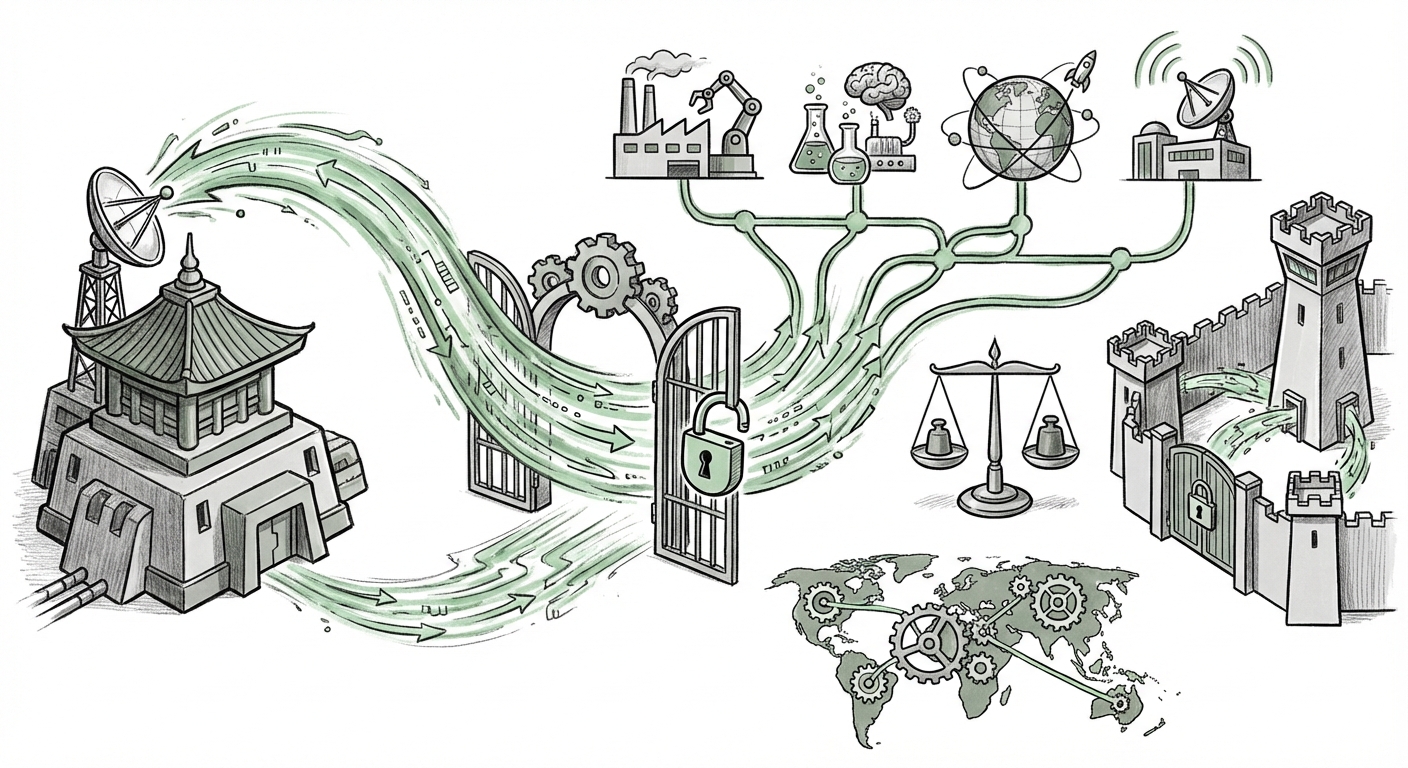
GLM-5 Unleashed: How China's Open-Source AI Parity Threat Reshapes the Global Race
The artificial intelligence world operates on a foundation of perceived dominance and rapid iteration. For the last few years, the narrative has been dominated by a handful of well-funded US labs controlling the cutting edge of proprietary, closed models like OpenAI’s GPT series and Anthropic’s Claude. However, a recent development from China signals a potential tectonic shift: the release of Zhipu AI’s GLM-5.
Zhipu AI, a leading Chinese AI lab, has released GLM-5, boasting an enormous 744-billion parameter count. Crucially, they claim this model achieves parity with top-tier Western proprietary systems (specifically mentioning Claude Opus 4.5 and a theoretical GPT-5.2 level on coding and agent benchmarks). The real bombshell, however, is the licensing: GLM-5 is released under the highly permissive MIT license.
This development is not merely an interesting data point; it’s a strategic pivot that forces the entire global AI ecosystem—from academic researchers to enterprise CIOs—to recalibrate their assumptions about the future of foundational models.
The Triple Threat: Performance, Openness, and Origin
The significance of GLM-5 can be broken down into three interconnected vectors, each carrying massive implications for the future:
1. The Performance Claim: Crossing the Quality Threshold
For years, the most advanced benchmarks were reserved for models costing hundreds of millions to train and kept secret behind APIs. Zhipu’s claim that GLM-5 rivals market leaders in specialized, high-value tasks like coding and complex agentic reasoning is staggering. These tasks represent the current frontier of real-world utility.
To confirm this, analysts must scour leaderboards and technical papers (the focus of our search query: "GLM-5" vs "GPT-4" coding benchmark performance). If these claims hold up under external scrutiny, it means that the cost of entry for achieving "world-class" AI capability has dramatically dropped. Businesses no longer have to rely solely on the roadmaps dictated by a few Silicon Valley giants.
2. The MIT License: Democratization at Scale
The adoption of the MIT license is perhaps the most strategically disruptive element. The MIT license is famously permissive, allowing virtually unrestricted use, modification, and commercialization, even for proprietary derivatives. This contrasts sharply with licenses that might restrict commercial use or demand model weights remain closed.
Why would a major lab do this? As we explore through targeted analysis (search query: Implications of MIT license for Chinese large language models), this signals a commitment to **global integration and rapid community adoption**. For enterprises hesitant about vendor lock-in or data governance with closed APIs, an MIT-licensed, high-performance model offers a compelling, self-hostable alternative. It bypasses many regulatory hurdles related to data transfer and sovereignty simply because the core technology can reside entirely within a company's own infrastructure.
3. The Origin: Geopolitical Rebalancing
That this breakthrough emanates from a Chinese lab adds a crucial geopolitical layer. It directly counters the narrative that Western hardware and regulatory environments provide an insurmountable lead. This release demonstrates that significant, world-leading AI capabilities are developing robustly outside the US sphere of influence.
Understanding Zhipu’s foundation (search query: Zhipu AI funding and previous model history) reveals a deeply integrated ecosystem, often supported by significant national and institutional backing. GLM-5 solidifies China's position not just as a fast follower, but as a genuine pacesetter in foundational model development.
Implications for Enterprise Adoption and Innovation
The release of an open, parity-level model like GLM-5 acts as a powerful accelerant for innovation across several sectors.
The Erosion of Proprietary Lock-In
The primary beneficiaries are the millions of developers and companies seeking robust, cost-effective AI solutions. When a model is available under MIT, companies gain:
- Data Control: Sensitive corporate data never has to leave the company firewall. This is non-negotiable for finance, healthcare, and defense sectors.
- Cost Predictability: API calls incur variable operational expenditure (OpEx). Hosting a powerful open model shifts the cost to capital expenditure (CapEx) for hardware, offering more predictable long-term budgeting, especially at scale.
- Customization Freedom: Developers can fine-tune the 744B parameters to meet niche industry jargon or specific workflows without requiring permission or paying premium fees to the original provider.
The New Open Source Arms Race
This move puts immense pressure on the Western proprietary leaders. If developers can achieve GPT-4 level outputs using GLM-5 locally, the value proposition of paying premium API rates for the latest closed models begins to diminish, except perhaps for the absolute bleeding edge of multimodal capabilities.
This dynamic echoes Meta’s Llama strategy, but with a twist: GLM-5 is claiming performance that already exceeds what many open models achieve, potentially skipping the "good enough" phase and jumping straight to "best-in-class for many tasks." Analysis of competitor responses (search query: OpenAI or Anthropic response to high-performing open-source LLMs) will reveal how urgently they feel the need to accelerate their own open releases or emphasize features that open models cannot easily replicate (like superior multi-modality or safety alignment).
Accelerated Agentic Workflows
The emphasis on agent benchmarks is significant. AI Agents are systems designed to perform complex, multi-step tasks (e.g., researching a market, writing code, debugging, and deploying). This requires strong reasoning and planning, areas where proprietary models previously held a clear lead. If GLM-5 excels here, it means the next wave of AI automation—truly autonomous business processes—will become accessible to any organization willing to host the model.
Navigating the New AI Landscape: Actionable Insights
For businesses and technologists looking to capitalize on this seismic shift, proactive adaptation is necessary.
For Technical Teams (ML Engineers & Data Scientists):
Actionable Insight: Prioritize Self-Hosting Benchmarking.
Do not rely solely on the initial claims. Immediately begin benchmarking GLM-5 (and any subsequent Chinese open models) against your proprietary workloads, especially in coding generation and complex instruction-following. Focus on the practical deployment challenges: How efficiently can the 744B model be quantized or served on your existing hardware stack? The true cost saving only materializes if you can run it efficiently.
For Business Leaders (CTOs & VPs):
Actionable Insight: Develop a Dual-Sourcing Strategy.
The reliance on a single vendor (like OpenAI) is now a significant strategic risk. Evaluate integrating a powerful open model like GLM-5 for internal, highly sensitive data processing and core automation tasks, while retaining API access to the latest proprietary models for tasks requiring unproven cutting-edge features (e.g., advanced video processing). This hedging strategy maintains agility while controlling long-term operational risk.
For Policy Makers and Researchers:
Actionable Insight: Engage with Global Open Ecosystems.
The diffusion of powerful, openly licensed models democratizes access, but also raises questions about safety guardrails. Researchers must rapidly evaluate the safety, bias, and misuse potential of GLM-5. For policy bodies, the MIT license means that technology transfer is highly efficient; regulatory frameworks need to adapt to govern the *use* of powerful, accessible models rather than just the *export* of proprietary technology.
The Future: A Truly Distributed Intelligence
The GLM-5 announcement suggests that the future of AI will not be a clean bifurcation between "good, closed US AI" and "less capable, subsidized Chinese AI." Instead, we are moving toward a landscape defined by rapid, global competition where open-source licenses are weaponized to drive adoption and innovation across borders.
This parity claim signals the maturation of foundational model engineering outside the immediate US sphere. As the cost and complexity barrier falls, the focus will inevitably shift from *who built the best base model* to *who can build the best applications and integrations* on top of accessible, high-quality foundations. For the enterprise, this means an immediate and powerful expansion of AI capability into areas previously deemed too sensitive or too expensive to automate. The race is no longer just about who has the biggest model; it’s about who can empower the largest number of users with that model, and Zhipu AI has just made a bold move to capture that widespread adoption.