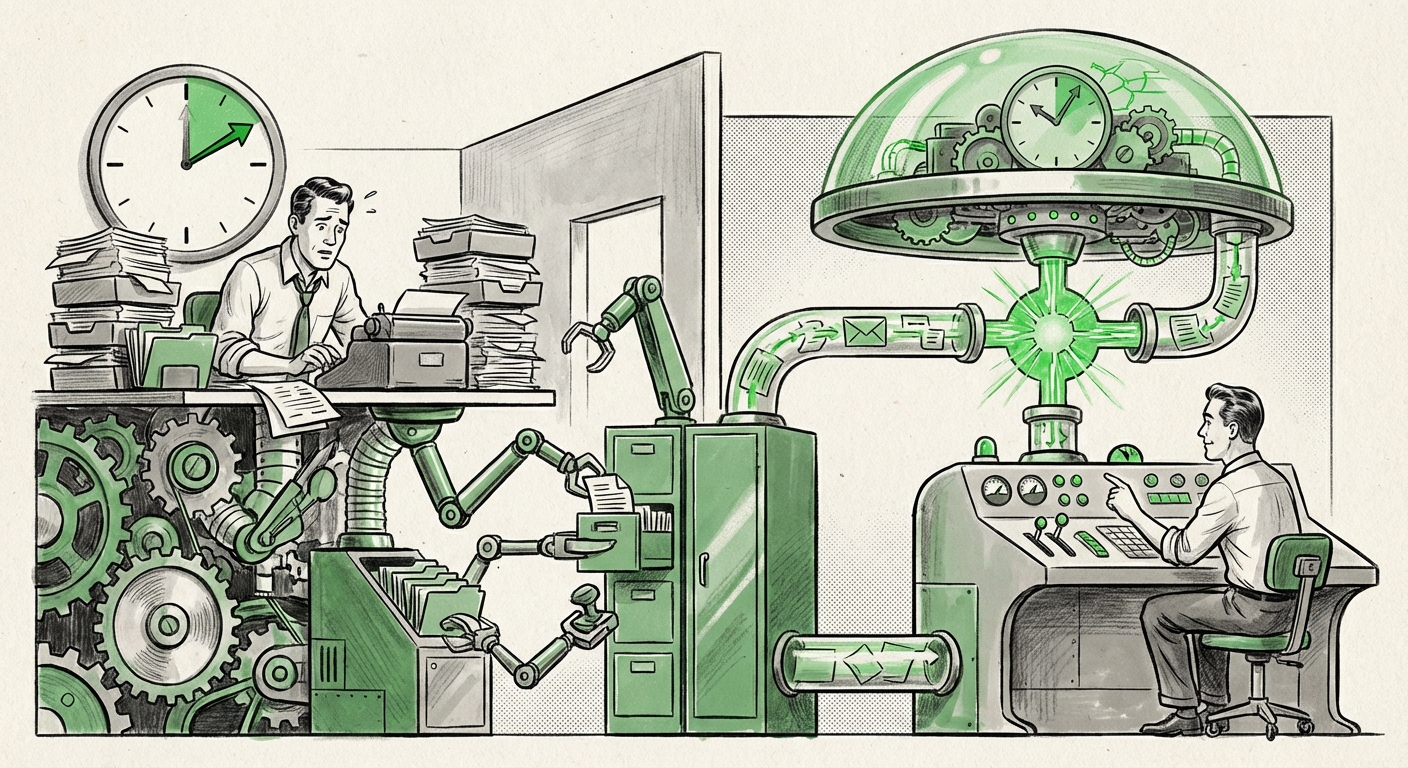
18 Months to Automation? Analyzing the Microsoft AI CEO's Disruptive White-Collar Prediction
The technology world rarely experiences a moment of quiet consensus. In fact, disruption often arrives through radical, borderline-sensational claims made by those closest to the innovation engine. Recently, Mustafa Suleyman, CEO of Microsoft AI, threw down one of the most provocative gauntlets yet: He predicted that "most" white-collar tasks will be automated within the next 18 months.
This isn't just a statement about future growth; it’s a radical declaration that the fundamental operating model for knowledge work—from finance and law to marketing and software engineering—is facing an immediate, near-total overhaul. For business leaders, strategists, and workers alike, the critical question is: Is this a genuine forecast of near-term reality, or an aggressive market positioning statement?
To properly analyze a timeline this aggressive, we must look beyond the headline and investigate the underlying currents of technology adoption, capability, and organizational friction. We need context, corroboration, and a healthy dose of skepticism.
The Acceleration Hypothesis: Capability Meets Momentum
Suleyman’s timeline is predicated on the belief that the current generation of Large Language Models (LLMs) and the emerging field of AI Agents are not just incremental improvements but true inflection points. When we discuss "task automation," we are referring to the capacity of AI systems to execute steps traditionally requiring human cognitive input—summarizing complex documents, writing functional code, generating detailed first drafts of strategic plans, or managing routine email workflows.
1. The State of Enterprise Adoption
If an event this large is to happen in 18 months, the adoption rate within large enterprises must already be accelerating at an exponential rate. We are moving past the "pilot phase" and into scaled deployment. Recent industry tracking aims to clarify this momentum. Reports focusing on "Generative AI adoption rate enterprise 2024" suggest that while investment is massive, true, large-scale integration is often the bottleneck. While many companies are using AI for basic tasks, moving to automate the *core* functions of a role requires deep integration into proprietary data systems, which is rarely a six-month process.
For Suleyman’s timeline to hold, we must assume that deployment hurdles—data security compliance, integration with legacy systems, and model fine-tuning—are being solved faster than experts previously thought possible. This implies that off-the-shelf solutions (like powerful Copilots or agent frameworks) are becoming plug-and-play for 80% of common business needs.
2. Where Automation is Happening First
Not all white-collar work is created equal. The automation impact will be uneven. Analyses tracking the "Impact of LLMs on coding and legal tasks 2024" reveal that tasks involving pattern recognition, synthesis of large unstructured data sets, and generating first-draft content are ripe for immediate disruption. For a developer, 60% of time spent on boilerplate code or debugging could vanish. For a paralegal, drafting standardized contracts could become instantaneous.
If "most tasks" means automating the high-volume, repetitive cognitive work across these sectors, then the 18-month window is plausible *at the task level*. However, this distinction is crucial: automating the task of "writing a memo" does not automate the job of the "Executive Assistant" who manages relationships, anticipates needs, and handles complex scheduling.
Contextual Reference: Reports on specialized LLM application often show massive productivity leaps in specific domains, suggesting the technical foundation for task automation is solidifying rapidly.
Skepticism and the Reality Check: The Adoption Chasm
While the capabilities of models like GPT-4o or those powering Microsoft Copilot are undeniable, the real world often lags behind the lab demo. This is where independent analysis serves as a vital check against the enthusiasm of platform providers.
The Timeline Discrepancy
When contrasting Suleyman’s rapid timeframe with broader industry assessments, a gap appears. Independent analysts focusing on "White-collar task displacement timeline analyst predictions" frequently project longer horizons—three to five years—for *significant job transformation*, let alone task saturation. These analysts account for the inertia of human systems.
Why the difference? Platform leaders are incentivized to forecast aggressive timelines to drive immediate investment and adoption. Independent analysts, conversely, factor in the slow evolution of regulatory environments, corporate inertia, and the necessary retraining cycles for the human workforce.
The Barriers to Rapid Implementation
The greatest threat to the 18-month timeline lies in operational reality, explored in research regarding the "Challenges to rapid AI implementation in large organizations." These challenges are not technical; they are structural:
- Data Governance and Security: Companies handling sensitive customer or proprietary data cannot simply hand that data over to third-party models without robust, often slow, internal auditing and security protocols.
- Cultural Resistance: Employees must trust the AI outputs enough to stake their professional reputation on them. This trust is built through validated experience, not mandate.
- The "Last Mile" Problem: The final 10% of customization—making the generic AI truly understand the specific language, workflow, and compliance needs of *one company*—remains the most time-consuming part of deployment.
If organizations cannot resolve these governance issues within the next year, the automation of "most" tasks will stall significantly before the 18-month mark.
Future Implications: From Automation to Augmentation and Reimagination
Whether the timeline is 18 months or 36 months, Suleyman’s prediction forces us to confront the new reality of knowledge work. The future is not simply about replacing workers; it is about radically redefining what a "task" entails.
The Death of the First Draft
The most immediate casualty of rapid AI deployment is the "first draft." In nearly every knowledge domain—writing, coding, financial modeling, architectural planning—the time spent generating the initial, often mediocre, output is about to collapse. This is a profound productivity boost, but it fundamentally changes the role of the human professional.
The value shifts from *creation* to *curation, verification, and strategic direction*. The professional of 2026 will not be paid to write; they will be paid to decide *what* to write, *why* it matters, and to rigorously audit the AI’s suggestion for bias, accuracy, and strategic fit. This represents a shift from being a **Doer** to being a **Director**.
The Rise of Agentic Workflows
The next phase of automation moves beyond simple prompts. We are rapidly entering the era of autonomous AI Agents. These systems can chain together multiple steps, use software tools, browse the internet, and execute complex projects with minimal human oversight. An agent might be tasked with: "Launch a Q3 marketing campaign targeting European SMEs." It would then autonomously handle research, draft copy, set up basic tracking dashboards, and flag only the critical decision points for human review.
This agentic future is what underpins the aggressive 18-month prediction. If these agents become reliable and scalable within large corporate environments, the sheer volume of individual, discrete tasks handled by humans drops precipitously.
Actionable Insights for Business Leaders
For organizations aiming to survive and thrive in this compressed timeline, immediate action is required:
- Audit Tasks, Not Titles: Stop thinking about which *jobs* will go away and start cataloging which *tasks* consume 50% or more of an employee's time. These tasks are the low-hanging fruit for immediate AI integration.
- Invest in Verification Skills: Begin mandatory upskilling programs focused not on learning to code AI, but on learning to critically *evaluate* AI output. Data scientists and compliance officers need to understand model provenance and error modes better than ever before.
- Establish AI Governance Now: Before the 18-month deadline, security and legal teams must have established clear guardrails for internal data usage. Unmanaged AI use is the single greatest operational risk in this environment.
Conclusion: Disruption is Inevitable, The Speed is the Variable
Mustafa Suleyman’s bold 18-month prediction is less a guarantee and more a powerful signal flare. It declares that the technological trajectory of Generative AI has reached a velocity where the traditional friction points of business adoption—which usually slow technological revolutions down by years—are being aggressively flattened by platform investment and market pressure.
For the future of AI, this means the race is no longer about building smarter models; it is about building more trusted, integrated, and agentic *systems*. For society, it means the necessary conversation around workforce transition, ethical guidelines, and value creation needs to move from a theoretical discussion to an urgent operational plan. The automation of white-collar tasks is not a distant horizon; it is the immediate landscape we must now navigate.