The $380 Billion AI Arms Race: Anthropic's Mega-Funding and the Future of Frontier Models
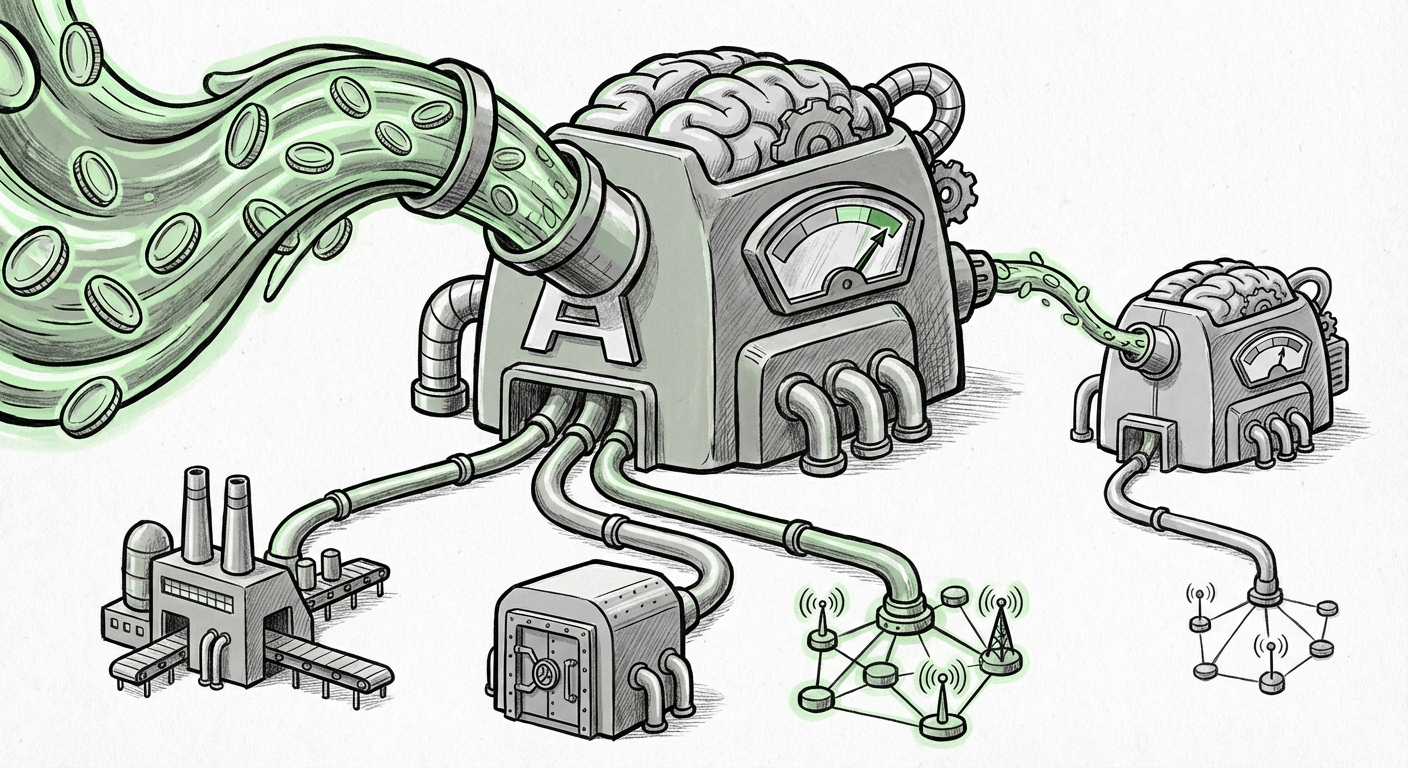
The world of Artificial Intelligence just witnessed a seismic financial event. Anthropic, the company building the powerful Claude models, has reportedly closed a staggering $30 billion Series G funding round, catapulting its post-money valuation to an eye-watering $380 billion. This number isn't just large; it’s a declaration of intent, signaling that the race to build the most capable, general-purpose AI systems is entering a new, hyper-capitalized phase.
This massive influx of cash into a pure-play foundational model developer, directly challenging established titans like OpenAI (backed by Microsoft), underscores several critical trends reshaping technology, economics, and global competition. To truly grasp the significance of this valuation, we must move beyond the headline figure and analyze what this money buys, who it empowers, and what it means for the trajectory of AI development.
The New Scale of AI: Competing on Compute, Not Code
In the past, a software company's success was often measured by the genius of its code or the elegance of its user interface. Today, developing frontier Large Language Models (LLMs) is less about clever algorithms (though those are still vital) and more about raw, industrial-scale resources. Building models like Claude 3 requires immense amounts of processing power, specifically high-end Graphics Processing Units (GPUs).
The $30 billion raise immediately validates the hypothesis that compute is the new oil. This capital allows Anthropic to secure multi-year commitments for next-generation hardware, ensuring they do not run into the critical bottleneck that plagues smaller labs: lack of access to chips.
Benchmarking the Competition
When analyzing this $380 billion valuation, the primary context is the ongoing battle with OpenAI. The competitive landscape is defined by who can train the largest, most capable, and safest models the fastest. A massive funding query like searching for the "Scale of AI infrastructure investment 2024" reveals that this isn't just about one company; it's about a global migration of capital toward entities that can command the world's most advanced silicon.
For businesses looking to partner or integrate AI, this signals that the market is rapidly consolidating around two or three dominant "platform providers." If you are not building the foundational model, you will soon be relying heavily on the capacity and terms set by the entities that can afford to invest $30 billion in a single funding round.
The Bifurcation of AI: Safety as a Premium Feature
Anthropic’s genesis and ongoing mission have been deeply intertwined with AI safety—a core philosophical divergence from some of its competitors. Their focus on "Constitutional AI" and rigorous safety testing positions them as the choice for organizations prioritizing risk mitigation and alignment with human values.
Searching for "Anthropic focus on AI safety investment implications" helps us understand how this capital will be deployed strategically. For investors, backing Anthropic is a dual bet: they invest in capability *and* in defensibility through responsible alignment.
- For High-Regulation Industries: Finance, healthcare, and government sectors are inherently risk-averse. Anthropic’s commitment to safety—backed by billions—makes Claude a far more palatable long-term choice than models built purely for speed or maximal capability, regardless of ethical guardrails.
- The Future of Alignment Research: This funding guarantees that Anthropic can hire top-tier alignment researchers and dedicate vast compute resources specifically to testing and hardening their models against misuse, essentially treating safety as a non-negotiable, capital-intensive product feature.
This trend suggests that future enterprise adoption may split: one segment aggressively seeks raw performance, and the other prioritizes verifiable safety. Anthropic is clearly positioning itself to own the latter, high-value segment.
The Hardware Imperative: Upstream Effects on the Supply Chain
A capital injection of this magnitude does not simply stay in the software company’s bank account; it flows directly into the physical world of manufacturing and supply chains. Queries concerning the "Impact of massive AI funding rounds on NVIDIA GPU supply" highlight the immediate ripple effect.
Training a state-of-the-art LLM requires clusters of thousands, if not tens of thousands, of cutting-edge AI chips. When Anthropic secures $30 billion, a significant portion is earmarked for purchasing or reserving capacity on the most advanced hardware available—currently dominated by NVIDIA's flagship accelerators.
Implications for Cloud Providers and Startups
This dynamic creates two significant pressures:
- Validation for Hardware Makers: It confirms the long-term demand cycle for AI hardware, justifying continued massive R&D spending by chip manufacturers.
- Increased Compute Cost: For smaller startups or academic researchers, the competition for scarce high-end compute intensifies. If the giants secure the lion’s share of the next generation of chips, accessing the equivalent power for foundational breakthroughs becomes exponentially harder and more expensive for everyone else. This exacerbates the concentration of power.
The Sustainability Question: Is the AI Valuation Bubble Accelerating?
A $380 billion valuation for a company whose primary revenue stream is selling API access or subscriptions to its models raises legitimate questions about market sustainability. This leads to inquiries about whether the AI sector is currently operating in an investment bubble, as evidenced by searches like "Is the AI bubble bursting or accelerating after large funding rounds?"
The current consensus among enthusiastic investors is that the valuation is justified by the *potential future TAM (Total Addressable Market)*. They are betting that the first company to achieve Artificial General Intelligence (AGI), or the closest approximation thereof, will capture immense economic value across every sector of the global economy.
However, analysts caution that the path to profitability requires more than just impressive benchmark scores (like those seen with Claude 3 Opus). Success hinges on:
- Efficient Inference: Reducing the cost of *running* the model for millions of users, not just the cost of *training* it once.
- Enterprise Adoption Velocity: Convincing large corporations that the ROI from integrating these tools significantly outweighs their subscription and integration costs.
- Monetization Moats: Establishing a proprietary advantage (e.g., unique proprietary data access, superior model architecture, or unparalleled safety compliance) that competitors cannot easily replicate.
For now, the market seems willing to fund the next few years of R&D purely on potential, accepting high burn rates in exchange for market leadership. This is a "land grab" mentality, where being second place might mean obsolescence.
Practical Implications for Businesses and the Workforce
What does this immense concentration of capital in the hands of two or three major AI labs mean for the average business decision-maker?
Actionable Insight 1: Standardize on Tiered Partnerships
Businesses should avoid putting all their AI eggs in one vendor basket. While Anthropic and OpenAI lead the capabilities race, diversification is key. Your strategy should involve understanding which model excels at which task (e.g., creativity vs. precise coding vs. security analysis) and structuring your architecture to leverage the best-in-class provider for each function.
Actionable Insight 2: Focus on Fine-Tuning, Not Foundational Training
The capital required for foundational model training is now squarely out of reach for almost every company outside of the top tech giants. The practical implication is that business value creation will shift from *building* the base model to *applying* it. Resources should be directed toward:
- Data readiness and cleanliness for fine-tuning.
- Developing secure, proprietary guardrails around third-party models.
- Integrating models deeply into core business workflows to improve productivity.
Actionable Insight 3: Prepare for Regulatory Scrutiny
When entities reach this scale—a valuation approaching that of many established Fortune 500 companies—they attract intense regulatory focus. The very safety focus Anthropic promotes will likely become a regulatory requirement imposed on the entire industry. Companies integrating these tools must stay abreast of evolving standards concerning data provenance, bias mitigation, and potential intellectual property issues, knowing that the foundation providers are now major geopolitical players.
Conclusion: The Era of AI Superpowers
Anthropic's $30 billion funding round is more than just a financial transaction; it’s a critical marker in the evolution of the AI industry. It solidifies the transition from a research pursuit to an industrial-scale technological race, financed by sovereign wealth funds, major corporations, and aggressive venture capital.
The future of AI development will be defined by those who can command the largest pools of capital to secure the necessary compute infrastructure. We are witnessing the rapid formation of AI "superpowers"—organizations capable of training models at a scale that dictates the pace and direction of innovation.
For technologists, this means mastering the APIs and application layers of these powerful platforms. For investors, it confirms that the returns, if realized, will be paradigm-shifting. The rivalry between Anthropic and its peers will drive unprecedented innovation, but the cost of entry—both financial and computational—has never been higher. The race is on, and the price tag just hit $380 billion.