The Authorship Crisis: Why AI Logos Lost Copyright in Germany and What It Means for Global Tech
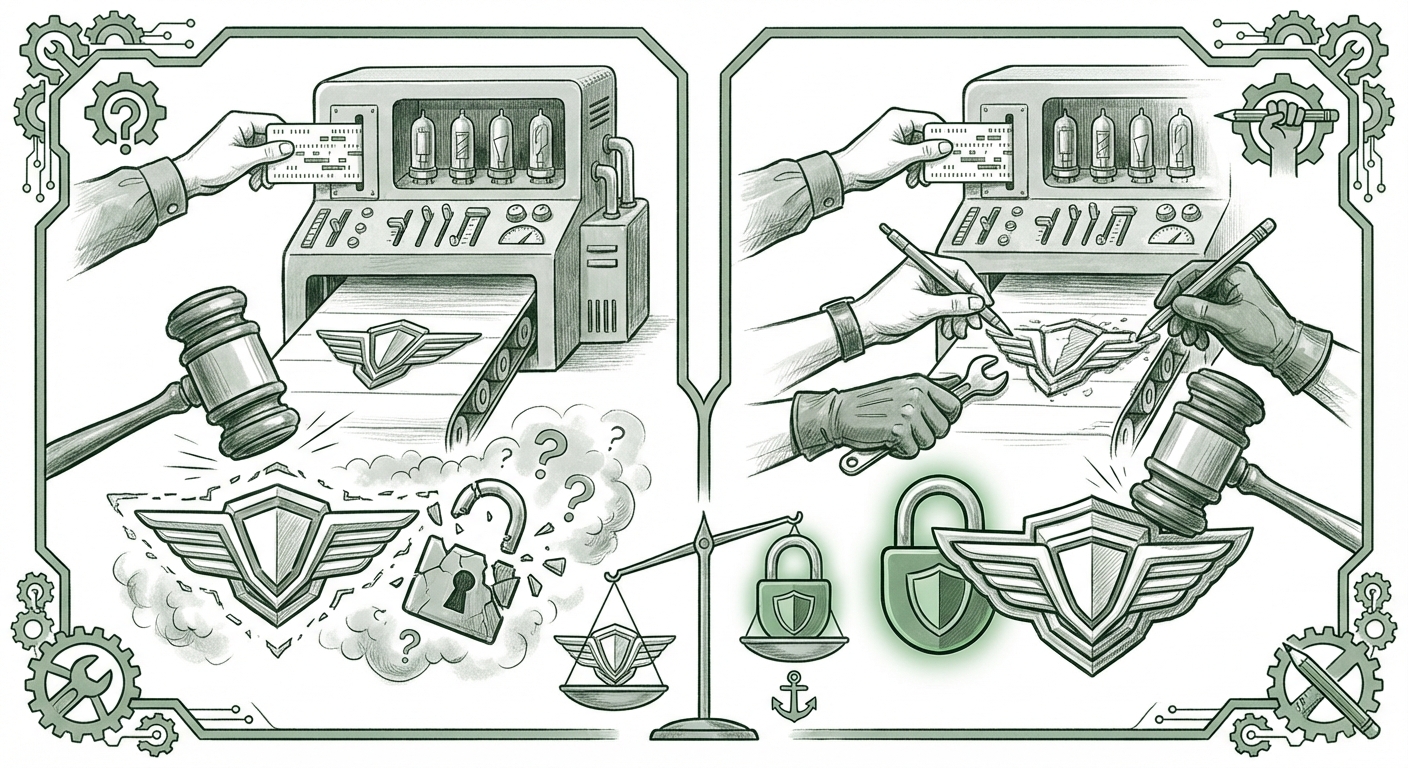
The digital frontier is littered with legal landmines, and nowhere is this more apparent than at the junction of Artificial Intelligence and Intellectual Property. A recent decision by a German district court serves as a stark warning shot across the bow of the Generative AI industry: **Copyright protection was denied for three elaborate, AI-generated logos.** The court’s reasoning was simple, yet profound: even the most detailed human instruction—the "elaborate prompt"—was insufficient when the final creative decisions were left entirely to the machine.
This ruling crystallizes the core tension of the AI era. For decades, copyright law has relied on a bedrock principle: creativity must stem from a human mind. If a computer program, no matter how advanced, executes the final stroke, who owns the result? The user who typed the command, the developer who built the model, or nobody at all?
The Core Conflict: Human Input vs. Machine Autonomy
The German court essentially decided that the user, despite their creative vision articulated in the prompt, did not contribute enough *creative expression* to the final product. Think of it like ordering a highly detailed meal from a chef: if the chef decides on the final seasoning, plating, and ingredient substitution without your final approval on every step, can you claim authorship over the finished dish? The court suggested the AI model acted as the autonomous chef.
Synthesizing the Global Trend: The Need for "Spark"
The German court’s decision is not an isolated incident; it is part of a growing global chorus demanding evidence of human intervention. To truly understand the trajectory of AI innovation, we must compare this European stance with others.
The American Parallel: Strict Adherence to Human Authorship
In the United States, the narrative is remarkably similar. The U.S. Copyright Office (USCO) has been firm. In cases reviewed (such as the legal challenges involving Stephen Thaler’s work created by the DABUS system), the USCO maintains that copyright protection requires a human author. If a user simply inputs text, and the AI generates complex visuals wholesale, the resulting image is considered uncopyrightable work lacking human authorship. This mirrors the German ruling, reinforcing that merely telling the AI what you want is not the same as *creating* it.
For further context on the global comparison, examining sources detailing the official guidance from the U.S. Copyright Office on AI-Generated Works is essential.
The Legislative Hammer: The EU AI Act
While court rulings address current disputes, the European Union is preparing the groundwork for the future through the landmark EU AI Act. This legislation is not just about safety; it will enforce transparency and traceability on generative models. If an AI creates commercial content, there will likely be strict requirements regarding disclosure—telling the world, explicitly, that it was AI-generated. This legislative push, combined with the German court's judgment, creates a high-compliance environment in Europe where ownership ambiguity could lead to assets being publicly owned, significantly devaluing them commercially.
The Nuance of Prompt Engineering
The debate hinges on the technical definition of "elaborate prompting." For the uninitiated, prompting seems like simple instruction. For AI specialists, it involves deep understanding of model parameters, style vectors, and iteration loops—a form of digital direction. However, the courts are asking: Is directing a model the same as wielding a paintbrush or designing the composition? Current consensus leans toward "no." If the prompt defines the style (e.g., "Impressionist painting of a blue dog") but the AI designs the brushstrokes, lighting, and specific texture, the human input may be deemed too abstract.
What This Means for the Future of AI Development and Deployment
This legal landscape forces a pivot point for how we think about creating, selling, and investing in AI-derived assets. The message is clear: Unassisted autonomy voids proprietary rights.
1. The Rise of the "Human-in-the-Loop" Requirement
The future of copyrightable AI creation lies in demonstrating substantial, traceable human intervention after the initial generation. Developers and businesses cannot simply rely on prompt input; they must show post-generation modification that rises to the level of original creation. This could mean significant manual editing, complex compositing, or using AI outputs as mere building blocks for a larger, human-designed structure.
For the creative industries, this means the workflow must shift: AI moves from being the *creator* to being the ultimate *power tool*. If you use Midjourney to generate 100 logo concepts, and then spend 20 hours manually refining one into a vector file, designing the final kerning, and integrating unique brand elements, that final product has a much stronger claim to authorship.
2. Investment Risk in Pure Generative IP
Venture capital and corporate legal departments must now view IP derived solely from complex prompts as high-risk assets. If a company bases its entire branding portfolio on fully autonomous AI outputs, they risk owning nothing that they can legally defend against infringement. This lack of defensibility dramatically lowers the asset's commercial value. Conversely, models or platforms that can clearly demonstrate a proprietary methodology for *ensuring* human input—perhaps through specialized editing interfaces integrated into the generation process—will gain a competitive edge.
3. Global Fragmentation and Regulatory Friction
As we see divergence between jurisdictions (e.g., potential differences between the strict interpretation in Germany/US versus more accommodating stances some regions might eventually take, like considerations in the UK for computer-generated works), global deployment becomes legally complex. A logo protected in one territory based on a specific degree of human input might be deemed public domain in another. This fragmentation demands multinational IP strategies that account for the lowest common denominator of human authorship requirements.
Understanding these international legal variances is crucial for global deployment. Research comparing the WIPO perspective on IP and AI alongside national laws is vital for risk assessment.
Practical Implications: Actionable Insights for Businesses and Creators
How should companies, developers, and creative professionals adjust their strategies in light of this intensified focus on the human element?
For AI Platform Developers: Engineering for Authorship
Stop marketing outputs as "ready-made." Instead, focus on developing tools that facilitate easy, legally defensible human modification. Build robust version control and logging systems that document every human edit applied post-generation. This creates an auditable chain of custody proving that the user actively shaped the final expression, moving beyond mere prompting.
For Brand Managers and Marketing Teams: The "Two-Step" Strategy
Do not treat AI output as final. Adopt a mandatory two-step process for any brand-critical asset:
- Generation (AI): Use AI for rapid ideation, mood boards, and concept iteration.
- Refinement (Human): Take the best AI output and pass it to a human designer for vectorization, color correction, refinement of proportions, and unique stylistic touches. The final protected work should be the *heavily edited* version.
For Legal and Policy Teams: Scrutinizing the Input/Output Ratio
Legal counsel must now scrutinize the technical distance between the prompt and the final asset. The question is no longer, "Did we use AI?" but, "What percentage of the final, commercially valuable expression originated directly from a human-authored modification?" Companies should prepare documentation demonstrating this ratio for any critical IP.
Academic analysis helps define these boundaries. Searching for discussions on prompt engineering vs. creative direction offers deeper insight into where courts might draw the line.
The Philosophical Core: Redefining Creativity
The German ruling serves as a catalyst forcing us to confront the philosophical underpinnings of creativity. If the AI is merely a stochastic parrot, repeating and remixing vast datasets, then the output lacks the spark of independent human consciousness that IP laws are designed to reward. To secure ownership, creators must inject that unique, unpredictable human element back into the process.
Conclusion: The Human Imperative in the Age of Autonomy
The era of "type and own" is rapidly closing, particularly in IP-sensitive jurisdictions like Germany and the US. The decision against copyright for AI-generated logos is more than a minor legal footnote; it is a fundamental signal that technology, regardless of its sophistication, cannot yet claim the status of an author.
For businesses leveraging generative AI, the future is not about stepping away from the technology, but about stepping *into* the workflow. Innovation will reward those who use AI as an unparalleled assistant, not as an autonomous replacement for human creative contribution. The challenge ahead is not just building better models, but defining, documenting, and legally defending the indispensable human spark that guides them.
TLDR: A German court ruled that AI-generated logos are not copyrightable because the creative expression came from the AI, not the user, despite elaborate prompting. This confirms a global trend, especially mirrored by the US Copyright Office, requiring significant human input post-generation to secure IP rights. Businesses must adopt a "human-in-the-loop" strategy, using AI for ideation but ensuring extensive human modification (like vectorization or unique edits) to claim ownership, mitigating risk in international deployment.