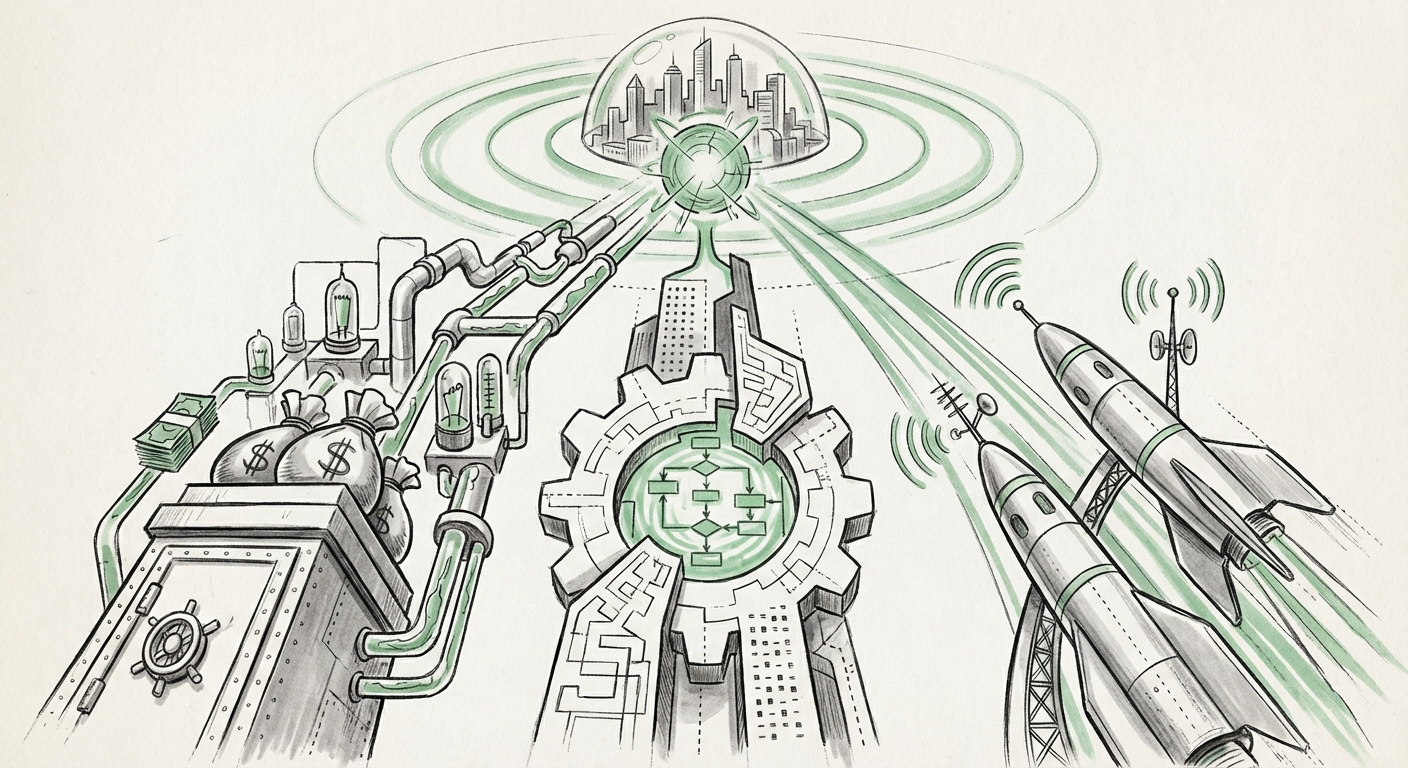
The Three Pillars of AI Supremacy: Capital, Code, and Competition Reshaping the Future
The Artificial Intelligence landscape is moving at a velocity that challenges even the most seasoned technology observers. Recent developments are not merely incremental updates; they represent foundational shifts in how AI will be funded, built, and deployed globally. By examining three distinct, yet interconnected, events—the massive capital injection into safety-focused research, the rapid technological ascent of models emerging from China, and foundational algorithmic breakthroughs from Google DeepMind—we can map the competitive terrain for the next decade of AI.
The Capital Race: Validation and Stratification in Frontier AI
The news of Anthropic securing a monumental funding round—often described in industry circles as reaching staggering valuations nearing $10 billion or more—is more than just a financial headline; it is a market declaration. This influx of capital, frequently backed by major tech giants like Amazon and Google, signals a clear prioritization: the race for frontier capability is now contingent upon limitless resources.
Safety as a Competitive Moat
What makes Anthropic’s position unique is its explicit focus on AI safety and constitutional AI principles. While competitors might emphasize speed to market, Anthropic’s immense backing suggests that institutional investors view demonstrable safety alignment not as a burden, but as a vital competitive moat. For venture capitalists and strategic partners, the high cost associated with training the safest, largest models (which require massive compute clusters) means only a handful of entities will survive this funding gauntlet.
What this means for the future: We are witnessing the creation of two distinct tiers in the AI ecosystem. Tier one consists of heavily capitalized, vertically integrated labs (OpenAI/Microsoft, Anthropic/Google/Amazon) capable of designing, training, and deploying models with trillions of parameters. Tier two comprises open-source and smaller players, who will increasingly rely on these frontier models via APIs or by iterating on slightly smaller, efficient architectures. The barrier to entry for building AGI has moved from being about genius to being about cash reserves and infrastructure access.
Actionable Insight for Business Strategists:
Businesses must decide quickly which ecosystem to align with. Relying solely on smaller, open-source models risks being left behind when the next generation of multimodal or reasoning-heavy frontier models drops. Businesses should prioritize partnerships or licensing agreements with the capital-rich leaders, viewing these relationships as crucial infrastructure investments, similar to securing cloud compute contracts a decade ago.
The Capability Race: China’s Rapid Ascent and Global Technology Leadership
The persistent release of sophisticated Large Language Models (LLMs) from China—from established players like Baidu and Alibaba to aggressive startups—is reshaping the geopolitical narrative around AI. The early assumption that Western labs held an insurmountable lead is rapidly being challenged by empirical benchmarks.
Closing the Benchmarking Gap
Recent technical evaluations (corroborated by analyses comparing models like Qwen or ERNIE against GPT-4) suggest that while a definitive global leader remains elusive, Chinese models are achieving parity or even superiority in specific domains critical to their national priorities, such as processing complex character sets, certain reasoning tasks, or specialized enterprise integration.
This parity is often achieved through rigorous engineering and massive domestic data utilization. For instance, if a Chinese model demonstrates superior performance on mathematical reasoning benchmarks (a frequent area of focus in recent DeepMind-style research), it implies that the translation of foundational research into practical application is happening at an astonishing pace across the Pacific.
What this means for the future: The technological decoupling feared by some policymakers is moving from theory to reality. We are entering an era of dual AI ecosystems. Developers, particularly those operating internationally, will need to manage two distinct sets of model strengths, compliance requirements, and architectural preferences. This bifurcation complicates standardization efforts but accelerates innovation through competitive pressure.
Implication for Society and Policy:
The proliferation of highly capable, culturally localized models means that the ethical and safety debates surrounding AI are no longer monolithic. What constitutes responsible deployment in Beijing may differ significantly from Silicon Valley. Policymakers must prepare for rapid adoption of sophisticated AI tools across global economies, requiring nuanced regulatory frameworks rather than broad global bans.
The Foundational Race: DeepMind’s Pursuit of True Reasoning
While funding shapes the market and competition drives deployment speed, the breakthroughs emerging from pure research labs like Google DeepMind define the ultimate ceiling of AI capability. The focus on "mathematical breakthroughs" suggests a deliberate pivot toward overcoming current LLM limitations.
Beyond Pattern Matching: The Quest for Symbolic Reasoning
Modern LLMs are phenomenal at interpolation—predicting the next most likely token based on vast patterns seen during training. However, they often struggle with true, multi-step deductive reasoning, planning, and novel problem-solving that requires manipulating abstract symbols (like pure mathematics or complex code structure). DeepMind’s historical successes (e.g., AlphaFold demonstrating scientific discovery) suggest their recent focus is aimed at embedding stronger, more reliable logical structures within neural networks.
If a DeepMind team cracks a significant problem in neural reasoning or efficient planning (perhaps by integrating symbolic AI approaches with deep learning), the resulting models will be fundamentally different. They won't just write better essays; they will design better infrastructure, discover new materials, and solve currently intractable optimization problems with verifiable accuracy.
What this means for the future: This research points toward the true definition of Artificial General Intelligence (AGI). The immediate practical impact will be felt in scientific R&D, engineering design, and enterprise-level automation where precision and logical consistency are non-negotiable. When models can reliably prove a mathematical theorem, the cost of prediction errors across industries plummets.
Corroborating Research Focus:
We should look closely at Google DeepMind’s published work (often indexed on platforms like arXiv) detailing novel algorithm designs that might allow models to dynamically allocate compute resources for complex reasoning steps, rather than treating every query identically. This efficiency gain, coupled with enhanced logic, is the secret sauce for the next major leap.
A strong parallel can be drawn to the importance of foundational work in areas like reinforcement learning and search optimization, which continue to pay dividends far beyond the initial product launch.
Synthesizing the Future: A Three-Dimensional AI Landscape
These three trends—Capital, Competition, and Core Research—are converging to create a volatile but incredibly productive technological environment. The future of AI will not be monolithic; it will be defined by the tension and interaction between these forces.
1. Accelerated Polarization
The massive funding rounds solidify the lead for a few well-resourced labs. This polarization means access to the absolute best compute and the most advanced foundational research will be concentrated, potentially leading to slower adoption of groundbreaking safety or efficiency mechanisms in smaller, less-funded spheres initially. Businesses relying on AI infrastructure must factor in vendor lock-in risk associated with these giants.
2. The Globalization of Excellence
The rise of highly capable Chinese LLMs ensures that the definition of "state-of-the-art" is now a global contest, not solely a Western one. This forces every major lab to innovate harder, pushing the pace of iteration faster than ever before. From a user perspective, this guarantees a rapid influx of better, cheaper, and more specialized tools across various languages and regulatory environments.
3. The Shift from Scale to Substance
While large models (scale) currently dominate the headlines, the breakthroughs from DeepMind indicate that the *next* frontier is substance—how effectively the model reasons, plans, and applies abstract concepts. The focus is subtly moving from "How big is your model?" to "How smart is your model's architecture?"
Actionable Insights: Navigating the Next Wave
For executives, researchers, and developers looking to thrive in this rapidly evolving environment, strategic clarity is paramount:
- Dual-Tracked Model Strategy: Do not bet the entire enterprise on a single vendor or architectural philosophy. Maintain proficiency with frontier API-driven models (for complex tasks) while actively experimenting with optimized, potentially open-source alternatives that can be fine-tuned locally for cost and data governance compliance.
- Invest in Verification, Not Just Generation: As models become more capable (thanks to DeepMind’s foundational work), their errors will become more subtle but potentially more impactful (e.g., subtle mathematical flaws in a financial model). Invest heavily in AI verification, validation, and audit tools tailored to detect reasoning errors, not just content inaccuracies.
- Monitor Geopolitical Red Lines: The increasing capability of Chinese models suggests that technology export controls and local data mandates will become more stringent. Companies operating globally must build compliance and data residency directly into their AI deployment architecture, recognizing that AI tooling is now a key component of international competition.
- Prepare for Scientific Acceleration: The combination of massive capital and foundational research means AI will solve problems in physics, medicine, and materials science much faster. Organizations in R&D-heavy sectors must begin integrating AI scientists who understand these new algorithmic paradigms today, or risk being out-innovated tomorrow.
The AI ecosystem is not just growing; it is specializing, polarizing, and deepening its theoretical underpinnings simultaneously. The weeks that brought us multi-billion dollar funding, world-class international competition, and algorithmic breakthroughs serve as a clear warning: the time for passive observation is over. The era of AI supremacy demands active, informed participation across the entire technological spectrum.