The Multi-Agent Revolution: Why OpenAI Hiring for Personal Agents Signals the Next AI Leap
The Artificial Intelligence landscape is defined by seismic shifts. For the past two years, the focus has overwhelmingly been on improving the foundational large language models (LLMs)—making them bigger, faster, and more conversational. We mastered the single, brilliant chatbot. Now, the industry is pivoting to the next, far more complex challenge: **agency**.
The recent news that Peter Steinberger, the developer behind the OpenClaw project, is joining OpenAI to build accessible personal AI agents is not just a personnel announcement; it is a loud declaration of intent. When combined with CEO Sam Altman’s repeated assertions that the future is "extremely multi-agent," it becomes clear that the era of AI as a clever tool is rapidly giving way to the era of AI as an autonomous **worker**.
To understand the gravity of this transition, we must analyze what it means to move from conversational AI to *agentic* AI, why this specific hiring validates a broader industry trend, and what obstacles remain before these agents become truly ubiquitous.
From Chatbot to Collaborator: Defining the Agentic Shift
If GPT-4 is a brilliant intern who answers questions perfectly when prompted, an AI agent is the project manager who can execute a multi-step plan without constant supervision. The key differentiator is **autonomy and planning**.
An LLM takes an input and generates an output. An AI agent takes a high-level goal (e.g., "Plan a two-week trip to Japan, budget under $5,000, prioritizing historical sites") and breaks it down into actionable sub-tasks:
- Search for flight options.
- Compare hotel costs in three cities.
- Check visa requirements.
- Compile a draft itinerary and send it for review.
The agent uses tools (web search, APIs, code execution) and iterates on its own failures until the goal is met. This transition requires far more complex reasoning and reliability than standard prompting, which is why Steinberger's background in building frameworks for agents (like OpenClaw) is so valuable.
The Multi-Agent Ecosystem: Why More Than One AI is Needed
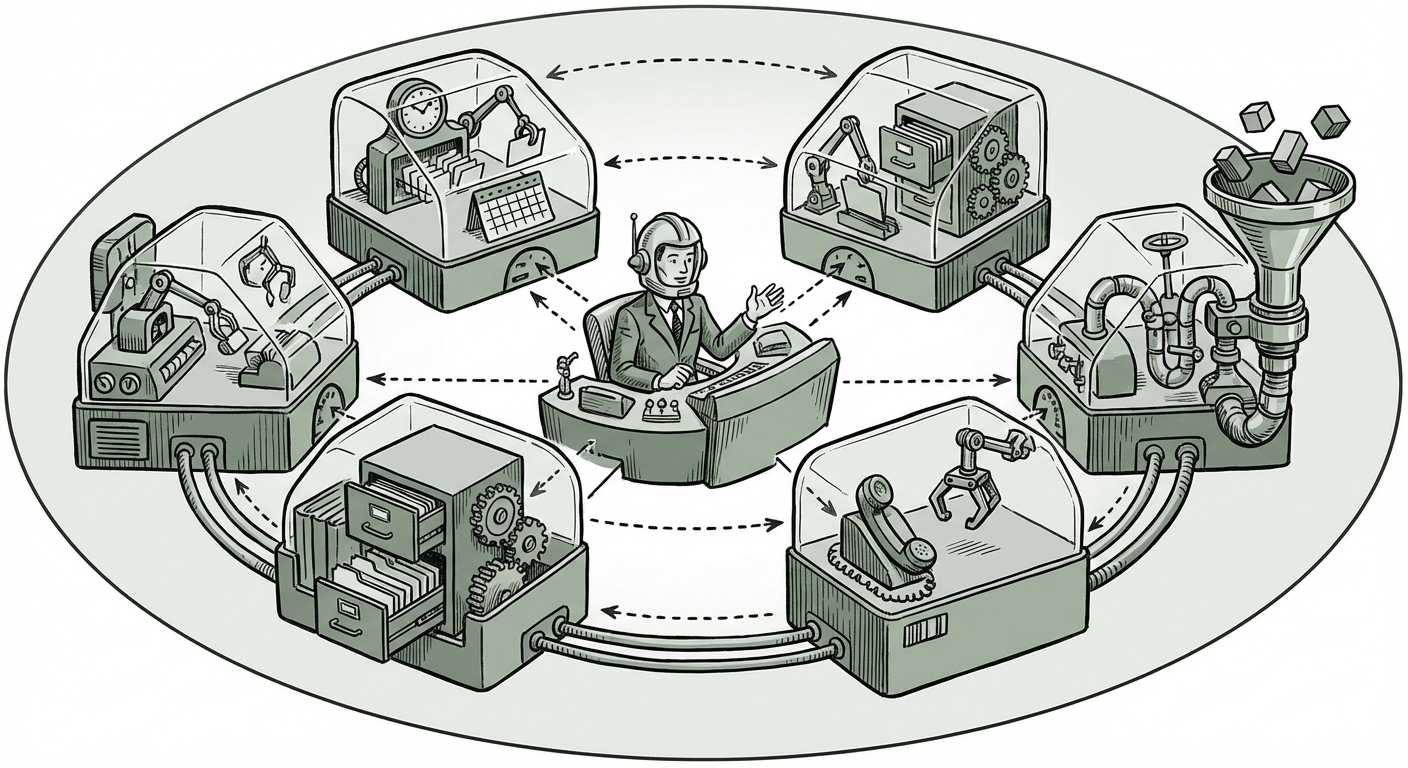
Altman’s vision of an "extremely multi-agent" future speaks directly to the complexity of real-world problems. No single AI, no matter how large, is specialized enough to handle every aspect of a complex task reliably.
Think of a complex financial audit. One agent might specialize in legal compliance, another in market analysis using live data feeds, and a third in generating clear narrative reports. This mirrors human organizations:
- Specialization: Different agents handle different skill sets, leading to higher fidelity outputs.
- Delegation: Agents can delegate sub-tasks to other specialized agents, mirroring efficient teamwork.
- Robustness: If one agent fails or returns a poor result, others can step in, check its work, or provide feedback.
This pursuit of a multi-agent environment is strongly supported by industry research. (Search Query 1: "OpenAI multi-agent future roadmap") confirms that top labs see this cooperative structure as essential for moving AI from "demo magic" to genuine utility.
The OpenClaw Context: From Open Source to Central Strategy
Peter Steinberger’s creation, OpenClaw, focused on creating a user-friendly interface layer for agentic workflows. The significance of his move to OpenAI is twofold:
- Validation of Agent Frameworks: It signals that OpenAI recognizes the need for robust, dedicated infrastructure to manage agent tasks, moving beyond simply stitching together API calls within a single chat window.
- The Accessibility Mandate: His stated goal—building agents "even his mother can use"—is the ultimate litmus test for this technology. If AI agents remain confined to programmers and power users, they will fail to achieve widespread impact.
The Crux of the Challenge: Usability and Trust
The industry is adept at building intelligence; it struggles with **trust**. This is where Steinberger's focus on user experience (UX) becomes paramount. (Search Query 2: "Challenges in creating usable AI agents for general public") highlights the constant friction:
- Hallucination in Planning: Agents can confidently execute a series of false steps if their initial assumptions are wrong.
- Tool Misuse: An agent might use the wrong tool for the job or fail to verify external data sources.
- Lack of Transparency: If an agent spends two hours completing a task, the user needs a clear, concise log of *why* it made each decision, especially when errors occur.
For the average person, AI must be predictable. If my personal agent accidentally double-booked my doctor’s appointment across three different time zones, I won't use it again. Making complex, multi-step autonomous systems reliable enough for everyday life—that’s the real frontier. This requires sophisticated alignment, error correction loops, and exceptionally clear user feedback mechanisms.
The Broader Competitive Landscape
OpenAI is not operating in a vacuum. The race to create reliable AI agents is heating up across the board, proving that this development is a universal marker of the next technological plateau. (Search Query 3: "Rise of autonomous AI agents and task completion") reveals ongoing work from competitors:
Open-source projects initially experimented with basic agent loops, often collapsing under complex tasks. Major labs like Google DeepMind are heavily invested in agent architectures that facilitate better memory and reasoning across long timelines. The competitive pressure forces every major player to prioritize not just the brain (the LLM) but the body and nervous system (the agentic framework).
The hire confirms that the strategic battlefield has shifted from model parameter counts to **agentic capability**. Whoever builds the most reliable, controllable, and user-friendly agent wins the next layer of computing abstraction.
Practical Implications: What Businesses Must Prepare For
For businesses, the shift toward reliable, personal AI companions is not a distant future event; it is the immediate subject of R&D budgets. (Search Query 4: "The role of personal AI companions in the next five years") suggests these tools will fundamentally reshape white-collar productivity.
1. Transformation of the Knowledge Worker Role
Personal agents, once perfected, will absorb repetitive, cross-application tasks. Drafting preliminary legal summaries, synthesizing competitor research across dozens of documents, debugging initial code blocks, or managing complex vendor communications—these functions will be offloaded entirely. This doesn't mean job elimination, but rather job *elevation*. Employees will be freed to focus solely on high-level creativity, negotiation, and strategic oversight.
2. The Need for Internal Agent Governance
Businesses will need to develop policies around internal agent interaction. If one employee’s financial agent is tasked with negotiating a small contract with another employee's purchasing agent, how are the boundaries managed? Companies must establish governance models for agent security, data access, and inter-agent communication protocols.
3. The Interface Collapse
Why use 15 different SaaS tools when one powerful, personalized agent can orchestrate them all? Agents act as the ultimate connective tissue. This could lead to a "monopoly of coordination," where the best agent framework becomes the primary interface through which employees interact with all other enterprise software.
Actionable Insights: Preparing for the Agentic World
For professionals and organizations looking to stay ahead of this curve, the focus must shift from *using* LLMs to *building systems* around them.
For Technologists and Developers: Master Tool Use and Monitoring
Your value will increasingly lie in your ability to write robust code that agents can call reliably, and, crucially, in developing monitoring tools that track agent performance. Learn frameworks that allow for easy integration of external APIs and focus on observability—how easily can you debug an agent's complex decision tree?
For Business Leaders: Define Scope and Trust Boundaries
Identify the three most time-consuming, multi-step processes in your organization right now. These are your first targets for agentic automation. Do not deploy these agents unsupervised immediately. Start with agents that operate in "read-only" or "suggest-only" mode, requiring human sign-off at critical decision points. Build trust iteratively.
For Consumers: Demand Usability
The move by Steinberger reminds us that accessibility matters. When evaluating new AI tools, ask not just "How smart is it?" but "How much cognitive load does it reduce for me?" The best personal agent will be the one you forget is running because it works so seamlessly in the background.
Conclusion: The Dawn of Practical Autonomy
The convergence of visionary leadership (Altman’s multi-agent framework) and specialized engineering talent (Steinberger’s agent infrastructure expertise) at OpenAI serves as a powerful signal. We are moving past the novelty of impressive text generation and entering the phase of practical, autonomous application.
The shift to multi-agent systems promises an AI capable of tackling tasks that currently require entire teams, but it demands a new level of engineering rigor focused on reliability, transparency, and, above all, simple usability. The next great AI product won't just answer your question; it will handle your entire problem, quietly and effectively, just as a trusted personal assistant should.