The AI Evolution of Meetings: Zoom Upgrades and the Future of Workflow Automation
The seemingly mundane news of a software update—like Zoom rolling out yet another enhancement to its AI toolkit—is, in fact, one of the clearest signals of the current technological era. We are past the initial novelty phase of Generative AI. AI is no longer a futuristic concept reserved for specialized labs; it is rapidly becoming the mandatory operating system layer for every piece of mainstream business software we use, from word processors to, critically, video conferencing tools.
When a massively popular service like Zoom, the default setting for remote work for millions globally, consistently upgrades its intelligence, it confirms a fundamental shift: AI features are now table stakes. If a collaboration tool doesn't offer smart summaries, real-time translation, or automated note-taking, it is already falling behind. This continuous integration isn't just about making meetings better; it's about transforming meetings from content capture events into automated workflow triggers.
To truly understand the significance of Zoom’s latest moves, we must analyze this evolution through four critical lenses: the fierce competitive environment, the complex technological architecture powering these features, the non-negotiable demands of data security, and the ultimate destination: true workplace automation.
1. The AI Arms Race: Why Upgrades are a Competitive Necessity
In the software world, stagnation is death. For video conferencing, the product is only as valuable as its ecosystem integration and feature set. Zoom’s constant refinement of its AI capabilities, often referred to as "AI Companion," is less about delighting users and more about survival in the shadow of tech giants.
The primary challenger here is not just another video platform, but the entire integrated productivity stack spearheaded by Microsoft. When Microsoft embeds Copilot deeply into Teams, Outlook, and the entire 365 suite, it creates a highly attractive, cohesive environment for enterprise clients already paying for that ecosystem. The competition isn't about the clearest video anymore; it's about whose AI can save an employee the most time before, during, and after the call.
This competitive pressure validates the trend that AI is now core infrastructure. For IT decision-makers, choosing a platform means evaluating the depth and trustworthiness of its AI tools. As the linked analysis on the deployment of Microsoft Copilot highlights, when competitors integrate large language models (LLMs) directly into the fabric of their enterprise offerings, Zoom must respond in kind, often demanding even faster iteration to maintain parity or carve out a niche advantage. The general availability of tools like Copilot sets a high benchmark for automated assistance that Zoom must meet.
Implication for Business: Feature Parity or Obsolescence
For businesses, this means the evaluation criteria for communication tools have fundamentally changed. AI capability is now weighed alongside uptime and security. If your conferencing tool can't automatically generate minutes or identify next steps, you are paying for an older generation of software, even if the interface looks modern.
2. The Engine Under the Hood: Technology and Deployment Choices
Behind every snappy AI summary lies a complex decision about infrastructure. When Zoom upgrades its AI, we are forced to ask: what models are they using, and where are they running them? This moves the conversation from marketing buzzwords to engineering reality.
There is a critical tension here between leveraging state-of-the-art, massive public models (like the most recent versions from OpenAI or Anthropic) for cutting-edge performance, versus deploying smaller, proprietary models closer to the user (Edge AI) for speed and privacy.
If Zoom relies entirely on the public cloud for every transcription and summary, latency can creep in, making real-time interaction clunky. However, if they deploy models locally—on the user's computer or device—they reduce reliance on constant internet connection and significantly improve privacy. For deep-tech audiences, understanding this architectural choice is vital. Are they running specialized models for noise cancellation or translation? Or are they feeding anonymized metadata back to partners to fine-tune models hosted elsewhere?
The continuous need to upgrade suggests a technology stack that is still actively maturing, often requiring strategic partnerships to stay ahead. This infrastructure discussion moves beyond simple software deployment; it concerns the selection of foundation models and the optimization pipeline required to deliver AI assistance in milliseconds rather than seconds.
Implication for AI Engineers: Latency and Model Selection
For the engineers building these systems, the focus shifts heavily toward inference optimization. Delivering real-time AI features in a crowded video feed requires incredibly efficient model deployment. This pushes innovation in areas like model quantization and specialized hardware utilization.
3. The Trust Layer: Data Security and Compliance Quagmires
The incredible utility of meeting AI comes tethered to an equally significant liability: data governance. Meetings capture strategy sessions, financial forecasts, privileged legal discussions, and proprietary engineering roadmaps. When an AI digests this content, where does it go, and who has access?
This is the area that causes the most friction for CISOs and legal teams. Early iterations of AI features in communication tools were met with skepticism because the data usage policies were often opaque or overly broad. If a meeting summary is generated by an external LLM provider, the enterprise must ensure that the conversation data isn't used for training that provider's public model, or that it doesn't violate industry-specific mandates like HIPAA or GDPR.
Zoom, recognizing this fundamental barrier to adoption in regulated industries, has been compelled to issue detailed assurances regarding data handling. As noted in discussions around their AI Companion deployment, transparency about whether customer data is used for training external models is paramount. Zoom’s commitment here—stating that customer content is not used to train their general models unless explicitly opted-in—is a direct response to organizational fears.
Implication for Governance: Auditing the Black Box
Businesses must now implement rigorous auditing procedures for any AI tool that ingests proprietary data. The focus shifts from simply signing a security agreement to understanding data flow maps. If an AI feature fails, the legal and compliance fallout can be severe, making the underlying data policy just as important as the feature itself.
4. The Destination: From Note-Taker to Workflow Executor
The final and most exciting implication is the trajectory of these features. Today's AI meeting assistant is tomorrow's automated project manager.
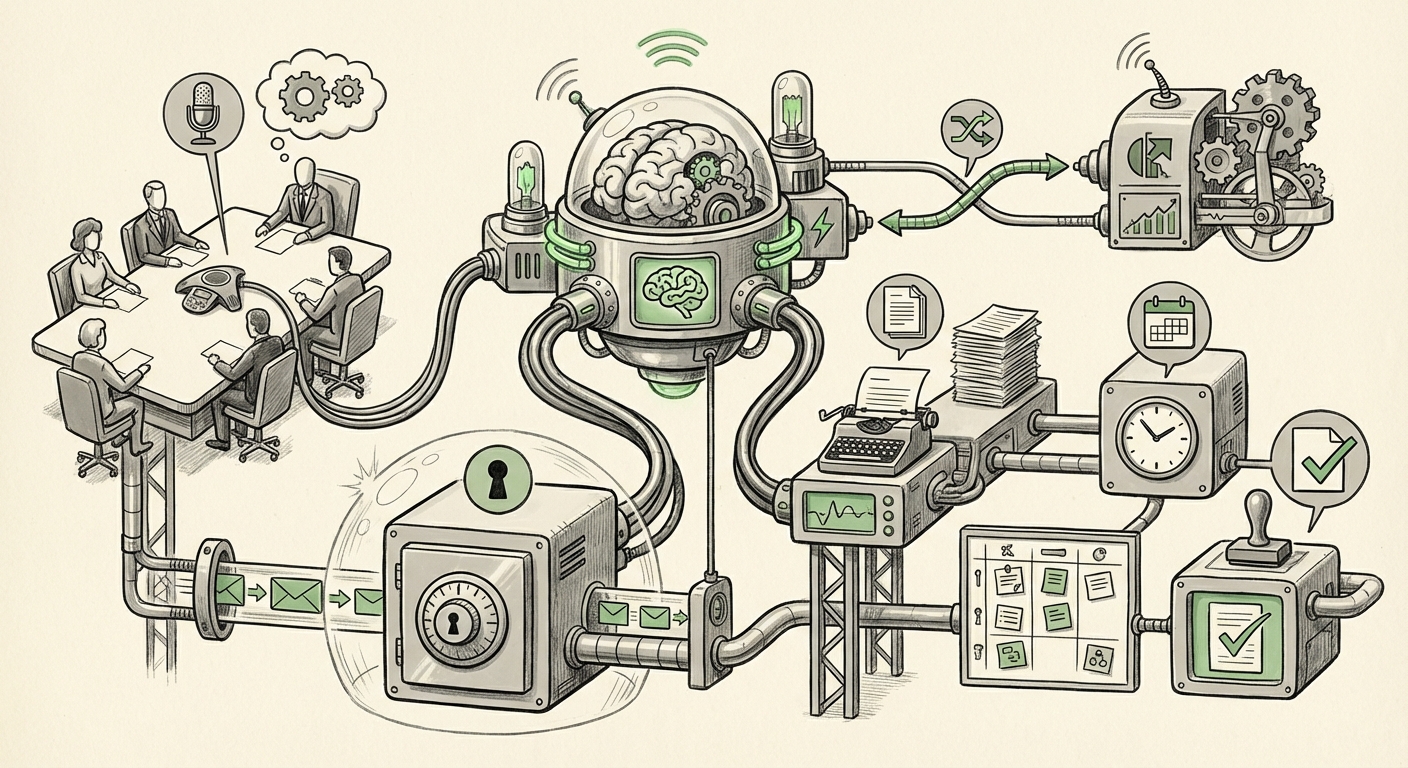
Current features—summarization, action item extraction, identifying key speakers—are merely the building blocks. The true value of AI in collaboration software is realized when these outputs are seamlessly injected into other business systems. This is the shift from passive content consumption to active workflow execution.
Imagine this scenario:
- Current State: AI generates a summary listing "Follow up with Marketing on Q3 budget."
- Future State: AI identifies the action item, recognizes the relevant individuals, checks their calendars, drafts a follow-up email summarizing the next steps, proposes three meeting times for the following week, and automatically creates a ticket in the company’s project management software (like Jira or Asana), assigning the follow-up task to the responsible person.
This future is being paved by current upgrades. The ability of platforms to understand context, names, and necessary future actions is the prerequisite for true enterprise automation. As Forbes suggests regarding the broader enterprise software shift, Generative AI is fundamentally reshaping how applications function, moving them from being tools we operate to being proactive partners that execute tasks autonomously. This progression means the value of a meeting platform will soon be defined by its API connectivity and automation potential, not just its video quality.
Actionable Insight: Map Your Automation Pathways
Businesses should not view these upgrades as mere productivity boosts for individuals. Instead, leadership must proactively identify which post-meeting bottlenecks—such as follow-up scheduling, CRM entry, or document circulation—can be targeted first by these expanding AI capabilities. The integration pathway is the next competitive battleground.
Synthesizing the Future: The Commoditization of Intelligence
The continuous stream of AI enhancements from companies like Zoom tells us that intelligence is quickly becoming a standardized utility, much like cloud storage or high-speed bandwidth. Once a core feature, AI assistance will soon be expected, much like the mute button. This drives two major conclusions for the future of technology adoption:
- The Battleground Shifts to Vertical Expertise: Since basic AI features will be ubiquitous, the next differentiator will be specialization. Which platform can offer AI that understands complex legal jargon, intricate financial modeling, or deep domain-specific knowledge specific to an industry? Zoom’s general utility must evolve into specialized intelligence to maintain premium pricing.
- The Blurring of Software Lines: The silo separating "meeting software," "project management," and "CRM" will dissolve. AI connecting the dots across these applications means the user experience becomes unified, even if the backend remains modular.
For the average user, this means less time spent on administrative drudgery and more time focusing on creative, high-value work. For the technology industry, it means the imperative is clear: embed, secure, and connect. The future of work isn't just about being in a meeting; it's about leveraging the intelligence captured in that meeting to make the next day’s work happen automatically.