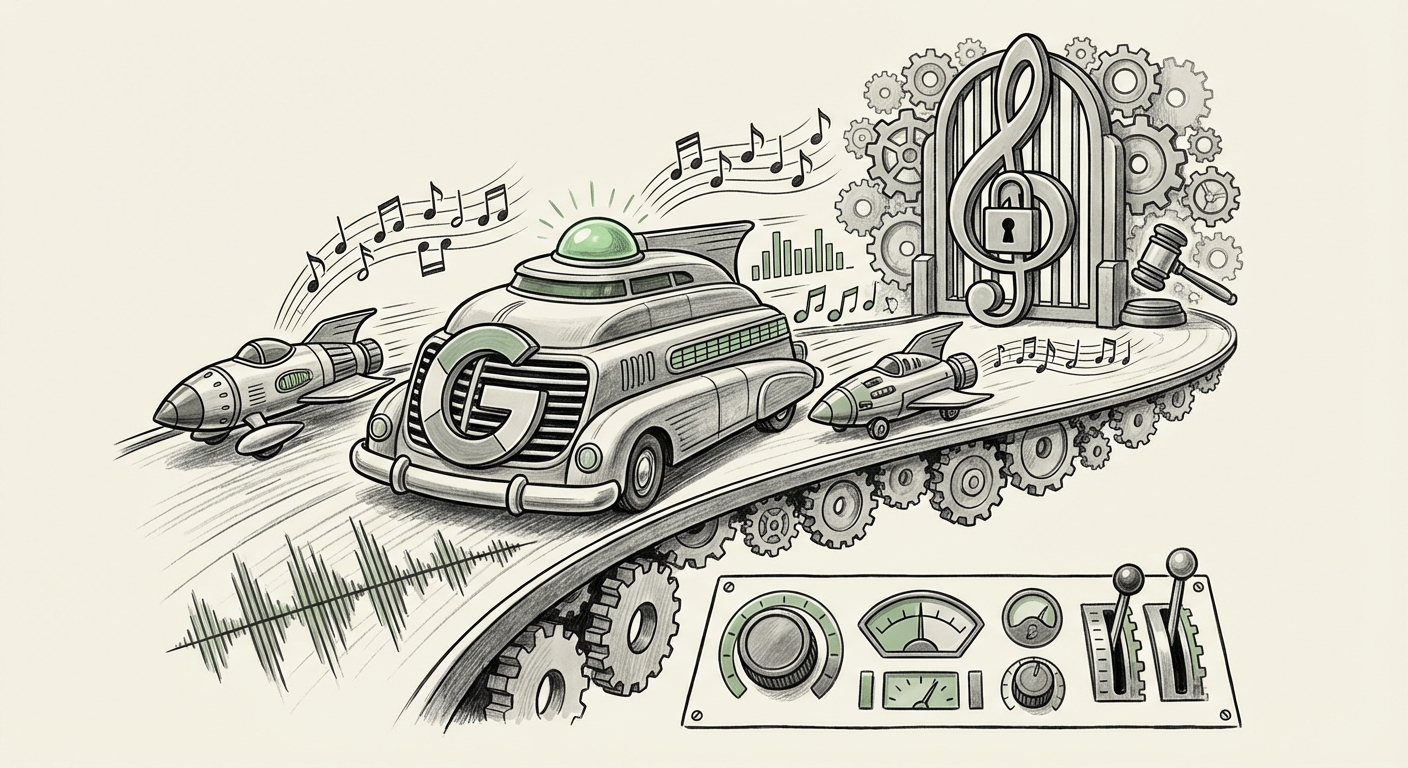
Google Lyria 3, Suno, Udio: The AI Music Arms Race Redefines Creativity and Copyright
The digital landscape is witnessing an accelerating battle for generative supremacy, and the latest front line is music. Google’s decision to embed DeepMind’s advanced Lyria 3 model directly into its Gemini ecosystem is not merely a product update; it is a declaration of intent. By enabling users to conjure 30-second, complete tracks—including custom vocals, lyrics, and cover art—from simple text prompts, Google has dramatically raised the stakes for every competitor, from nimble startups like Suno and Udio to its massive rival, OpenAI.
As AI technology analysts, we must move beyond the novelty of "AI making music." The critical questions now center on technological parity, strategic platform integration, and the inevitable legal reckoning that follows the creation of complex, human-like synthetic media. This development signals a fundamental shift in how content is sourced, produced, and monetized in the digital age.
The New Battlefield: Multimodal Mastery and Vocal Realism
For years, generative audio struggled with cohesion. Earlier models produced interesting loops or instrumentals, but integrating convincing, emotionally resonant vocals remained the ultimate technical hurdle. The introduction of Lyria 3, which generates tracks with vocals and lyrics, places Google squarely in the ring with the current leaders who have popularized this capability.
Contextualizing the Competition
To understand Lyria 3’s significance, we must look at the current market leaders. Companies like **Suno** and **Udio** have rapidly gained traction by delivering surprisingly high-quality, song-structured outputs. The core debate driving the developer community right now revolves around performance metrics:
- Vocal Fidelity: Can Lyria 3 replicate the nuances of human singing—breathing, vibrato, emotional texture—as well as its rivals? A deep dive into the technical underpinnings (as prompted by looking for "DeepMind Lyria 3 technical paper details") is necessary to see if they’ve solved vocal synthesis differently than existing diffusion models.
- Coherence and Structure: Can the 30-second prompts generate a coherent verse/chorus structure, or are they merely sophisticated snippets? The market demands models that can handle longer-form composition.
For the **Tech Enthusiast and Developer**, this comparison is crucial. If Lyria 3 offers a superior technical foundation—perhaps due to DeepMind’s extensive research heritage—it suggests a potential future where Google's models set the quality benchmark, forcing Suno and Udio to rapidly iterate or face obsolescence. This is the classic Silicon Valley race: innovation through direct competition.
Platform Strategy: Gemini as the Creative Operating System
The most strategically potent move isn't the model itself, but where Google placed it: inside Gemini. This aligns perfectly with the trend of consolidating generative capabilities into large, central multimodal agents.
The Stickiness Factor
Why integrate music generation into a general chatbot/assistant framework? The answer lies in user engagement and ecosystem control. If a user is brainstorming a social media campaign in Gemini, they can instantly ask it to generate an accompanying jingle or background track. This removes the friction of switching applications.
As analyses focusing on "Google's strategy integrating generative media into Gemini ecosystem" suggest, this solidifies Gemini’s role as a comprehensive creative co-pilot, rather than just a search aggregator. For **Investors and Product Managers**, this integration strategy is key: controlling the gateway to multimodal creation translates directly into sustained user attention and superior data feedback loops for refining future models.
While competitors might offer specialized, deeper editing tools, Google is betting on ubiquity. The ability to create a 30-second piece of music quickly, directly within the text interface, democratizes creation for the average user far more effectively.
The Inevitable Collision: Ethics, Copyright, and Industry Reaction
As soon as AI can convincingly replicate human creative output, the legal and ethical frameworks built over the last century immediately buckle. The generation of tracks featuring custom vocals and lyrics brings the issue of artist identity and likeness to the forefront.
Navigating the Legal Minefield
The music industry is rightfully wary. Unlike simple image generation, where concerns focus on style mimicry, music generation with vocals touches upon personality rights, performance rights, and intellectual property embodied in the voice itself. The ability to prompt for a specific *style* or even a *vocal timbre* that sounds like a known artist creates potential legal landmines.
This necessitates deep analysis into the "Music industry response to Google Gemini AI music generation." Major labels and collecting societies are keenly watching models that generate full songs. Are the training datasets for Lyria 3 ethically sourced and licensed? If the output is deemed derivative, who holds the liability—the user, the platform (Gemini), or the model provider (DeepMind)?
For **Legal Analysts and Industry Stakeholders**, Lyria 3 acts as a stress test for current copyright law. We expect immediate pushback and calls for new licensing structures or perhaps even federal regulation defining the boundaries of synthetic performance rights. The industry needs clear answers on compensation and attribution.
Future Implications: Redefining Creation and Consumption
The arrival of Lyria 3 is not an endpoint; it is a major milestone in the democratization of high-quality media production. The implications span far beyond pop music.
For Content Creators and Small Businesses
The barrier to entry for high-quality, royalty-free audio production is effectively dissolving. Consider independent podcasters, YouTubers, and small marketing agencies. They can now generate custom background music and sonic branding cheaply and instantly. This capability, accessible through Gemini, means:
- Hyper-Personalization: E-commerce sites can generate unique, mood-specific ambient music for every visitor session.
- Rapid Prototyping: Film editors or game developers can generate hundreds of thematic cues in an hour instead of commissioning an entire score.
- Accessibility: A small business owner with no musical background can create a professional-sounding radio ad jingle by simply describing it.
This rapid prototyping ability lowers operational costs significantly, but it simultaneously devalues entry-level composition work. As AI handles the functional, template-driven audio tasks, human composers will be forced to focus even more intensely on truly avant-garde, deeply personal, or live performance-based artistic endeavors.
The Evolution of the AI Model Itself
Technologically, the trend confirms the path toward unified generative models. We saw this with GPT mastering text, DALL-E/Midjourney mastering static images, and Sora targeting video. Lyria 3 places audio firmly in that multimodal hierarchy. Future models will likely integrate music generation seamlessly with video and 3D environment generation.
We anticipate the next leap will be in interactivity. Imagine an AI assistant that not only creates a song but dynamically remixes it based on your heart rate, the current weather, or your real-time textual conversation flow—a concept requiring complex, low-latency integration that Lyria 3’s placement in Gemini seems designed to test.
Actionable Insights for Navigating the New Soundscape
For organizations and creators looking to stay ahead of this rapid evolution, several actions are necessary:
1. Audit Training Data and Licensing Readiness
If your business relies on licensed music or your organization develops generative models, you must immediately review your compliance posture. If you are a creator, understand the difference between style influence and direct mimicry in the eyes of the law.
2. Embrace Prompt Engineering for Audio
The skill of communicating precise, nuanced instructions to an AI will become as valuable as traditional technical skills in some creative domains. Learning the specific prompt syntax that unlocks the best vocal realism and instrumental layering in models like Lyria 3 will create a temporary competitive advantage.
3. Invest in Multimodal Integration
Businesses should look at their current content pipelines and ask: Where can a high-quality, instantly generated 30-second audio clip dramatically improve user experience or reduce content costs? Whether it’s for internal training modules or public-facing advertisements, adoption within existing, trusted platforms like Gemini minimizes risk.
Conclusion: The Score is Set
Google’s Lyria 3 launch within Gemini marks a pivotal moment. It confirms that generative music has matured past the experimental phase and is ready for mass integration. The era of bespoke audio production for every small need is waning, replaced by an on-demand soundscape curated by powerful foundation models.
The challenge is no longer can AI make music, but how society will govern the distribution of that power, how human artistry will be recognized and rewarded, and how quickly our digital interfaces can absorb this new, complex layer of synthetic reality. The music has just begun, and the terms of engagement are being written in real-time.