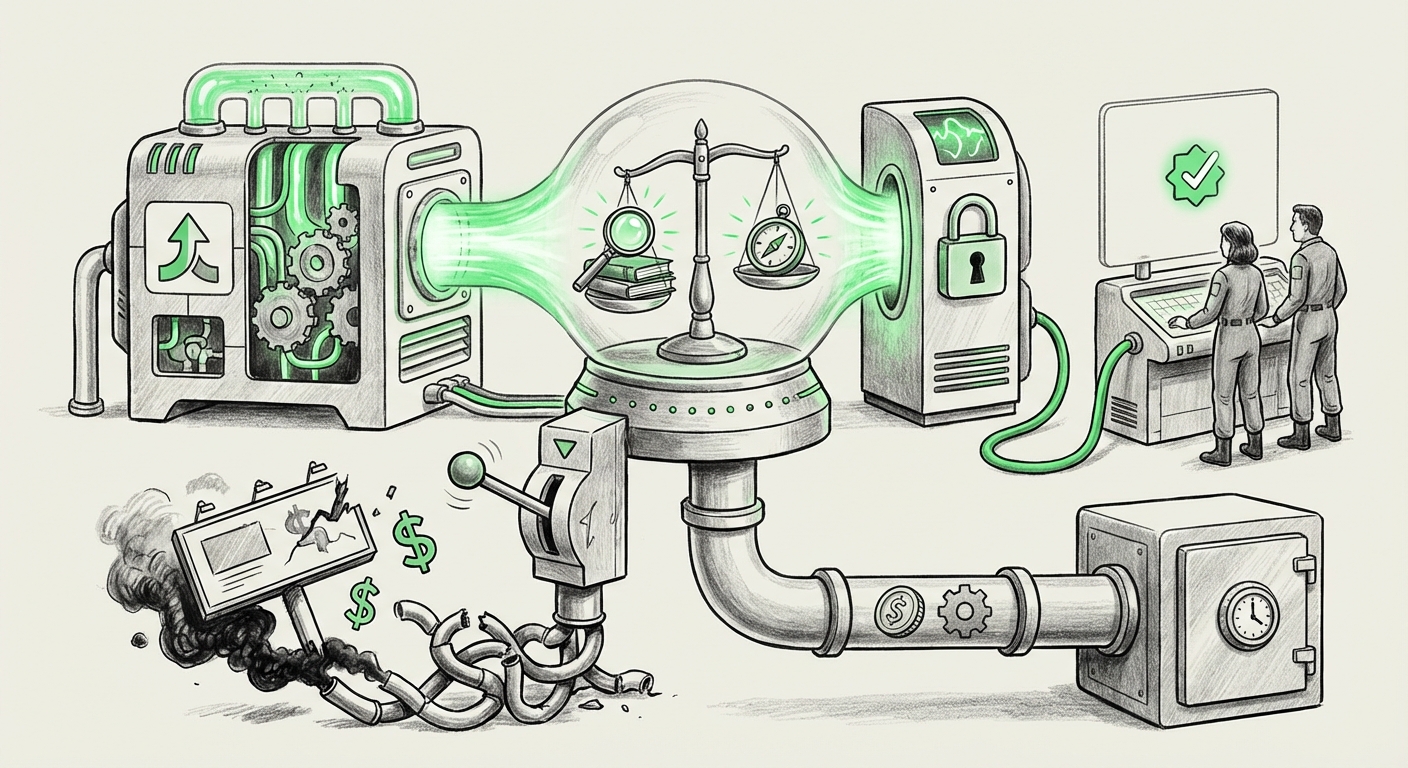
The Accuracy Revolution: Why Perplexity's Ad Ban Signals the Next Era of AI Search
The internet’s foundational business model—linking information access to advertising revenue—is being directly challenged by the rise of generative AI. Nowhere is this clash more apparent than in the rapidly evolving field of AI search. The recent decision by AI startup Perplexity to completely pull advertising from its platform, labeling itself fundamentally an "accuracy business," is more than a PR move; it is a major strategic declaration about where value truly lies in the future of information retrieval.
For years, search engines thrived by prioritizing click-through rates (CTR) and serving relevant, yet commercially advantageous, advertisements. Perplexity’s pivot suggests that the new generation of users expects direct, synthesized, and unbiased answers, and they are prepared to pay a premium—or at least, accept a different cost structure—to get them. As AI technology analysts, we must examine the implications of this move across monetization, user psychology, and the competitive battlefield.
The Core Conflict: Trust Versus Ticking the Meter
Traditional search has long been a compromise. When you ask Google a question, you are not just searching for knowledge; you are entering a marketplace where advertisers pay for proximity to your intent. This system inherently creates friction between the user’s need for the absolute best answer and the platform’s need to generate shareholder value through ad impressions.
Perplexity is betting that generative AI has matured to a point where this compromise is no longer acceptable. When an AI synthesizes information, the stakes for accuracy are exponentially higher. A slightly misplaced ad in traditional search is annoying; a fabricated or biased answer in an AI summary can lead to significant real-world errors.
As analysts note when investigating potential monetization shifts ("AI search engine monetization strategies beyond advertising"), the path forward for AI platforms cannot simply mirror the 2000s web. Perplexity’s aggressive stance signals that the first and most crucial layer of AI utility must be unimpeachable trust. If the answer engine is accurate, monetization can follow; if monetization compromises accuracy first, the engine fails entirely.
What the Advertising Ban Means for User Experience (UX)
To the average user, this change is immediately felt as a cleaner interface. There are no sponsored links hijacking the primary answer box. This focus aligns with a growing sentiment that modern search engines are becoming too cluttered. Reports tracking the degradation of standard search results, noting how they are "increasingly littered with ads and spammy SEO content," underscore the public appetite for an alternative. Perplexity is effectively offering a 'clean room' for knowledge acquisition.
For those new to AI tools, this clean experience drastically lowers the barrier to entry for complex information gathering. It removes the cognitive load required to distinguish between organic results, paid placements, and AI synthesis. It’s simpler, faster, and appears more honest. This focus directly addresses the "Generative AI advertising integrity concerns" by removing the very mechanism that introduces commercial bias.
The Hard Question: How Do You Pay the Bills Without Ads?
While prioritizing user trust is laudable, running large language models (LLMs) costs substantial capital—for computing power, data processing, and foundational model licensing. If Perplexity is not selling user attention to advertisers, it must sell something else of direct, quantifiable value. This forces the pivot toward subscription and enterprise models, which brings us to the second major trend.
The Rise of AI as a SaaS Utility
If advertising is out, the primary revenue streams become utility and access. This aligns with broader industry analysis showing a trend toward "Freemium/Subscription-as-a-Service (SaaS) for AI Tools." Perplexity’s existing Pro tier becomes the central focus, likely expanding features that justify a recurring charge, such as:
- Deeper Context & Citations: Providing richer, multi-source verification tools.
- Advanced Reasoning: Access to the most powerful, state-of-the-art LLMs (e.g., GPT-4o or Claude Opus) for complex tasks.
- API Access: Allowing developers and businesses to build upon Perplexity’s trusted engine for internal applications.
This model creates a virtuous cycle: The free product establishes trust and user adoption; the premium product leverages that established trust to secure higher-margin, dedicated revenue streams from users who rely on accuracy for professional work.
For businesses, this is crucial. Why risk your internal research or market analysis on a model subsidized by the same advertising model you are trying to escape? Companies are increasingly willing to pay for dedicated, controlled, and demonstrably accurate AI infrastructure, positioning Perplexity as a potential B2B solution provider rather than just a consumer search tool.
The Competitive Crucible: Taking on the Tech Giants
Perplexity’s strategy is particularly bold because it directly contrasts with the established playbooks of its main competitors: Google and Microsoft.
The incumbent Advertising Machine
Google Search remains the global behemoth, and its AI integrations (like Search Generative Experience, or SGE) are fundamentally designed to layer AI synthesis *on top of* its existing, multi-billion-dollar advertising revenue streams. Similarly, Microsoft has integrated Copilot into Bing and Edge, effectively using its massive ad footprint to subsidize the rollout of AI features. As market comparisons frequently highlight "Microsoft Copilot vs Perplexity AI strategy comparison," the difference is philosophical.
Microsoft and Google are trying to transition their existing ad-centric user base to AI without disrupting their primary income source. They are injecting AI into an existing, commercialized system. Perplexity, being newer, has the advantage of starting clean. They are building a car designed from the ground up for electric power, whereas the giants are trying to convert massive V8 engines mid-race.
This rivalry sets the stage for a fascinating technological split. Will users decide that the convenience of a deeply integrated, ad-supported AI assistant (like Copilot) outweighs the purity of an ad-free, accuracy-first engine (like Perplexity)? The answer likely depends on the user’s tolerance for commercial noise versus their reliance on the output.
Implications for the Future of Information Retrieval
Perplexity’s move forces the question: Is accuracy the next growth driver for generative AI startups? The answer, supported by analyst perspectives on AI maturation, is increasingly yes.
As generative AI moves from novelty to essential utility—from a chatbot parlor trick to a critical component of business operations, academic research, and decision-making—the quality of the output becomes the differentiating factor. We are transitioning from a phase defined by *capability* (Can the AI do this?) to a phase defined by *reliability* (Can I trust the AI to do this correctly, every time?).
The Professionalization of AI Search
This shift is profoundly influencing the trajectory of AI adoption in professional settings. For fields like law, medicine, and engineering, hallucinations or subtle biases are unacceptable liabilities. These sectors will naturally gravitate towards platforms that explicitly reject ad-based monetization, viewing the subscription fee as an insurance premium against error.
This means the market is bifurcating:
- The Mass Market (Ad-Supported): Dominated by incumbents, offering "good enough" AI integrated into existing free ecosystems (e.g., Google, some aspects of Copilot).
- The Professional/Power User Market (Subscription-Driven): Focused on verifiable accuracy, citation rigor, and specialized workflows (e.g., Perplexity Pro, enterprise LLM wrappers).
Perplexity is making an aggressive play for the second category, seeking to capture the high-value, low-volume professional user base first. If they succeed in establishing themselves as the gold standard for trustworthiness, they create a moat that mere feature parity cannot easily cross.
Actionable Insights for Businesses and Developers
For any business integrating AI tools or developing new information services, Perplexity’s decision offers clear takeaways:
- Audit Your Trust Score: If your AI application relies on synthesized data, assess the current monetization model. Is any commercial incentive—even subtle ones—potentially biasing the output? For critical internal tools, eliminate the middleman.
- Embrace the Subscription Mindset: Stop viewing AI access as an infinite, free resource. Start packaging accuracy, data sovereignty, and advanced reasoning capabilities into tiered subscription offerings. Users paying for utility are typically more engaged and less prone to churn than users who are simply being advertised to.
- Monitor the Divergence: Watch how Google and Microsoft attempt to address the "accuracy tax." If they are forced to create separate, paid, ad-free tiers to compete with Perplexity, it confirms that the market genuinely values uncompromised information integrity.
Conclusion: Accuracy as the Ultimate Moat
Perplexity is not just dropping ads; it is declaring its core value proposition. In an age saturated with easily accessible, yet often unreliable, information generated by powerful models, the most valuable commodity is verified truth. By forfeiting short-term ad revenue, Perplexity is investing heavily in long-term user loyalty built on a foundation of transparency and accuracy.
This strategic gamble could redefine AI search. It establishes a clear, premium tier in the market where monetization is directly tied to verifiable quality, not click volume. If this model proves sustainable and scalable, we may look back on Perplexity’s decision not just as a feature removal, but as the moment AI search chose trust over transaction, setting a powerful precedent for the next decade of information technology.