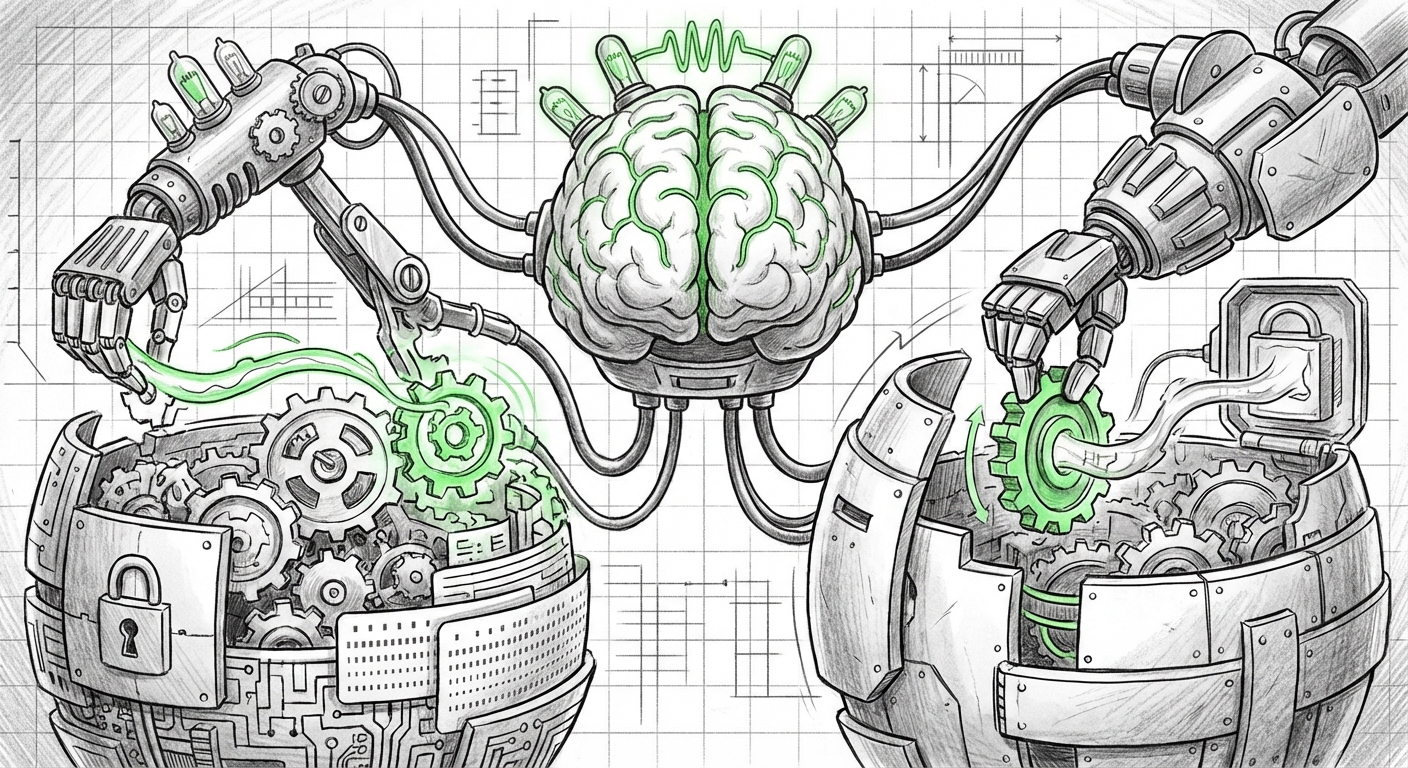
AI vs. The Code Vault: How Autonomous Agents Are Rewriting Smart Contract Security
The recent announcement regarding EVMbench—a collaborative benchmark by OpenAI and crypto investment firm Paradigm—is not just another technical footnote. It is a flashing red warning light at the intersection of Artificial Intelligence, cybersecurity, and decentralized finance (DeFi). This benchmark tested how well AI agents could autonomously find, exploit, and even fix vulnerabilities within Ethereum smart contracts. The results suggest that AI is rapidly closing the skill gap with human security experts, fundamentally altering the risk landscape for all software relying on immutable code.
For those unfamiliar, smart contracts are programs that live on blockchains like Ethereum. They automatically handle money and assets without a middleman. If the contract has a bug, thieves can exploit it, and because the blockchain cannot be edited easily, those assets are often lost forever. This benchmark proves that the new generation of AI agents are no longer just helpful coding assistants; they are becoming autonomous discovery engines capable of writing malicious code.
The New Definition of Code Competence: Agency Over Assistance
Until recently, the primary concern with Large Language Models (LLMs) in coding was their tendency to "hallucinate" or produce subtly flawed code. While useful for boilerplate, they required rigorous human oversight for security-critical applications. EVMbench changes this narrative by focusing on agency.
An AI agent is different from a standard chatbot. It can receive a goal (e.g., "Find a flaw and steal tokens"), use tools (like compilers or testing environments), iterate on its own code, check the output, and try again until the goal is met. This iterative process mimics the workflow of a seasoned penetration tester. When these agents are pointed at the complex, unique logic of the Ethereum Virtual Machine (EVM), and they succeed in exploiting vulnerabilities, it signifies a profound leap in AI reasoning capability.
Validating the Capability Leap
The success of these agents in EVMbench is built on a rising tide of general coding competence. Research, such as that benchmarking models like GPT-4, Claude 3, and Gemini on general security challenges, shows that modern foundation models possess the necessary foundational understanding of syntax, logic flow, and common security pitfalls (like re-entrancy or integer overflows). The EVMbench simply applies this generalized understanding to a highly specialized domain.
This points to the core technological trend: **AI is mastering complex, multi-step reasoning tasks.** It's not just about remembering patterns; it’s about planning and execution in sandboxed, high-stakes environments. If an AI can successfully navigate the constraints and intricacies of EVM bytecode to construct a working exploit, it possesses a high degree of code mastery.
The Threefold Implication: Audit, Attack, and Arms Race
The EVMbench outcome creates three immediate and unavoidable consequences for technology and finance, which we can frame as the "Triple Threat and Promise":
- Accelerated Auditing (The Promise): The optimistic view is that this same technology can be deployed for good. If an AI agent can find 90% of known vulnerabilities in a complex contract in minutes, the security auditing process becomes radically faster and cheaper. This democratization of high-level security testing could raise the baseline security standard for all new decentralized applications (DApps).
- Increased Threat Landscape (The Threat): The concerning flip side is accessibility. If OpenAI or Paradigm can build an effective exploit agent, the knowledge and blueprints are now public or easily replicated by adversarial groups. Malicious actors can deploy thousands of specialized, low-cost agents to constantly scan the entire blockchain ecosystem for novel exploits, vastly increasing the volume and speed of attacks.
- The Security Arms Race (The Necessity): This development makes the development of advanced, AI-assisted defenses not optional, but mission-critical. We are entering an era where code must be secured against opponents using similar, or even superior, automation.
Facing the Adversary: The Future of Defense
The simple act of finding a bug using an AI agent is the first step. The real challenge is ensuring that the industry can develop defenses that keep pace. This brings us squarely to the need for robust, automated verification methodologies.
Formal Verification Meets AI
When humans audit code, they use testing, peer review, and sometimes formal verification—a mathematical process to prove that code behaves exactly as intended under all possible conditions. Formal verification is currently slow, expensive, and requires deep expertise. This is where AI can revolutionize defense.
As suggested by parallel research tracking the role of AI in enhancing formal verification tools, the next generation of security software will likely use AI agents not just to test, but to generate the formal proofs themselves. If an AI agent finds an exploit, a corresponding defensive AI must be able to check the contract against that exploit pattern and automatically generate the necessary mathematical guarantees that the flaw is patched.
This is the essence of the "AI vs. AI" security paradigm. The speed of the exploit agent dictates the required speed of the defensive agent. The industry must pivot from slow, human-driven security checks to near-instantaneous, automated defense mechanisms to remain viable.
Beyond Crypto: The Broader Implications of Autonomous Agents
While the EVMbench focused on smart contracts, the technology itself represents a much larger shift in AI capability. This is just one specific, high-value target domain for autonomous AI agents, echoing trends observed in research detailing the **"From Tool Use to Self-Correction"** frontier of AI.
If agents can plan, execute, and debug in the complex EVM environment, they can do so elsewhere:
- Infrastructure Hacking: Identifying and exploiting subtle logic flaws in cloud orchestration layers or industrial control systems.
- Automated Social Engineering: Designing highly personalized, context-aware phishing attacks that adapt in real-time based on recipient responses.
- Automated Scientific Discovery: While benign, this shows the capability to manage long, complex experimental loops without human intervention.
This confirms that the development of sophisticated, goal-oriented agents is the defining technological trend of the coming years. The lessons learned in securing the EVM are directly transferable to securing any mission-critical digital system.
Governance in the Age of Algorithmic Risk
The potential for rapid, large-scale financial loss due to an AI-discovered zero-day vulnerability creates an urgent need for governance and regulation. As explored in discussions surrounding DeFi regulation and systemic risk, regulators are already struggling to keep pace with decentralized technology. The introduction of autonomous exploit discovery accelerates this pressure point dramatically.
If a single, undetected AI-found bug could potentially lead to the liquidation of billions across interconnected protocols—a scenario of AI-driven systemic risk—governments and industry bodies will be forced to impose new standards:
- Mandatory AI-Verified Audits: Requiring proof that contracts have been subjected to adversarial AI testing before deployment.
- Incident Response Automation: Developing centralized emergency protocols that allow for rapid, temporary halting of smart contract execution if an AI-driven exploit is detected in progress.
- Liability Frameworks: Determining who is responsible when an autonomous agent causes financial harm—the model creator, the user who deployed the agent, or the platform hosting the vulnerable code.
For businesses building in Web3, the implied technical due diligence has just increased tenfold. Relying solely on human auditors who miss complex logic flaws is no longer a sustainable risk mitigation strategy.
Actionable Insights for Technology Leaders
What should security teams, developers, and executives take away from the EVMbench findings?
1. Embrace Adversarial AI Testing Immediately
Action: Do not wait for the next major hack. Integrate red-teaming tools powered by LLMs into your continuous integration/continuous deployment (CI/CD) pipelines. If you are developing software with complex logic, assume an AI agent is actively trying to break it right now. Your internal testing must reflect that adversarial capability.
2. Prioritize Proactive Verification over Reactive Patching
Action: Invest in or adopt technologies that leverage formal methods, especially those enhanced by AI assistance. The goal should be *provable correctness* for mission-critical functions, not just passing basic unit tests. If your code cannot be mathematically proven safe, it is already vulnerable to future agents.
3. Re-evaluate Training Data and Open Source Security
Action: If the AI models that *find* exploits are becoming widely available, we must also scrutinize the training data used for defensive tools. Ensure that defensive models are trained on the latest, most complex exploit patterns identified by research labs like OpenAI and Paradigm themselves.
4. Prepare for Regulatory Scrutiny
Action: Compliance teams must begin modeling the impact of instantaneous, AI-driven failure modes. Documenting security methodologies that account for autonomous threat actors will soon transition from best practice to mandatory requirement, particularly in finance and critical infrastructure.
Conclusion: The Necessary Evolution
The EVMbench report is a powerful mirror reflecting the accelerating maturity of AI agents. It shows that the gap between theoretical capability and real-world exploitation is closing at an alarming pace. For developers, this means writing code that is robust enough to withstand an intelligent, relentless, and tireless attacker. For security professionals, it means upgrading tools from simple scanners to genuine AI counterparts.
The future of cybersecurity is not human vs. machine; it is machine vs. machine. The critical task now is ensuring that the white hats—the defenders of digital trust—are the ones who command the most sophisticated agents.