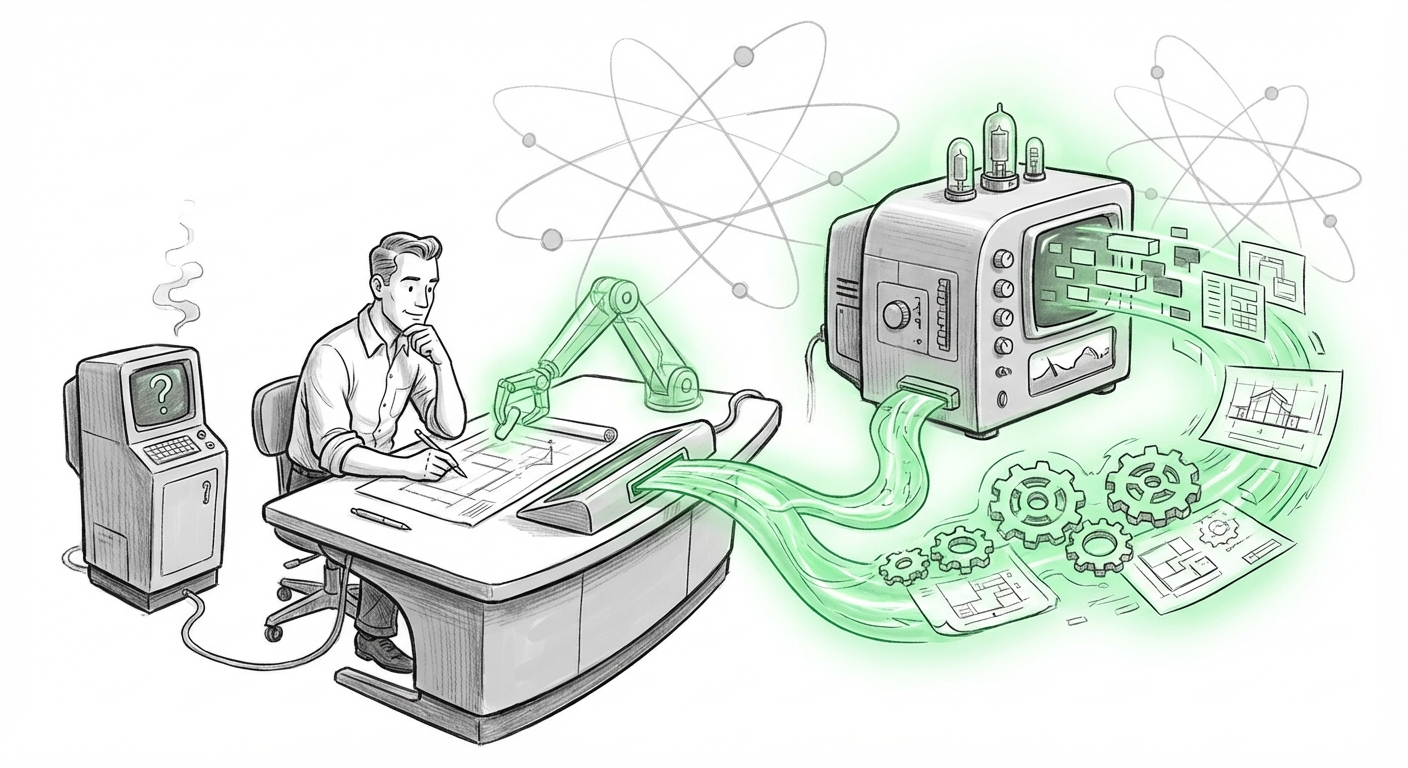
The Ambient Revolution: Why Desktop Integration is the Next Frontier for AI Coding Assistants like Claude Code
The narrative around Large Language Models (LLMs) in software development has rapidly matured. Initially, AI assistants were novelties—smart chatbots where developers pasted code snippets for debugging or generation. However, the recent move by Anthropic to roll out **desktop-specific features for Claude Code**, designed to automate more of the development workflow directly where work happens, signals a profound pivot. This isn't just an update; it’s a declaration that the future of AI assistance is not in the browser tab, but deep within the operating system itself. We are witnessing the birth of **Ambient AI** in the coding world.
As AI technology analysts, we must examine this development through three crucial lenses: the competitive environment shaping this race, the technological hurdles of true desktop immersion, and the measurable impact on engineering efficiency and enterprise strategy.
The Great Migration: From Chatbot to Co-Pilot
The core change signaled by Anthropic’s desktop update is the rejection of the context barrier. In the early days of coding LLMs, the developer had to leave their Integrated Development Environment (IDE)—the primary digital workbench—navigate to a website, interact with the AI, and then copy the results back. This process introduces friction, forcing the engineer to constantly switch focus. For a busy developer, this context switching is toxic to deep work.
Desktop integration solves this by moving the assistant into the 'native environment.' Imagine an AI that can see what files you have open, understand the surrounding codebase structure, and perhaps even monitor system diagnostics—all without you explicitly typing a prompt asking it to look. This is the essence of automation.
Competitive Convergence: The Race to Embed
Anthropic is not entering an empty field. To understand the weight of their move, we must benchmark it against established leaders. The expectation now is not *if* an AI can write code, but *how seamlessly* it can integrate into the existing toolchain.
The benchmark for deep integration has long been set by tools like **GitHub Copilot**, which is tightly woven into the VS Code and Visual Studio experience. Similarly, IDE makers like JetBrains have rolled out their own **JetBrains AI Assistant**, which leverages local context effectively. For Anthropic to compete effectively, their desktop features must offer comparable, if not superior, levels of contextual awareness and command execution.
This competitive pressure forces providers to move beyond simple suggestion generation. The ambition is toward **Agentic Workflow**—AI systems capable of taking a high-level directive (e.g., "Refactor this dependency management module") and executing a multi-step plan: researching documentation, generating tests, implementing changes across multiple files, and finally, submitting a draft pull request. Deep desktop access is the prerequisite for true agent capabilities, as agents need permission and access to the local file system to act.
(This competitive pressure is vital context, as noted by analyses focusing on the landscape of integrated coding assistants, pushing all major players toward deeper integration.)
The Technological Leap: Defining Ambient AI in Development
The term "ambient AI" suggests an intelligence that surrounds the user, always present but rarely intrusive. In software development, this translates into AI that is proactive rather than reactive.
Context and Persistence
For an AI to be truly ambient, it must maintain persistence of context across sessions and understand the nuances of the local machine state. This is far more complex than processing a single prompt:
- Codebase Awareness: The AI needs to index and understand the relationships between thousands of lines of code, not just the 100 lines currently visible.
- Toolchain Interoperability: True desktop automation means interacting with terminals, version control systems (like Git), and local testing environments. This requires robust APIs and permissions management within the desktop environment.
- Speed of Response: If the AI is running locally, even partially, latency drops dramatically. For moment-to-moment coding assistance, delays measured in seconds are unacceptable.
The Privacy-Performance Trade-off (Query 4 Context)
A significant factor underpinning desktop deployment is the shift toward localized computation. While large, foundational models like Claude 3 Opus require massive cloud infrastructure, smaller, highly optimized models (or quantization techniques) are making it feasible to run *parts* of the inference process locally. This trade-off is critical:
- Cloud Models (e.g., full Claude API): Offer maximum intelligence but demand high latency and send sensitive proprietary code off-premises.
- Local/Hybrid Models: Offer better privacy and near-instantaneous response times for simple tasks (like auto-completion or syntax checks), but might lack the depth for complex architectural suggestions.
Anthropic’s desktop initiative implies they are optimizing Claude to handle more localized processing for routine tasks, thereby enhancing speed and privacy—a major win for enterprises sensitive about exposing Intellectual Property.
(The ongoing discussion around whether developer AI tools should prioritize local or cloud processing directly impacts adoption rates, especially in regulated industries.)
The Productivity Equation: Measuring the ROI of Automation
For executives and engineering managers, features are secondary to quantifiable results. The critical question is: Does embedding AI deeper into the desktop workflow actually make engineers significantly faster and better?
Beyond Lines of Code
Early metrics on AI coding assistants often focused narrowly on lines of code generated. Modern analysis recognizes that code quality, debugging time, and context switching reduction are far more valuable metrics. If desktop integration automates boilerplate setup, dependency management, or the tedious process of writing test scaffolds, the time saved can be immense.
Research into LLM impact on productivity suggests significant gains, particularly for junior developers or when tackling unfamiliar codebases. When AI takes over the "search and remember" tasks, developers are freed to focus on higher-level architectural challenges.
However, there are pitfalls. Over-reliance can lead to the atrophy of fundamental skills, and integrating complex AI agents introduces new failure modes. If an agent makes a subtle but system-breaking error across ten files, the time spent debugging the *AI’s output* can erase any initial productivity gains. This necessitates strong verification loops, which themselves must be automated by the very AI tools being discussed.
(The evaluation of these productivity benchmarks will determine the speed at which every enterprise adopts these deeply integrated tools.)
Implications: The Future Developer Experience
The trend toward desktop integration is a sign that AI is leaving its sandbox and entering the real world of production systems. What does this mean for the future of software creation?
1. Redefining the Developer Role
Developers will spend less time writing tactical code and more time defining strategy, reviewing AI-generated proposals, and ensuring system integrity. The job shifts from *implementation* to *orchestration* and *validation*.
2. Democratization of Complexity
Tools that can interpret complex, large-scale systems and automate migration paths (e.g., moving from one cloud provider to another, or upgrading legacy frameworks) will become essential. Desktop integration gives these tools the necessary access to execute these massive, multi-file tasks.
3. The Rise of the Unified Interface
We are moving toward a future where the operating system layer itself understands the context of the primary applications running on it. Just as mobile operating systems learned to handle notifications intelligently, future desktops will manage AI agents based on application context. Anthropic’s move anticipates this by building out from the application (Claude Code) toward the OS layer.
Actionable Insights for Technology Leaders
For engineering leaders and CTOs tracking this rapid evolution, here are three immediate considerations regarding the movement toward ambient, desktop-integrated AI:
- Audit Contextual Access: Before deploying tools that integrate deeply into the desktop (like Claude Code’s new features), establish strict policies on what the AI agent is allowed to see and modify on local machines. Security must evolve faster than automation.
- Measure Beyond Velocity: When evaluating new AI tools, prioritize metrics related to code quality (e.g., security vulnerability density, test coverage improvement) over simple speed metrics. The goal is smarter code, not just faster code.
- Invest in Prompt Engineering for Agents: Training teams to interact with these systems requires a shift from crafting single prompts to designing sophisticated workflows that the agent can follow reliably.
Anthropic’s push for deeper desktop integration for Claude Code isn't just a feature addition; it's a strategic realignment recognizing that friction kills efficiency. By embedding AI directly into the engineer's primary workspace, they are accelerating the timeline for truly ambient, agentic software development. The era where AI was merely a helpful suggestion box is ending; the era where AI becomes an inseparable, context-aware partner operating silently alongside us has begun.