The Embodied AI Revolution: Why OpenAI's Move to Consumer Hardware Changes Everything
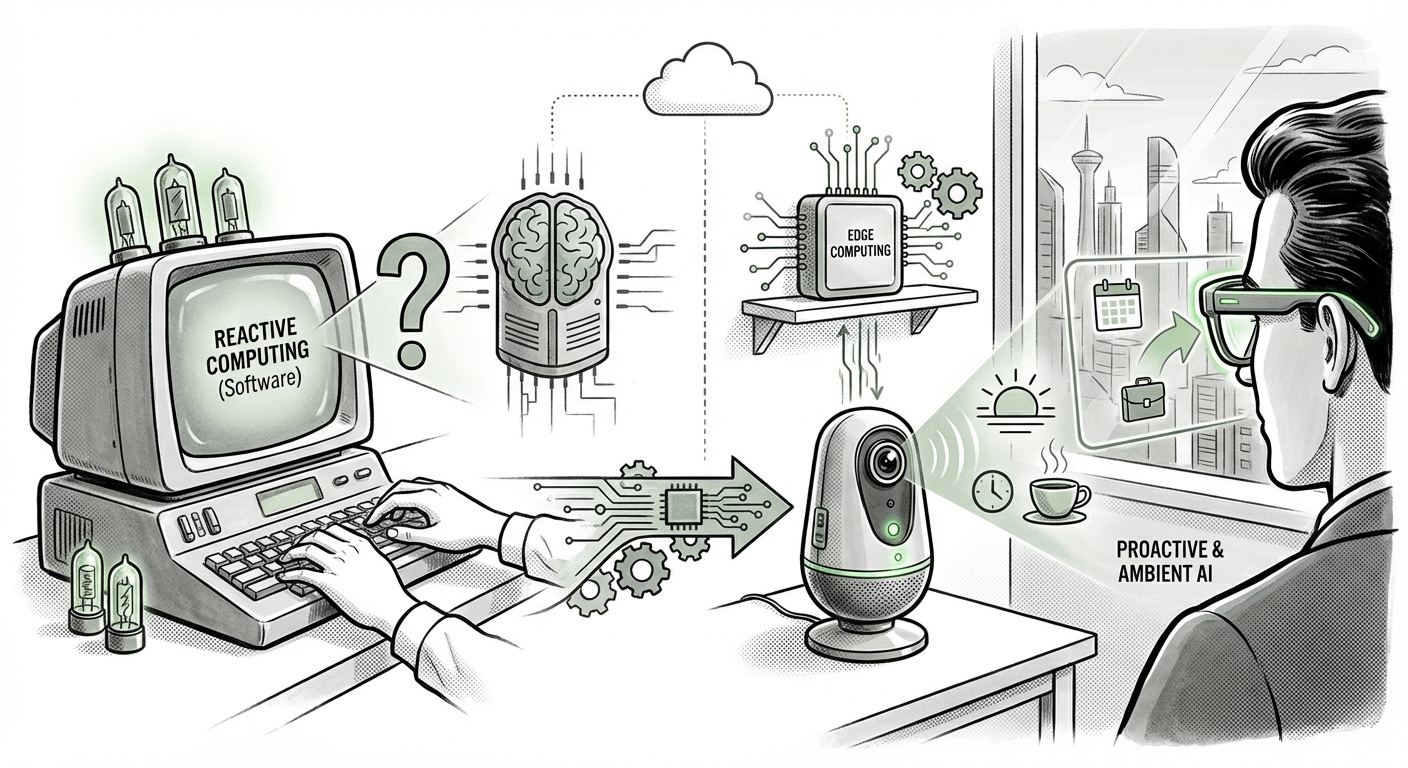
For years, Artificial Intelligence has largely existed behind a screen—a chat window, an API call, or a text prompt. We asked ChatGPT a question, and it delivered a text answer. But a recent wave of reports suggests a profound shift is underway: OpenAI is moving AI from the digital screen into our physical world through dedicated consumer hardware. This isn't just about building a fancy gadget; it represents a fundamental strategic pivot toward ambient, embodied AI.
The rumored roadmap includes a $200–$300 smart speaker equipped with a camera and facial recognition, designed to offer proactive assistance—like telling you when it’s time for bed. Beyond that, the pipeline reportedly includes smart glasses and an AirPods competitor. As an AI technology analyst, I see this as the moment the AI landscape matures from being software-centric to becoming an integrated utility, much like electricity or running water. Let’s break down what this strategy means for technology, competition, and our daily lives.
The Shift from Software to Presence: Defining Ambient AI
When we interact with current-generation AI, we initiate the process. We open the app, type the query, and wait. This is reactive computing. OpenAI’s proposed hardware flips this model.
The Proactive Home Manager
Consider the rumored smart speaker. With a camera and facial recognition, this device doesn't just wait for you to ask about the weather; it knows who you are, recognizes your fatigue level (perhaps through visual cues or voice tone), and proactively suggests, "It looks like you've been working late. Perhaps you should wind down now." This is proactive AI in action.
For the average person, this technology simplifies life by removing the need to explicitly command the system. It learns patterns, anticipates needs, and intervenes helpfully. This requires the AI to process multimodal data—seeing (camera), hearing (microphone), and understanding context (LLM)—all in real-time. This is the essence of ambient computing: technology that fades into the background until it is needed, delivering assistance precisely when and where it matters.
The "Always-On" AI in Your Pocket and Ears
The plan for smart glasses and audio accessories is even more significant. Smart glasses aim to overlay digital intelligence onto the real world, offering instant visual context, translation, or navigation cues without you having to pull out a phone. An AirPods competitor, powered by an advanced LLM, promises conversational AI that flows seamlessly during walks, workouts, or meetings. This is the transition to embodied AI—AI that is physically present with you throughout your day.
The Competitive Crossroads: Challenging the Incumbents
OpenAI’s hardware ambitions are a direct declaration of war against established tech giants who currently control the ambient experience.
1. Targeting the Smart Home Giants (Google & Amazon)
Amazon (Alexa) and Google (Nest/Assistant) built the foundation of the smart home speaker market by focusing on connectivity and low-cost entry points. Their current AI often feels transactional. OpenAI is aiming for a qualitative leap, leveraging the superior reasoning capabilities of GPT models. If a $250 OpenAI speaker delivers truly insightful, personalized, and proactive assistance—information that Google’s Gemini or Amazon’s evolving Alexa cannot—consumers may be willing to pay a premium for this intelligence density.
This competition forces a strategic analysis of the market. As suggested by examining search trends like `"Google vs OpenAI" "ambient computing" hardware roadmap`, the core question is whether platform lock-in (Google's integration across Android) or superior raw intelligence (OpenAI's foundational models) wins the next decade of home interaction.
2. The Wearable AI Race (Meta & Apple)
The pursuit of smart glasses pits OpenAI against Meta and Apple. Meta is aggressively embedding its AI into its Ray-Ban smart glasses, prioritizing quick, on-the-go information retrieval. Apple, meanwhile, is focusing on spatial computing with the Vision Pro, prioritizing immersive experiences.
OpenAI, using its core strength in language models, likely aims for a middle ground: utility over immersion. Their hardware likely won't be about virtual worlds but about augmenting reality with hyper-intelligent conversational context. This is why analyzing `"Meta Ray-Ban smart glasses AI features vs Apple Vision Pro"` is crucial; it defines the available niches. OpenAI is targeting the AI assistant that helps you manage reality, not escape it.
The Technical Hurdles: Privacy, Speed, and Edge Processing
For proactive AI to be effective and trustworthy, it must be fast and private. An AI that tells you to go to bed is only useful if it responds instantly. An AI that watches you needs ironclad trust.
The Necessity of Edge Computing
If the smart speaker needs to process video streams (facial recognition) and complex contextual understanding instantly, sending all that data to the cloud is too slow and raises massive privacy concerns. This is why deep dives into `"proactive AI hardware requirements 'on-device processing'"` are vital.
OpenAI will need powerful, efficient Neural Processing Units (NPUs) embedded directly in the device. Edge computing—where the AI inference happens locally—is the only viable path for this level of ambient responsiveness. Mastering this efficiency will be a major technical moat. If they can run large, sophisticated models locally while maintaining rapid updates from the cloud, they solve the latency and privacy paradox.
The Pricing Paradox: Justifying the Premium
The reported $200–$300 price point suggests OpenAI is not aiming for the budget market. This aligns with the findings from analyzing the `"AI hardware premium pricing strategy $200-$300 smart speaker"`. Incumbents sell cheap speakers to sell services (music subscriptions, shopping). OpenAI, on the other hand, must sell the hardware based on the superior intelligence it contains.
This premium positioning implies a high barrier to entry for competitors. They are betting that a leap in AI capability (e.g., truly understanding nuance or complex planning) is worth paying 2x to 3x the price of a basic voice assistant.
Implications for Business, Society, and the User Experience
This hardware pivot has wide-ranging effects that businesses and consumers must prepare for.
For Businesses: From Service Providers to Ecosystem Builders
The traditional model for tech companies has been selling software or cloud compute time. If OpenAI controls the hardware interface—the primary way users interact with their advanced AI—they control the gateway to that intelligence. Businesses that previously integrated with ChatGPT via API may find themselves needing to integrate with the "OpenAI OS" that runs on these new devices.
This forces a strategic decision: Do we build our own ambient AI interface, or do we build compelling applications that run optimally on the dominant hardware platform? Companies relying on simple automation might struggle as the bar for "smart" interactions rises dramatically.
For Society: The Creep Factor and Trust
When AI moves into the home with always-on cameras and proactive suggestions, the line between helpful automation and surveillance blurs. A device that knows when you are tired enough to go to bed is incredibly useful, but it also possesses intimate knowledge of your living patterns.
This demands radical transparency regarding data handling. The success of these devices hinges not just on performance but on trust. Consumers must clearly understand what data is processed locally (on the device) versus what is sent to the cloud for model improvement. If the privacy assurances are weak, the market for proactive AI will stall, regardless of how smart the speaker is.
For Users: The End of "Searching," the Beginning of "Knowing"
The long-term implication for the end-user is the transition from active information seeking to passive information delivery. Imagine walking into your kitchen: the glasses discreetly highlight expired food in your fridge, or the speaker tells you the traffic patterns are bad for your afternoon meeting before you even ask. This level of ambient support redefines productivity and personal management. It requires a new user skill: learning to trust and rely on an AI that anticipates needs.
Actionable Insights for Navigating the Embodied AI Era
The race is on to embed powerful LLMs into the physical world. Here is what stakeholders should be prioritizing:
- Hardware Partners Must Prioritize NPU Density: For any company hoping to compete, the focus must shift to procuring or developing specialized silicon capable of running sophisticated models locally. Cloud-only solutions are too slow for ambient interaction.
- Develop "Opt-In" Proactive Scenarios: Businesses should focus R&D on applications that offer undeniable, immediate value in exchange for personal data access. (Example: Showing immediate energy savings in exchange for analyzing home energy usage patterns.)
- Prepare for Ecosystem Fragmentation: Unlike the early days of apps, the next generation of AI interfaces may be fragmented across OpenAI, Google, and Meta platforms. Companies must design software architectures that can communicate or adapt across these distinct ambient AI operating systems.
- Establish Privacy as a Feature: For consumers, treat data handling not as a compliance issue but as a core product differentiator. Clear, auditable guarantees about local processing will be the ultimate selling point against competitors perceived as data vacuums.
OpenAI’s rumored hardware suite is more than just product diversification; it is a strategic maneuver to claim the primary interface layer for the next era of computing. By moving beyond the chat box and into our homes and onto our faces, they are striving to make AI truly ubiquitous. The success of this gamble will determine who sets the standards for how humans and intelligent machines coexist in the very near future.