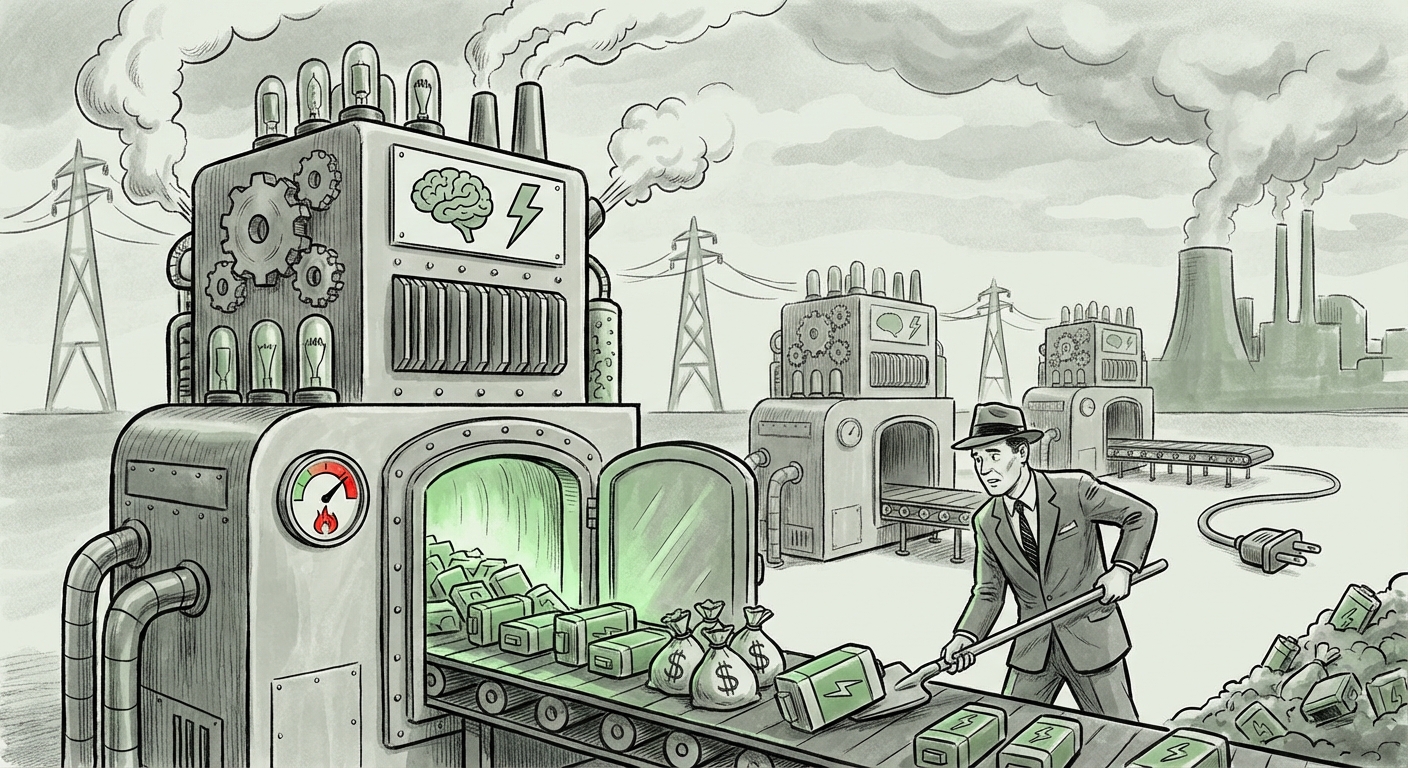
The AI Cost Crisis: Why OpenAI's Skyrocketing Burn Rate Signals the Next Tech Reckoning
The world of Artificial Intelligence is moving at breakneck speed. New models are launched seemingly every month, promising leaps in capability, reasoning, and utility. Yet, beneath the surface of these exciting advancements, a sobering financial reality is taking hold: the economics of building the most powerful AI systems are spiraling beyond initial projections.
Recent reports indicating that leading labs, such as OpenAI, are dramatically increasing their projected cash burn—even as revenue climbs—are not just a footnote in financial reports; they represent a critical inflection point for the entire industry. This development forces us to confront a hard truth: frontier AI is currently a capital expenditure game, not a quick path to high margins.
As an analyst tracking these tectonic shifts, the immediate question is not just *if* these labs can afford to build these models, but *how* the rest of the technology ecosystem—from competitors to corporate adopters—must adapt to this intense capital requirement.
The $111 Billion Shadow: Decoding the Cost Spiral
When a company increases its revenue forecast but simultaneously warns of a massive jump in cash outflow, it signifies that the cost of *producing* the next level of intelligence is outpacing the efficiency gains from the previous level. In simple terms: the machines required to train GPT-5 (or its equivalent) cost far more than anticipated, and the current user base isn't paying enough yet to cover the bill.
This situation is the inevitable result of Moore’s Law meeting the insatiable appetite of transformer architectures. We are moving from building powerful tools to building digital brains, and that requires unprecedented scale. To understand why this burn rate is so critical, we must look beyond OpenAI’s balance sheet and examine the four pillars supporting this enormous cost structure.
Pillar 1: The Unyielding Grip of Hardware Scarcity (The GPU Bottleneck)
The engine room of modern AI is the Graphics Processing Unit (GPU), overwhelmingly dominated by NVIDIA. The computational power needed to train a cutting-edge Large Language Model (LLM) can require tens of thousands of these specialized chips running non-stop for months.
The high cash burn is directly correlated with the escalating price and demand for top-tier accelerators like the NVIDIA H100 and the impending Blackwell architecture. When supply is constrained, prices soar. Articles tracking **GPU scarcity in 2024** confirm that demand from hyperscalers and AI labs far exceeds immediate supply. This scarcity forces these labs to make massive, upfront capital commitments years in advance, locking up billions of dollars just to secure the necessary compute cluster space.
For businesses looking to adopt AI, this means compute is becoming a premium, finite resource. Access to the best models may depend less on technological insight and more on who secured the most NVIDIA contracts last year.
Pillar 2: The Arms Race: Competitor Financial Velocity
OpenAI does not operate in a vacuum. The competitive landscape—dominated by Google DeepMind, Meta, and well-funded startups like Anthropic—is characterized by an identical, immense capital hunger. When one lab announces a breakthrough, competitors must immediately commit equivalent or greater resources to match or surpass it.
Reports detailing **Anthropic’s multi-billion dollar funding rounds** or Google’s continuous commitment to DeepMind demonstrate that this is a sector-wide reality. These massive funding injections are often used not just for R&D salaries, but primarily to purchase the infrastructure mentioned above. This creates a powerful feedback loop: high costs necessitate massive fundraising, which validates high valuations, but the underlying operational burn remains stubbornly high. This suggests that until a fundamental architectural shift occurs, the economics of the *frontier* will remain intensely capital-intensive.
Pillar 3: The Efficiency Imperative: Bending the Cost Curve
If the hardware costs (the training phase) are an immutable reality, the only place to find immediate relief is in optimization, particularly during *inference*—the phase where the model is actually used by customers.
This is where research into **Mixture of Experts (MoE) models and inference optimization** becomes vital. MoE architectures allow an LLM to selectively activate only parts of the model needed for a specific query, rather than running the entire massive network every time. This is akin to using only one specialized tool from a massive digital toolbox instead of firing up the whole factory for every small job.
Articles discussing advancements in model sparsity, quantization (using smaller numbers to represent data), and custom silicon (like specialized AI accelerators beyond standard GPUs) show the industry’s intense focus on this problem. If inference costs can be slashed by 50-90%, the path to profitability becomes viable, even if training costs remain exorbitant.
Pillar 4: The Data Dilemma: Beyond the Compute Bill
While the hardware costs often grab the headlines, another critical, escalating cost centers around the fuel for these models: data. As models advance, the need for *high-quality, novel, and clean* training data increases dramatically.
The easy, publicly available data sets have largely been exhausted. Future progress requires either licensing vast, proprietary corpora or investing heavily in creating highly curated, high-quality synthetic data. Reports detailing the **emerging market for licensed datasets** show that the cost of acquiring the next generation of training material is rising fast. This complexity introduces regulatory and legal overhead, further contributing to the overall operational expenditure.
Implications for the Future of AI Adoption
The unsustainable nature of the current cost trajectory has profound implications across the technology landscape:
- The Centralization of Power: Only a handful of entities (Microsoft/OpenAI, Google, Amazon, potentially Meta) can afford the initial R&D investment required to push the absolute frontier. This concentrates the most powerful AI capabilities in very few hands, raising concerns about decentralized innovation and access.
- The "Good Enough" Reality: For 95% of businesses, the massive, multi-billion dollar models are overkill. The real market opportunity lies with smaller, highly specialized, and efficient models trained or fine-tuned using techniques discussed in Pillar 3. Businesses need to prioritize cost-effective inference over bleeding-edge parameter counts.
- Hardware as a Strategic Asset: Compute providers (like cloud vendors) gain immense leverage. The relationship between OpenAI and Microsoft is a classic example: Microsoft invests billions in Azure infrastructure, securing early access to OpenAI’s products, effectively subsidizing their partner's burn rate in exchange for strategic advantage.
- The Focus Shifts to Velocity vs. Scale: The next wave of successful startups won't be the ones with the biggest models, but the ones that can iterate fastest on *using* those models efficiently, solving the inference problem better than their peers.
Actionable Insights for Businesses and Investors
How should organizations navigate this era of capital-intensive AI development?
For Technology Leaders (CTOs/CIOs):
- Audit Your Inference Budget Immediately: Do not assume your current cloud AI spend is sustainable. Investigate model pruning, quantization, and exploring smaller, specialized open-source models for internal tasks. The cost to *run* your AI applications will likely dwarf the cost to *test* them.
- Prioritize Strategic Partnerships: If you rely on frontier models, secure long-term pricing agreements or explore deeper platform partnerships (like Microsoft Azure or Google Cloud commitments) to gain preferred access to compute resources, effectively hedging against market volatility.
- Demand Transparency on Efficiency: When evaluating AI vendors, look past parameter counts. Ask vendors pointed questions about their inference stack, latency reduction techniques, and commitment to efficiency standards like MoE implementation.
For Investors and Financial Analysts:
- Value Operational Leverage, Not Just Hype: The market narrative must shift from celebrating model size to valuing demonstrable progress toward operational profitability. Look for companies that are both growing revenue *and* actively communicating strategies to reduce their cost-per-query ratio.
- The Rise of the Enablers: Companies specializing in AI optimization software, specialized networking for data centers, or custom silicon designed specifically for inference (not just training) become increasingly attractive. They offer a deflationary counter-force to the inflationary hardware market.
- Risk Assessment in Venture: Recognize that any company promising to build the *next* general-purpose model faces an operational risk profile similar to a small nation building a nuclear reactor. Investment must be weighted against extreme capital longevity requirements.
The Long View: From Gold Rush to Industrial Utility
The current cash burn explosion is the painful, necessary adolescence of Artificial General Intelligence (AGI). We are currently in the "Gold Rush" phase, where access to the most advanced digital machinery commands astronomical prices. This era is defined by massive upfront investment to secure a leadership position.
However, history shows that technological revolutions eventually commoditize. Just as early internet infrastructure required massive fiber optic investment, today, accessing the internet is cheap. The same path awaits AI. The current cost spiral confirms the immense *value* locked inside these foundation models, but it also signals that the current economic structure is temporary.
The next five years will be defined by the race to transition from this hyper-capitalized training phase to an efficient, scalable inference utility. The winners will be those who not only build the biggest models but those who discover how to deliver their intelligence reliably, cheaply, and widely. The burn rate today is a debt taken against the efficiency gains of tomorrow.