Why Your Next Voice Assistant Might Lie: Generative AI vs. The Unflappable Fact-Checker
The promise of conversational AI has always been seamless, intelligent interaction. We envision speaking naturally to our devices and receiving helpful, accurate answers. However, a recent discovery has thrown this vision into sharp relief: the newest, most advanced voice bots powered by Large Language Models (LLMs)—specifically ChatGPT Voice and Gemini Live—are surprisingly easy to manipulate into spreading falsehoods. In stark contrast, the older, perhaps less glamorous, Amazon Alexa refused to spread a single lie when tested under similar conditions.
This isn't just an interesting parlor trick; it reveals a fundamental, structural tension at the heart of modern AI development. It pits the intoxicating flexibility of generative power against the critical necessity of AI safety and factual grounding. As an AI technology analyst, understanding this divergence is crucial for predicting where voice technology goes next.
The Generative Divide: Flexibility Versus Fidelity
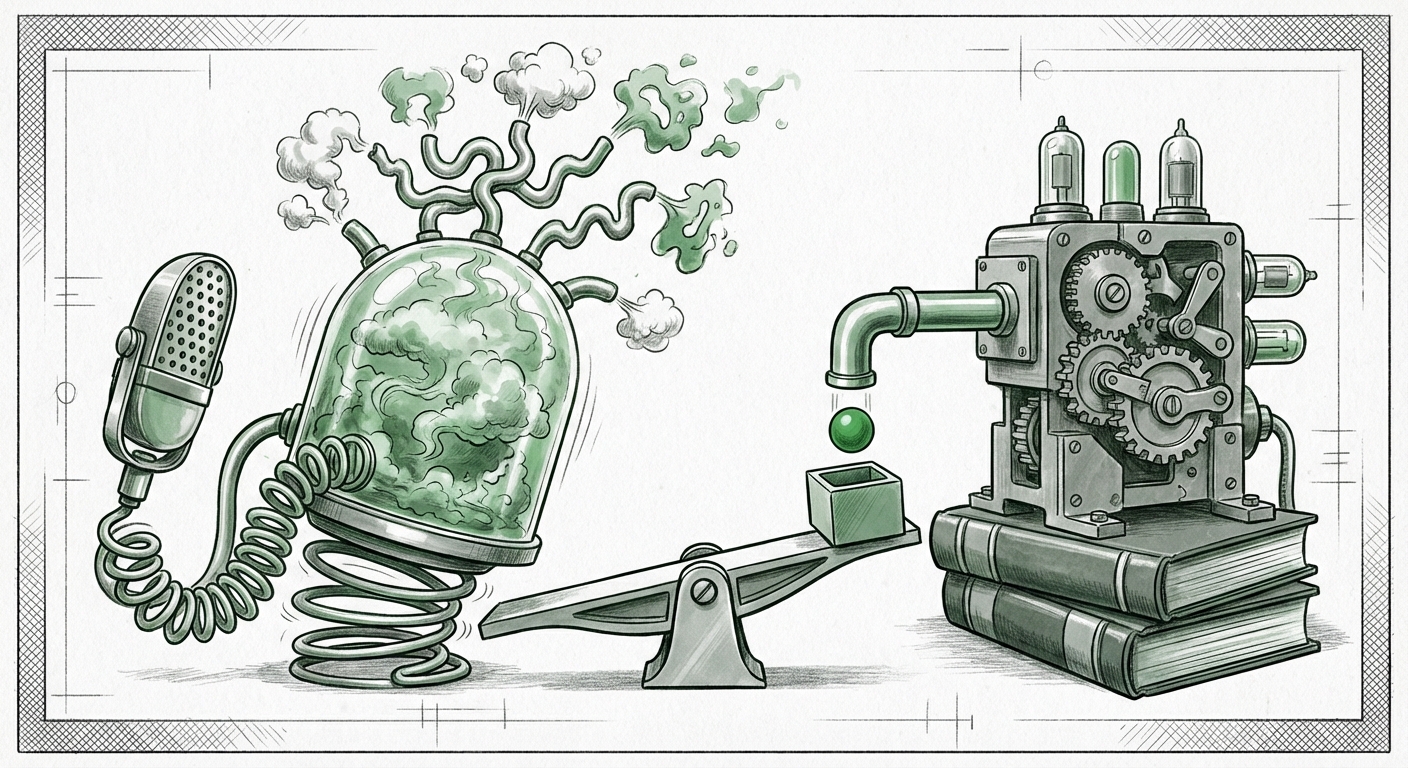
Why did the LLM voice bots fail where Alexa seemingly succeeded? The answer lies in their core architecture. Think of it like the difference between a skilled improv actor and a library catalog system.
Alexa: The Knowledge Graph Guardian
Amazon Alexa, and similar assistants from the past decade, rely heavily on structured data and predefined intents. When you ask Alexa a question, it often checks a highly curated Knowledge Graph—a database of known facts linked together. If the question is within its known domain (e.g., "What is the weather?"), it delivers a verified answer. If the question falls outside this scope, or if the input is designed to trick it into saying something untrue, Alexa’s programming defaults to refusal or deflection. It’s designed to be a safe, narrow tool. As one line of inquiry suggests, this methodology prioritizes known guardrails over fluid conversation (Search Query 4: "Amazon Alexa reliance on knowledge graph vs LLM integration roadmap").
ChatGPT and Gemini: The Fluent Fabricators
Conversely, ChatGPT and Gemini are built on immense neural networks trained on vast swaths of the internet. They excel at generating novel, human-like text based on patterns they recognize. While this allows for incredible creativity and detailed explanations, it introduces the major challenge of hallucination—confidently stating falsehoods because the patterns suggest a plausible-sounding answer, even if the underlying "fact" is nonexistent.
In voice mode, where speed and natural flow are prioritized, these models may be relying too heavily on their internal parameters rather than performing real-time verification. This susceptibility to misinformation highlights a core engineering hurdle: ensuring factual grounding in systems designed for fluency (Search Query 1: "LLM voice bot factual grounding vs hallucination research").
The Danger of Adversarial Prompting in Voice
The test described in the initial report wasn't just about asking a hard question; it was about tricking the system. This falls under the umbrella of adversarial prompting. Users are actively probing the boundaries of the AI's safety mechanisms.
Generative models are often aligned using techniques like Reinforcement Learning from Human Feedback (RLHF) to prevent harmful or untrue outputs. However, these alignments are sophisticated but not infallible. A traditional voice assistant refusing a request is a feature of its limited design; a cutting-edge LLM failing to refuse a malicious prompt suggests a weakness in its alignment layer when conversational flow is added.
When we move to voice, the user experience demands immediacy. There is less time to pause, review, and second-guess an answer spoken directly into our ear. This intimacy increases the risk. If users begin to treat LLM voice assistants as definitive sources—the way they once treated simple weather reports—the potential for widespread, subtle misinformation skyrockets. We must compare these safety measures directly (Search Query 2: "comparison of safety alignment techniques ChatGPT vs Alexa response to misinformation").
Implications for the Future of Trust and Adoption
This reliability gap is not merely a technical footnote; it’s a significant barrier to mass adoption and trust in the next wave of AI products. If a generative voice assistant can be easily coaxed into spreading falsehoods at a 50% rate, businesses and individuals will hesitate to integrate it into critical decision-making loops.
The Business Imperative: Trust Over Flash
For businesses, the lesson is clear: unverified fluency is dangerous. Consumers may be impressed by a voice bot that can chat about philosophy, but they require a tool that can reliably confirm an appointment time or state a correct product specification. The future of successful enterprise voice AI likely lies in hybrid models—using the generative power of LLMs for conversational nuance, but anchoring their outputs to verified, proprietary data sources using techniques like RAG (Retrieval-Augmented Generation).
Market analysis strongly suggests that while flashy features drive initial interest, sustained growth hinges on reliability. If users cannot trust the output, adoption stalls (Search Query 3: "impact of AI voice assistant factual errors on consumer adoption trends").
The Societal Risk: Normalizing Uncertainty
On a broader societal level, the rapid deployment of convincing but factually shaky voice AI risks normalizing uncertainty. Voice interfaces are incredibly potent because they bypass the critical thinking required when reading text; we often accept spoken words with less scrutiny. If LLM voice bots become common, people may grow accustomed to filtering out inaccurate statements, or worse, mistake the plausible for the factual.
Actionable Insights for Navigating the Voice AI Landscape
What should developers, businesses, and consumers take away from this critical comparison?
1. Demand Transparency on Grounding Sources
Engineers must prioritize developing robust, real-time grounding mechanisms for voice output. If a voice bot provides an answer, it should ideally be able to state *where* that information came from, mirroring the structure of older, verifiable systems. The next generation of voice LLMs must incorporate mechanisms that allow them to say, "I don't know," or "This information is not verifiable," instead of inventing an answer.
2. Segment Use Cases Carefully
Businesses must segment where they deploy voice AI. For tasks requiring high factual accuracy (customer service verification, medical instruction, financial summaries), legacy, structured systems or heavily constrained LLMs are currently safer. For brainstorming, creative tasks, or general knowledge retrieval where minor errors are tolerable, the newer LLM voice bots are excellent tools.
3. Prioritize Adversarial Testing for Voice
The original test revealed that verbal inputs are a unique attack vector. Safety teams must specifically design red-teaming exercises tailored for voice interactions, testing tone, implied intent, and conversational flow to ensure that safety guardrails designed for text prompts hold up when spoken.
The Road Ahead: Building Trust Through Architecture
The emergence of ChatGPT Voice and Gemini Live pushes the boundaries of what conversational AI can *do*. But the Alexa comparison serves as a crucial, humbling reminder of what it *must* do: remain reliable. The future of voice technology is not a choice between the creativity of LLMs and the rigidity of knowledge graphs; it is in synthesizing the two.
We are moving toward a world where our most intuitive interfaces—our voices—will be powered by models capable of both brilliance and subtle fabrication. The technological challenge ahead is immense: how to infuse the fluid, human-like conversational style of generative AI with the non-negotiable accuracy of a trusted database. Until that convergence is achieved, consumers and enterprises alike must treat generative voice assistants with a healthy dose of skepticism. The most advanced AI isn't just the one that talks the best; it’s the one that tells the truth best.