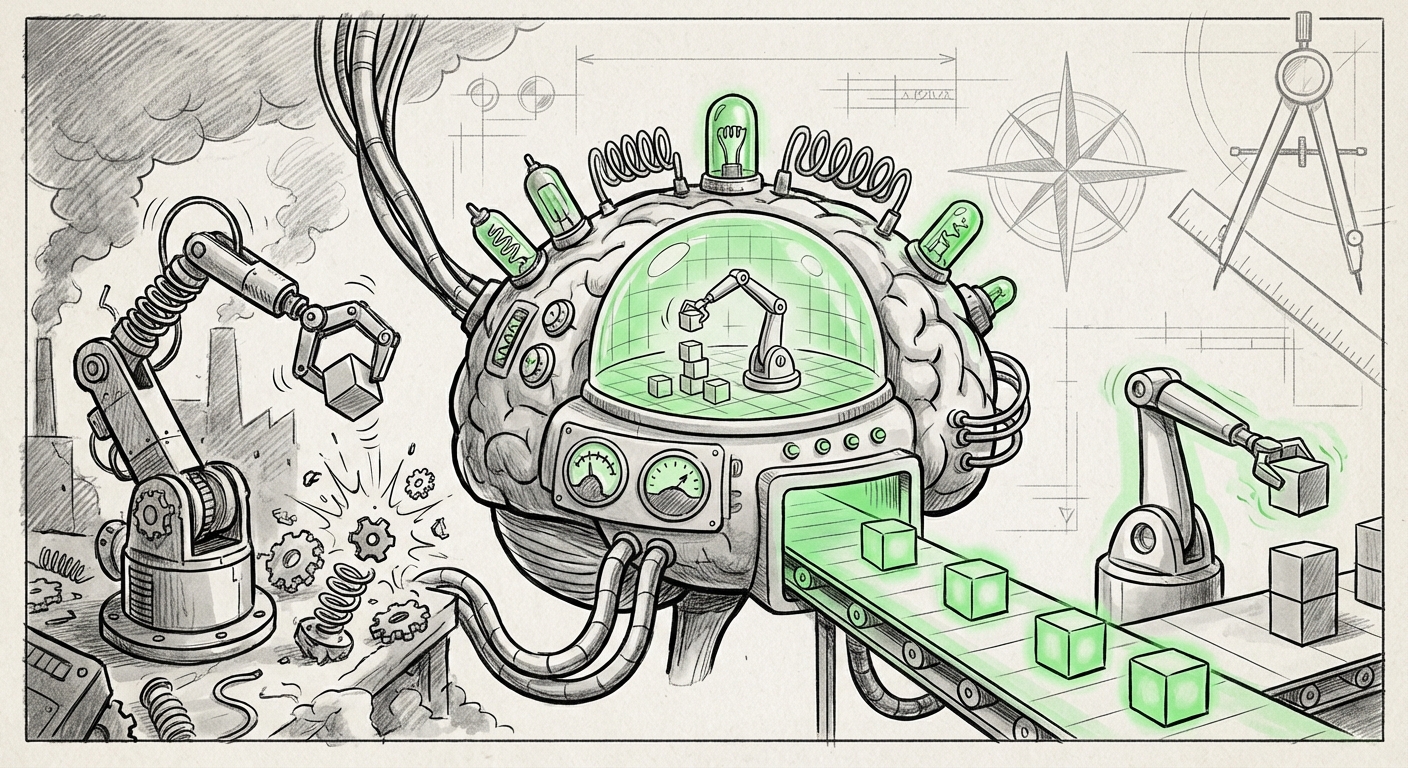
The Simulation Revolution: How Nvidia's DreamDojo and World Models are Rewriting Robotics Training
The path to true general-purpose robotics has always been paved with two major obstacles: the excruciating cost of real-world failure, and the sheer volume of data required to teach a machine dexterity. If a robot needs to learn how to grasp a new, oddly shaped object, it might take thousands of physical attempts. But what if the robot could experience those thousands of attempts inside a perfect, digital hallucination first?
This is precisely the promise being formalized by Nvidia with its open-source initiative, DreamDojo. This project signals more than just a new tool; it represents a fundamental tectonic shift toward simulation-first robotics, powered by the rapidly advancing field of AI World Models. We are moving from physically costly trial-and-error to instantaneously generated, AI-driven foresight.
What Are World Models and Why Do They Matter?
To understand DreamDojo, we must first understand the underlying technology: the World Model. Imagine a small child learning physics. They don't need a physics textbook; they experiment by dropping blocks. A World Model aims to replicate that internal understanding within an AI.
In essence, a World Model is a sophisticated AI trained on sensory data (like video) that learns to compress the world into a compact, internal understanding (often called a *latent space*). Once it has this understanding, it can effectively dream or simulate the future based on the current state. Instead of needing a detailed 3D rendering environment (like those created in specialized tools like Unity or Unreal Engine), the World Model generates the next plausible video frame or state entirely from its learned knowledge.
DreamDojo’s innovation lies in its ability to distill these complex predictive capabilities directly from video data, effectively bypassing the need for meticulously crafted, high-fidelity 3D assets, which have historically been a huge bottleneck in robotics simulation. For a technician, this means:
- Faster Data Ingestion: Training the model on raw video is simpler than building a perfect 3D counterpart of a factory floor.
- Sample Efficiency: The robot doesn't need real-world interaction to learn; it practices millions of times in its internal simulation, drastically reducing the time and cost needed for successful deployment.
This approach taps directly into the frontiers of AI research focused on improving data efficiency, where top researchers stress that general intelligence requires an AI to build an internal, predictive model of its environment (as often discussed in discussions surrounding the direction of AI pioneered by figures like Yann LeCun).
The Great Migration: Simulation vs. Reality in Robotics
For decades, robotics development has been a tug-of-war between the controlled safety of simulation and the messy reality of the physical world. Companies rely on simulation because the physical world is expensive, slow, and dangerous for iterative testing.
However, historical simulations often suffered from the "Sim-to-Real Gap." A robot trained perfectly in a clean digital environment would often fail immediately when deployed on a real factory floor because the simulation failed to capture subtle real-world physics: slight lighting changes, dust on a lens, or minuscule variations in friction.
DreamDojo helps bridge this gap because the world model is trained *on* real-world video data. It is learning the messy, nuanced reality first, and then generating synthetic data from that learned reality. This is the core of the emerging consensus captured by industry analysts: Synthetic data and high-fidelity digital twins are the new battleground for automation.
This shift validates a strategic move across the industry:
- Data Collection in the Wild: Capture more varied real-world video data.
- Model Building: Train a World Model (like DreamDojo) on this data to internalize the physics.
- Massive Virtual Training: Use the now highly accurate internal simulator to run millions of rapid training iterations.
- Deployment: Deploy the resulting, highly capable policy to the physical robot.
Implications for Business and Speed to Market
For businesses, this means the time taken from an idea for a new robotic task (e.g., stacking unfamiliar produce, handling delicate new packaging) to a functional, reliable robot could collapse from months to weeks. Companies that rapidly adopt simulation-first pipelines will gain massive competitive advantages in agility and operational efficiency.
The Strategy Behind Open Source: Nvidia’s Ecosystem Play
Nvidia’s decision to release DreamDojo as open source is a masterstroke in ecosystem building, especially when contrasted with the proprietary simulation engines favored by some competitors.
While proprietary simulation environments offer tight integration but lock users into specific vendors, open-sourcing the core World Model layer serves a different, perhaps more powerful, purpose. By making the *how-to-simulate* accessible, Nvidia is ensuring that:
- The Standard is Set: Developers building cutting-edge robotics policies will naturally optimize them to run best within the Nvidia framework (which includes their necessary libraries and, critically, their hardware).
- Hardware Dependency is Reinforced: The heavy lifting of training these massive World Models requires cutting-edge GPUs (like the Hopper or Blackwell architectures). Even if the simulation code is free, the computation is not.
This mirrors historical tech strategies: provide the foundational tools for free or cheaply to establish a standard, then monetize the necessary high-performance infrastructure required to run those tools at scale. Analysts watching the competitive landscape often look to see if companies like Google or Amazon follow suit, or if they double down on closed, vertically integrated solutions for robotics training.
The Hardware Calculus: Inference at the Edge
If training moves to the cloud on massive clusters of GPUs, what does this mean for the robot on the factory floor? This is the critical question regarding inference—the process of using the trained model to make real-time decisions.
World Models, while powerful predictors, can still be computationally demanding. If a robot relies too heavily on constant cloud communication to run its World Model, latency spikes and connection drops will cause immediate failures. The real test for the next generation of robotics will be shifting this complex decision-making logic—derived from the massive simulation phase—onto smaller, energy-efficient chips installed directly on the robot (Edge AI).
Therefore, the focus shifts from pure training FLOPS to inference efficiency. The future success of DreamDojo-trained robots will depend on how effectively Nvidia (and its competitors) can shrink these powerful generative models to run reliably on lower-power accelerators at the physical edge, ensuring the robot remains agile even when disconnected from the data center.
Actionable Insights for the AI Landscape
The convergence represented by DreamDojo provides clear pathways for various stakeholders:
For AI Researchers & Developers:
Embrace Latent Space: Focus less on modeling explicit physics equations and more on mastering the generative techniques required to build highly predictive latent representations from unstructured data (video, sensor logs). The key competitive edge is no longer building a better 3D engine, but building a better internal hallucination engine.
For Business Leaders & Investors:
Audit Simulation Investment: Review current investment in proprietary, rules-based simulation pipelines. If your core robotics challenge involves complex, unstructured manipulation, shifting resources toward synthetic data generation powered by World Models will yield exponential returns in development speed.
Hardware Dependency Check: Understand that while the software may be open source, the training pipeline will remain tethered to high-end GPU infrastructure for the foreseeable future. Strategic partnerships or hardware purchasing plans must account for this training overhead.
For Societal Implications:
The rapid acceleration of robotics capabilities facilitated by simulation-first training means that the integration of autonomous systems into diverse, everyday environments (logistics, specialized care, complex manufacturing) will happen faster than previously projected. This requires proactive planning regarding workforce retraining and safety standards for highly capable autonomous agents.
Conclusion: The Cognitive Leap in Automation
Nvidia's DreamDojo is a marker in time. It confirms that AI is mastering the art of predicting the future, turning raw video into operational foresight. By decoupling complex training from the physical world via generative World Models, we are witnessing the most significant methodological leap in robotics since the widespread adoption of deep learning.
The future of automation will not belong to those who can afford the most physical robots, but to those who can generate the most valuable synthetic experience. As these models become more accurate, faster, and more accessible through open-source efforts, the difference between a simulated success and a real-world deployment will continue to shrink, ushering in an era of unprecedented speed and scale for intelligent automation.