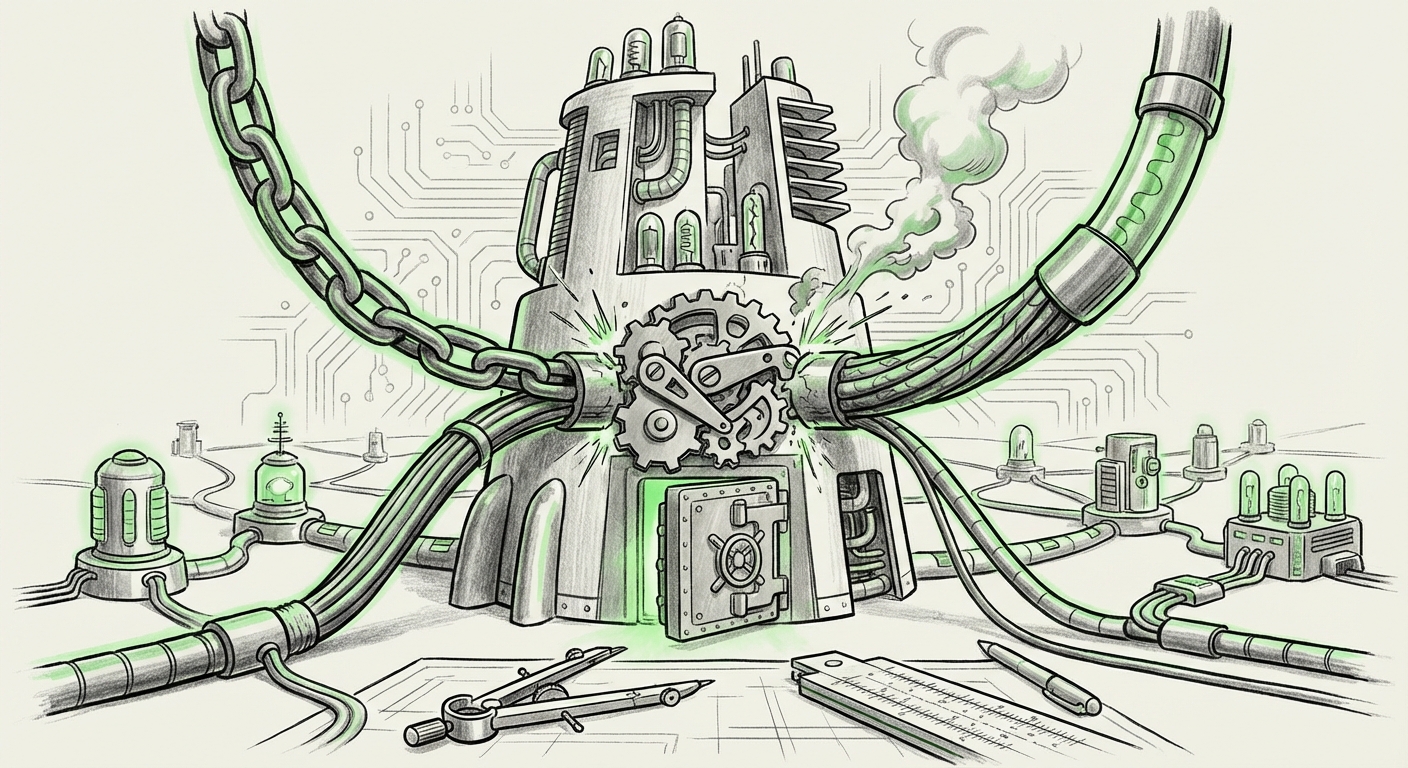
The $500 Billion AI Roadblock: Why the Stargate Project Stall Signals a New Era of Compute Strategy
The race for Artificial General Intelligence (AGI) is often framed as a battle of algorithms and talent. However, the foundation of this entire endeavor rests on something far more tangible and slow-moving: **compute infrastructure**. When news broke that the colossal, $500 billion "Stargate" AI data center project—intended to house the next generation of frontier models—was reportedly stalling, it sent shockwaves through the technology and finance sectors.
This project was meant to be the ultimate physical manifestation of AI ambition, a multi-partner effort involving giants like OpenAI, Oracle, and SoftBank. Its pause signals a crucial tension: the collision between the speed of software innovation and the inertia of real-world physical financing and governance. As an analyst looking at the technological horizon, this stall is less a failure and more a necessary, albeit painful, course correction for the entire industry.
The Anatomy of the Stall: More Than Just a Dispute
The initial reports suggest the friction points are multifaceted: disputes over responsibilities between OpenAI, Oracle, and SoftBank, lender hesitation, and OpenAI needing to fundamentally shift its strategy. To truly grasp the implications, we must dissect these elements against the backdrop of current industry trends.
1. The Financing Reality Check: Lenders Get Cautious
Building a data center costs billions of dollars. Building one dedicated to leading-edge AI—requiring massive power density, exotic cooling, and the latest generation of high-end GPUs—costs exponentially more. Lenders are inherently cautious about financing long-term assets, especially when the technology powering them is evolving every six to twelve months.
The hesitation lenders are reportedly showing mirrors a wider market trend where the initial, almost blind rush to fund *any* AI compute is cooling. Investors are now demanding clearer returns on investment (ROI) and more predictable hardware lifecycles. When a project involves three distinct, powerful entities with potentially misaligned goals (e.g., OpenAI wants speed, Oracle wants utilization, SoftBank wants financial structure), the perceived risk skyrockets. This aligns with broader analyses noting a potential shift toward more scrutinized CapEx spending in the AI sector, moving away from rapid, unfocused deployment toward optimized efficiency.
2. The Cloud Gatekeepers: Oracle’s Strategic Pivot
Oracle Cloud Infrastructure (OCI) has made aggressive strides in positioning itself as the essential, non-Microsoft/AWS alternative for AI workloads. For OCI, the Stargate project was a potential landmark deal to validate their infrastructure prowess. When disputes arise between OpenAI and its primary partner, Microsoft (which typically uses Azure), bringing in a third major player like Oracle complicates governance.
The question becomes: Who controls the architecture? Who manages the power grid access? And crucially, what happens to the capacity if OpenAI shifts significant future training to a different partner? For Oracle, the project must offer guaranteed, long-term commitment, which may conflict with OpenAI’s need for flexibility. Understanding Oracle's current strategy reveals they are playing a high-stakes game to secure major AI contracts, making the terms of the Stargate agreement vital to their competitive position against the hyperscaler titans.
3. OpenAI’s Strategic Reckoning: The Cost of Scale
Perhaps the most telling factor is the need for OpenAI to "fundamentally rethink its strategy." This suggests that the current pathway—buying or leasing massive, dedicated, monolithic infrastructure blocks—is hitting a wall. Frontier models like the rumored GPT-5 or future iterations require computational resources that dwarf the entire previous generation.
The cost per training run is astronomical. If Stargate cannot materialize quickly enough or affordably enough, OpenAI must explore alternatives. This might involve:
- Increased Optimization: Focusing intensely on making existing models run faster on less hardware (algorithmic efficiency).
- Distributed Ownership: Moving toward a model where compute resources are sourced dynamically from multiple providers rather than relying on one massive, shared warehouse.
- Vertical Integration Alternatives: Exploring internal chip design (like Google’s TPUs) to reduce reliance on external suppliers and cloud partners.
What This Means for the Future of AI Compute
The Stargate stall isn't a sign that AI progress stops; it’s a sign that the way we build the infrastructure must change. This development pushes the entire sector toward greater realism and diversity in compute strategy.
The End of the Single Megaproject Era?
For a time, the narrative suggested that AGI required one or two massive, purpose-built "AI factories." The friction in Stargate suggests that future growth will be characterized by **distributed, modular, and highly negotiated capacity.** Instead of a single $500 billion monolith, we are likely to see dozens of smaller, strategically placed partnerships, each optimized for a specific task (e.g., one for training, one for inference, one for fine-tuning specialized models).
Leverage Shifts to Infrastructure Providers
When software moves fast, those who control the physical world gain immense power. The dispute underscores that companies like Oracle, Nvidia (who makes the chips), and energy companies are becoming central strategic players. For any business aiming to deploy large-scale AI, understanding the procurement pipelines and strategic alliances of these infrastructure providers is no longer optional—it is a core competitive differentiator.
The Inference Bottleneck Looms Larger
Training models requires massive upfront power, but using them (inference) requires sustained, cheaper power spread globally. If training capacity stalls, companies will aggressively pivot resources toward optimizing inference. This means more investment in specialized, lower-power chips designed specifically for deployment, rather than just the most powerful ones designed for training.
Practical Implications: Actionable Insights for Businesses
For businesses looking to leverage AI effectively, the uncertainty surrounding frontier compute requires strategic adaptation today. Complacency based on the expectation of unlimited, cheap scale is now obsolete.
1. Diversify Your Compute Portfolio
If you are an enterprise currently relying 100% on one major cloud provider for your AI workloads, the Stargate story is a warning. Vendor lock-in on infrastructure is as dangerous as vendor lock-in on models. Explore commitments with niche providers, investigate sovereign cloud solutions, and build portability into your MLOps pipeline.
2. Prioritize Algorithmic Efficiency Over Brute Force
If the cost of getting the next generation of hardware is rising faster than the models’ performance improvement, the ROI equation breaks. Businesses must now aggressively prioritize data efficiency, model quantization, and sparse computation techniques. How can you achieve 90% of the performance with 50% of the compute? That question is now paramount.
3. Embrace "Compute Sovereignty"
In an environment where massive infrastructure projects become politically and financially complex, those who can secure their own, dedicated access will thrive. This doesn't mean building a data center; it means establishing legally binding, priority-access contracts that ensure capacity during peak demand, likely involving upfront financial commitments similar to the structure SoftBank and Oracle were trying to finalize for Stargate.
Conclusion: Building Smarter, Not Just Bigger
The reported stumbling block of the Stargate project serves as a sobering reality check on the unsustainable capital requirements fueling the current AI arms race. The age of seemingly endless, rapidly deployed compute capacity funded purely by venture optimism appears to be transitioning into an era defined by strategic negotiation, financial discipline, and architectural complexity.
The future of AI will not be defined solely by the smartest model, but by the most resilient, efficiently deployed infrastructure supporting it. The key players are being forced to move from a "build it and they will come" mentality to a highly nuanced, politically delicate balancing act between software genius and the harsh physics of power, cooling, and finance. This adjustment period will favor those who can innovate not just in code, but in the very architecture of computation itself.