The $16 Million Question: Why AI Model Theft Through Querying Will Reshape IP Law and Security
The world of Artificial Intelligence is built on two pillars: groundbreaking research and immense computational power. When an AI company claims that competitors have effectively stolen the result of these investments, it signals more than just a business dispute; it marks a fundamental shift in how intellectual property (IP) is valued and protected in the digital age. Anthropic’s recent accusation—that Chinese firms Deepseek, Moonshot, and MiniMax executed 16 million queries to siphon the learned knowledge from their Claude models—is precisely this kind of watershed moment.
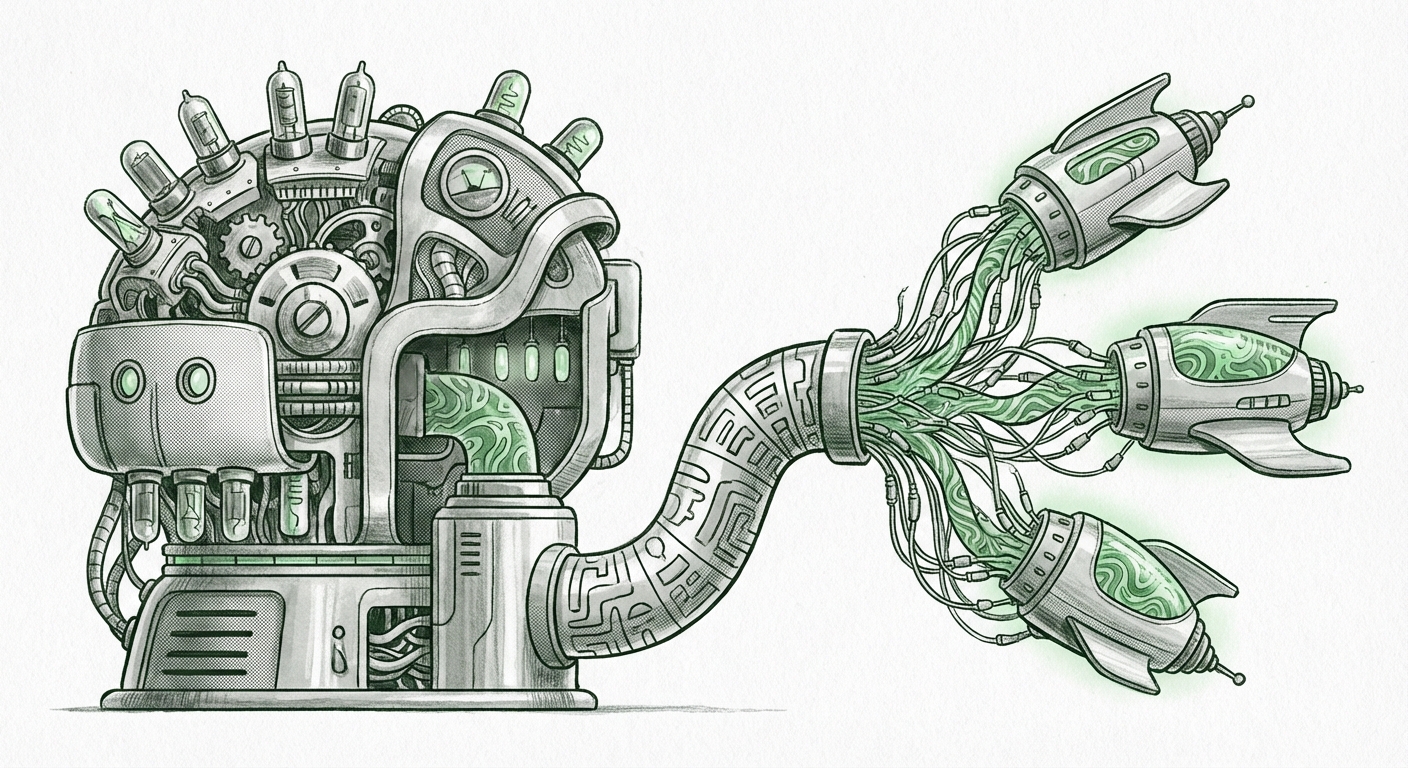
This isn't about hacking a server to steal source code. This is about model extraction. Imagine spending years building a complex machine, and someone figures out how to perfectly replicate its output just by feeding it thousands of tailored inputs and carefully recording the results. That's what this controversy suggests. For technical experts, business leaders, and policymakers alike, understanding this new form of theft is crucial for charting the future of innovation.
The New Frontier of Theft: Black-Box Model Extraction
To grasp the gravity of this situation, we must understand the technology involved. Large Language Models (LLMs) like Claude are massive neural networks. Their "knowledge" isn't stored in neat files; it's encoded in billions of numerical parameters (weights). Replicating these weights is the holy grail for competitors seeking to bypass years of costly training.
When a model is accessed only via an Application Programming Interface (API)—a software gateway—it is considered a "black box." You can see the inputs (your prompt) and the outputs (the model's answer), but you cannot see the internal workings. The alleged theft method relies on systematically probing this black box.
If you ask an LLM, "What is the capital of France?" a million different ways, or prompt it with complex logical sequences that highlight its unique reasoning capabilities, you are essentially mapping out its decision-making structure. Researchers have long warned about this threat, often called **"model extraction attacks"** or **"knowledge distillation."** The attacker builds a smaller, secondary model whose sole job is to mimic the massive target model. By feeding the target millions of strategically designed queries, the attacker creates a huge dataset perfectly tailored to train their mimic model until it behaves nearly identically to the original Claude.
For the technical audience: This method validates the concern that query volume and query quality can be used as proxies for weight theft. It suggests that the 16 million queries were likely not random conversation, but a highly structured sweep designed to cover the input distribution space of Claude’s unique capabilities—perhaps focusing on complex coding tasks, safety guardrails, or unique reasoning chains that Anthropic spent millions developing.
The Geopolitical and Competitive Undercurrents
This accusation is not happening in a vacuum. It is deeply embedded in the accelerating global race for AI supremacy. As detailed in analyses of Chinese LLM training methods and data acquisition strategies, there is immense pressure on domestic firms to rapidly close the perceived capability gap with leaders in the US and Europe.
Training a frontier model costs hundreds of millions of dollars and requires access to vast, curated datasets. If a company can reduce that timeline and cost by essentially "reverse-engineering" the outputs of a competitor’s mature model, the economic incentive is staggering. The success of Deepseek, Moonshot, and MiniMax in the competitive landscape hinges on achieving state-of-the-art performance quickly. If these firms can clone the most expensive part of the process—the learning itself—they gain an immediate, massive competitive advantage.
This puts the focus squarely on the ethics and legality of using commercial API access—meant for generating outputs—as a means of data harvesting. It’s the difference between buying a car (using the API for its intended purpose) and running destructive stress tests on the engine overnight to figure out exactly how the manufacturer tuned it.
The Legal Quagmire: Is Learned Knowledge Protectable?
This case will almost certainly end up in court, setting precedents that will define the AI industry for decades. Currently, international AI intellectual property rights frameworks are struggling to catch up to the technology.
Copyright vs. Trade Secrets
Source code is clearly protected by copyright and trade secret laws. But what about the pattern of responses generated by the model? Anthropic must argue that the *systematic construction* of the query set, and the resulting map of responses, constitutes proprietary data or trade secrets. The defense, conversely, will argue that every single query and response was generated using a publicly available, paid-for service—treating the interaction as standard commercial use.
This brings up essential legal questions:
- Can an API rate limit (or lack thereof) define the boundary of acceptable usage?
- Does the intent behind the queries matter more than the technical means of collection?
- How does international IP law treat the theft of *knowledge* versus the theft of *expression*?
For policymakers, this forces a reckoning. If model outputs cannot be sufficiently protected, the incentive for well-funded labs to invest in foundational research may diminish, leading to a centralization of power or, worse, a widespread reliance on "sampling" competitor work rather than true innovation.
Future Implications: The AI Security Arms Race
Anthropic’s public accusation is, in itself, a form of defense—a public warning shot designed to deter future attempts. However, the future of secure AI development hinges on how developers, like Anthropic, respond to threats against their foundational models, which leads to the critical area of model security safeguards against data extraction.
Defensive Innovation
The industry cannot afford to rely solely on Terms of Service agreements. We are entering an AI security arms race:
- Advanced Rate Limiting and Anomaly Detection: Future API monitoring must evolve beyond simple request counts. Systems will need sophisticated AI detectors trained to spot the subtle patterns indicative of model extraction attempts—the statistical uniformity, the lack of semantic drift in queries, or the focus on known adversarial test cases.
- Output Watermarking and Fingerprinting: Developers may implement subtle, invisible modifications within the model’s internal architecture or outputs. If a rival model produces an answer bearing Anthropic’s hidden "watermark," the evidence of theft becomes undeniable and mathematically verifiable.
- Differential Privacy Measures: Integrating techniques that intentionally introduce noise during training or inference can make it mathematically difficult for an extraction model to learn the exact parameters of the original, ensuring that the mimic model only achieves a blurry approximation, not a high-fidelity clone.
For CTOs relying on third-party foundation models, this event serves as a stark reminder: Your vendor’s security posture is now part of your supply chain risk. If your business relies on proprietary models for competitive advantage, you must press your vendors on their model extraction detection and prevention capabilities.
Practical Takeaways for Business and Society
This incident has immediate, practical implications across several sectors:
For AI Developers and Startups: Revaluing Training Data
If the value of an LLM can be distilled down to queryable outputs, developers must treat their data acquisition and training methodology as their most guarded secret. Investment must shift heavily toward techniques that make extraction harder, even if it slightly slows down initial deployment.
For Corporations: Auditing Third-Party AI Usage
If your company licenses access to a proprietary model (e.g., Claude, GPT-4, Gemini), you need clarity on your contractual obligations. Are your usage patterns permissible? Could your scale of use inadvertently trigger monitoring alerts for suspicion of data harvesting?
For Regulators: Defining Digital IP
Governments must urgently clarify the legal status of learned knowledge within AI systems. Without clear rules, companies will either over-protect their research, stifling open collaboration, or under-protect it, leading to a stagnation of genuine foundational innovation as firms prioritize defensive maneuvers over breakthrough research.
Conclusion: Beyond the Code
The alleged actions of Deepseek, Moonshot, and MiniMax represent the maturation of AI competition. We have moved past merely fighting over computing clusters and open-sourcing code. The battleground is now the *intelligence* itself—the highly compressed, proprietary representation of world knowledge encoded within the model weights.
Anthropic’s move forces the entire AI ecosystem to confront the fragility of its current security assumptions. The next generation of foundational models will be designed not just for performance, but for forensic traceability and resilience against systematic probing. This conflict is not just about one company defending its asset; it is about establishing the ground rules for who owns the fruits of digital ingenuity in the age of artificial intelligence.
The technology is advancing faster than the law. Unless robust, enforceable standards for model integrity are rapidly established—both technically and legally—the pace of fundamental AI development risks being overshadowed by endless cycles of accusation, defense, and imitation.
Note on Corroboration: This analysis synthesizes the core allegation and discusses anticipated research directions based on established AI security literature concerning model extraction. The exploration of technical feasibility, legal hurdles, and competitive dynamics relies on anticipated corroborating evidence sought via the suggested search queries.
Reference to initial report: The Decoder article detailing the accusation can be found at: https://the-decoder.com/anthropic-accuses-deepseek-moonshot-and-minimax-of-stealing-claudes-ai-data-through-16-million-queries/