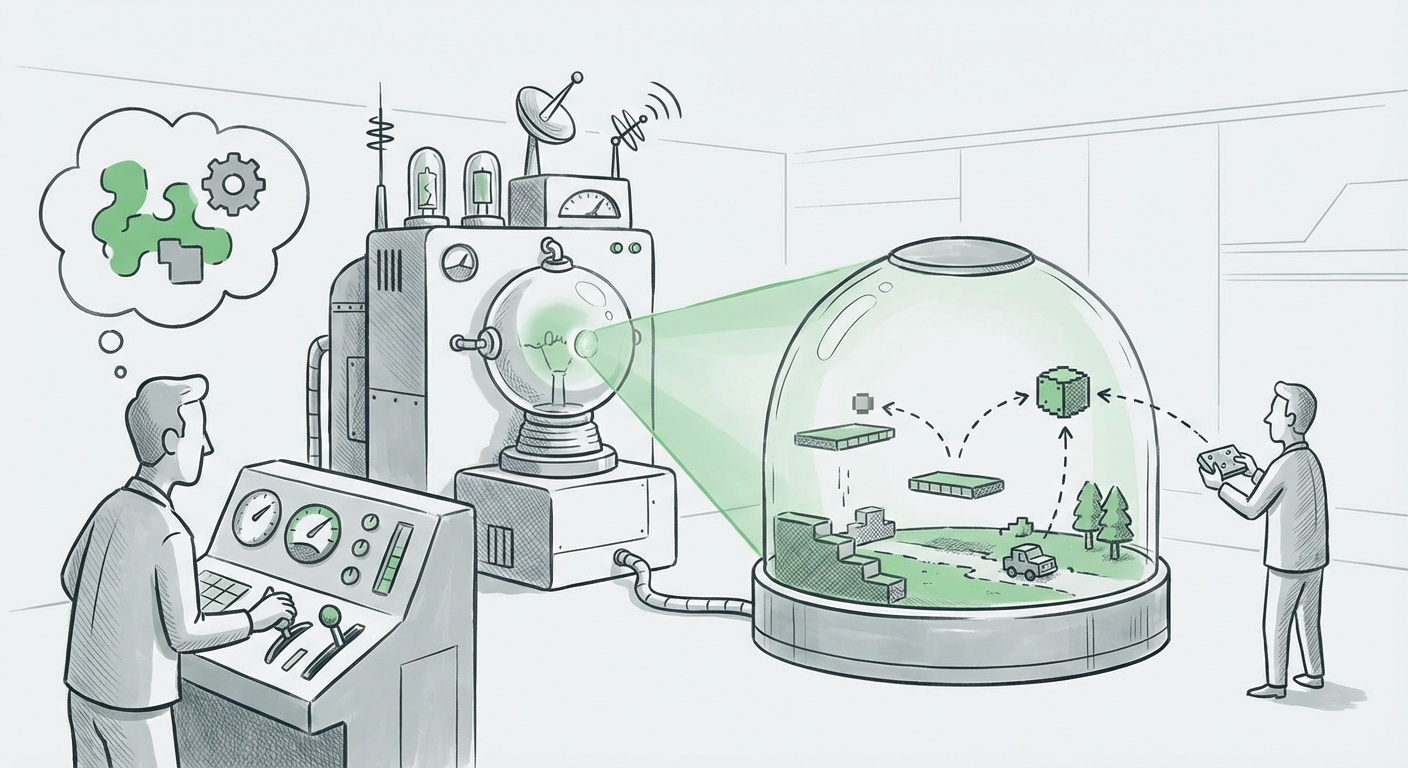
DeepMind Genie: The AI That Generates Controllable Interactive Worlds – What This Means for the Future of Simulation
The world of Artificial Intelligence is rapidly accelerating beyond static creation—generating images, text, and video—and moving toward dynamic, interactive experiences. DeepMind’s recent introduction of Genie, a generative interactive world model, is not just an incremental update; it signals a paradigm shift in how we conceive of AI-driven simulation and creativity. Based on initial reports, Genie allows users to prompt a text description and instantly receive a controllable, playable 2D environment. This leap from passive generation to active interaction demands a deeper analysis of its technological underpinnings, competitive positioning, and profound future implications.
The Core Breakthrough: World Models Meet Diffusion Power
To appreciate Genie, one must understand the dual technological forces at play: World Models and Diffusion Models.
Imagine an AI trying to learn chess. An older system might simply memorize millions of games (data). A World Model, however, tries to build an internal, simplified "physics engine" or rulebook of the game. It learns the *consequences* of its actions within a simulated environment. This is crucial for planning and adaptability.
Genie appears to combine this predictive power with the incredible fidelity of modern diffusion models (the technology behind tools like DALL-E or Midjourney). Diffusion models excel at generating high-quality, novel outputs by iteratively refining random noise into a coherent image or scene. Genie applies this generative power to an interactive state space.
In simple terms, Genie doesn't just draw a picture of a castle; it generates the underlying logic—the "world"—that allows that castle to be explored and manipulated. This moves us beyond simple content synthesis into procedural, controllable simulation. For our ML engineering audience, this suggests a powerful new method for training predictive latent spaces that are directly steerable by natural language inputs.
To gain deeper insight into this technological foundation, one should explore recent advancements in predictive AI systems. Sources focusing on how AI is moving from pattern recognition to predictive modeling—often involving self-supervised learning in complex state spaces—provide the necessary context for understanding Genie's architecture.
Actionable Insight for Researchers:
Focus research on how prompt adherence can be maintained across sequential, interactive steps, ensuring the emergent "world" remains logically consistent as the user interacts with it.
The Competitive Edge: Agents and the Race for Interactive AI
Genie enters a crowded field where tech giants are vying to create the next general-purpose AI platform. This competition centers not just on intelligence, but on *interaction*.
While other leaders—like OpenAI, Meta, and specialized firms—are focused on creating embodied agents that can navigate the real world (robots) or digital worlds (advanced LLM agents), DeepMind’s approach seems focused on rapid, user-facing world *creation*. If a user can type "a spooky, pixelated platformer with floating rocks" and immediately start playing and directing the environment, this significantly lowers the barrier to entry for digital simulation.
We need to compare Genie's interactive fidelity with ongoing work in areas like creating synthetic training environments. Platforms like NVIDIA Omniverse or various research efforts building digital twins rely on complex, often hand-coded, simulation physics. If Genie can generate these complex environments on demand, it offers a disruptive efficiency advantage.
This competitive analysis shows that the future platform wars will be fought over controllability and speed of instantiation within complex systems, not just the size of the model parameters. For business strategists, this means that any platform offering superior, on-demand simulation capabilities will hold significant leverage.
Connecting the Dots:
Analyzing how Google/DeepMind’s capabilities stack up against those of competitors like Meta's generative efforts or OpenAI's agent planning reveals where the industry consensus lies on the next major computational hurdle: mastering dynamic, controlled environments.
Practical Implications: The Democratization of Digital Creation
The ability to generate an entire, playable world from a few sentences is a seismic event for content creation. This is where the technology transitions from a lab curiosity to a powerful commercial tool.
1. Revolutionizing Game Development and Prototyping
For decades, creating even a simple game required specialized coding, asset design, and level building. Genie promises to shrink this timeline from months to minutes. A small indie studio or even a single developer can now iterate on game mechanics and aesthetics instantly. They can test dozens of world concepts before committing to a single one.
This doesn't mean human designers are obsolete; rather, their roles evolve. Instead of manually building the 1000th tree asset, the designer becomes the curator and director of the AI’s output, focusing on narrative depth, unique mechanics, and polishing the generated core experience. The market disruption here is immense, potentially flooding the digital landscape with novel experiences at an unprecedented rate.
2. The Metaverse and Interactive Training
Beyond gaming, interactive world models are foundational for future metaverse platforms and specialized training simulations. Imagine simulating complex emergency responses, surgical scenarios, or intricate factory floor logistics, all generated instantly based on desired parameters (e.g., "simulate a fire in a five-story building with compromised structural integrity").
This rapid, tailored simulation capability offers immediate ROI in fields requiring high-stakes practice without real-world risk. For audiences in industrial technology and VR/AR development, Genie hints at a future where bespoke training environments are built on the fly.
3. Content Generation at Scale
For digital artists and marketers, the ability to generate worlds that can be *interacted with* opens up new avenues for advertising, interactive learning modules, and digital art installations that respond to user input. The shift is from creating flat media to creating persistent, explorable spaces.
The Necessary Check: Ethical Guardrails for Controllable Worlds
With great generative power comes great responsibility, especially when the output is not just a picture but a functioning, interactive environment. The very definition of "controllable" must be rigorously scrutinized.
If Genie can create any world based on a prompt, what mechanisms prevent the generation of worlds that promote hate speech, contain illegal content, or simulate harmful activities? The challenge here is exponentially harder than filtering static text or images.
We need robust filtering on the *input* (the prompt) and, more critically, on the *emergent state* of the generated world. If an agent interacting within the generated world learns harmful behaviors based on the environment's rules, the system must recognize and interrupt that trajectory. This necessitates advanced AI alignment techniques that monitor state transitions rather than just static outputs.
This area of research—focused on the governance and safety of highly capable, interactive AI—is arguably the most critical for sustainable long-term adoption. Policy makers and ethicists must engage now to understand the risks associated with creating powerful, customizable simulation engines.
Key Ethical Questions:
- How can we ensure model alignment when the AI is generating the rules of the environment itself?
- What level of oversight is required for user-generated interactive simulations deployed publicly?
- How do we trace bias originating from the training data into the physics and logic of an emergent world?
Conclusion: The Dawn of Synthetic Reality Engineering
DeepMind’s Genie, as contextualized by the broader trends in generative models and interactive agents, marks a significant milestone. It is a transition point where AI moves from being a powerful tool for *creation* to becoming a platform for *simulation engineering*. We are rapidly approaching a time when defining a complex digital environment will require only language, not years of specialized programming.
For businesses, the actionable takeaway is clear: start exploring how on-demand, high-fidelity simulation can accelerate your R&D, training pipelines, or content strategy. For AI practitioners, the challenge lies in mastering the control and safety of these emergent interactive spaces.
The sequence of knowledge suggests that the next great frontier for AI is not just intelligence, but the ability to rapidly prototype, test, and iterate within self-generated realities. Genie is building the scaffolding for that future, one text prompt at a time.