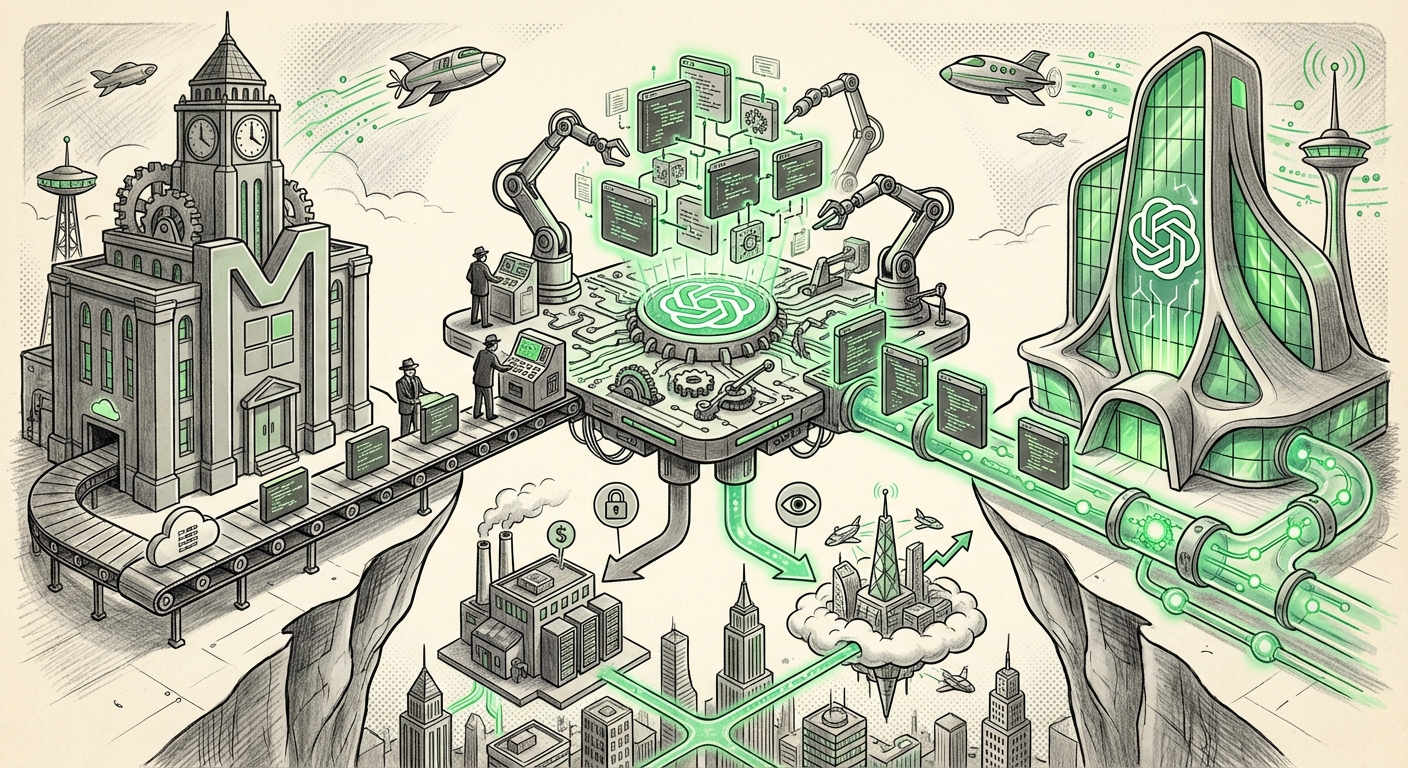
OpenAI vs. Microsoft: Why the Next AI Battleground is Your Code Repository
The technology landscape is currently defined by one core tension: the race to control the next generation of AI capabilities. For months, we have watched OpenAI and its largest investor, Microsoft, collaborate to bring revolutionary tools like GPT models and GitHub Copilot to the world. But recent reports suggest a tectonic shift is underway: OpenAI is reportedly building its own alternative to GitHub, the world’s leading platform for code management owned entirely by Microsoft.
As an AI technology analyst, this is far more than a simple business rivalry; it is a clear signal about where the true power in the AI economy will lie. If AI tools are the engine of future software creation, then the platform where that code lives—the repository, the testing ground, and the collaboration hub—is the critical territory. Controlling that ecosystem means controlling the developer workflow, the data lineage, and ultimately, the future monetization of AI-assisted software.
The Pivot: From Partner to Competitor
To understand the magnitude of this rumor, we must first acknowledge the existing relationship. Microsoft has poured billions into OpenAI and has deeply integrated its technology across its stack, most notably through GitHub Copilot, which sits directly on the GitHub platform. This partnership has been mutually beneficial: OpenAI gets massive computing power via Azure, and Microsoft leverages OpenAI’s cutting-edge models.
However, the goal of any foundational AI provider is to own the interface where users interact with their intelligence. For OpenAI, this means moving beyond merely offering APIs and into offering end-to-end application platforms. A dedicated, OpenAI-native code platform suggests a strategy where the repository itself is optimized specifically for their most advanced models and future autonomous coding agents.
This move directly challenges the core thesis of Microsoft’s developer strategy. If developers flock to an OpenAI-native code environment because it offers superior integration with the next generation of AI tools, GitHub becomes relegated to being just a storage locker, rather than the central nervous system of code creation. This is a classic case of ecosystem capture.
Contextualizing the Trend: The Rise of AI-Native Platforms
This suspected move by OpenAI is not happening in a vacuum. It reflects a broader market realization that legacy tools built before the generative AI boom are fundamentally ill-equipped for the new paradigm. We have explored this competitive dynamic through analysis of the emerging market for **“AI code platform” vs GitHub future**. Developers are looking for tools designed from the ground up for LLMs, not tools that have had LLMs bolted on as an afterthought.
Existing platforms must now prove they can handle reasoning across vast, multi-file codebases efficiently. If OpenAI builds a repository tailored for its models—perhaps one that indexes context instantly or allows for agent-driven commits—it immediately sets a new bar that even the market leader, GitHub, must scramble to match. This pressure forces healthy competition but also creates friction in major partnerships.
The Real Prize: Autonomous Coding Agents
The most compelling reason for OpenAI to build this platform is the looming reality of autonomous coding agents. We are moving past simple code completion (like Copilot) toward AI systems that can receive a high-level instruction, plan the necessary changes across multiple files, write the code, test it, and push the final pull request.
These advanced systems, often called AI software engineers, require a specialized environment. They need deep, persistent context about the entire project state, security sandboxes for testing, and direct integration with version control pipelines. A platform built by OpenAI would ensure their agents have the optimal environment to function, potentially rendering GitHub’s current interface and integration paths less efficient for these future tasks.
As noted when tracking the progress of **“Autonomous coding agents” software engineering future**, the success of tools like Devin has proven that developers are ready for AI to take on larger, more complex engineering tasks. OpenAI’s move indicates they believe the future platform must serve the agent, not just the human user.
Implications for Developers and Businesses
For developers, this means choosing sides in a high-stakes technological arms race. Do you stick with the established giant (GitHub, supported by Microsoft) that offers excellent tooling today, or move to the potentially more integrated, but currently theoretical, platform from the model creator?
For businesses, the implication is crucial for risk management. If your core intellectual property (your code) resides on a platform that may soon be less favored by the AI models driving your development, you face technical debt and platform risk. Companies must monitor the **Microsoft Azure OpenAI service roadmap implications** closely, as Azure's strategy is designed to keep those OpenAI capabilities locked within the Microsoft cloud fence.
The Cracks in the Foundation: Partnership Stress
When a company directly challenges its primary investor’s crown jewel, the partnership dynamics shift from symbiotic to tense. This move signals that OpenAI is prioritizing platform control over partnership comfort. This is a necessary evolution for any company aiming for true market dominance rather than relying solely on licensing fees.
This action also drives analysts to examine **OpenAI moving away from Microsoft Azure dependence**. While Microsoft currently provides the essential compute power for training OpenAI’s cutting-edge models, an independent code platform suggests OpenAI is building its own client-facing application layer that might benefit from running on alternate cloud providers (like AWS or Google Cloud) or even custom hardware in the long term. This diversification reduces their vulnerability to Microsoft’s strategic decisions regarding pricing or access.
What Does This Mean for AI Infrastructure?
The battle for code repositories is part of a larger trend: the fight for the AI stack’s vertical integration. Currently, the stack is fragmented:
- Foundation Models: Dominated by OpenAI, Google, Anthropic.
- Infrastructure (Compute): Dominated by AWS, Azure, GCP.
- Developer Tools (Codebase): Dominated by GitHub.
OpenAI’s potential move aims to own Points 1 and 3 simultaneously. By controlling the platform where code is stored and managed, they gain invaluable, proprietary feedback loops on how their models perform in real-world engineering scenarios—data that is gold for iterative model improvement.
Actionable Insights: Navigating the Coming Split
The technology world must prepare for a future where the primary AI vendor might not be hosting your code. Here are actionable insights for leaders:
1. Diversify Your AI Tooling Strategy (For CTOs & Architects)
Do not allow your organization to become entirely dependent on a single vendor stack. If your AI assistance is entirely Copilot-based, start piloting tools from other providers (like Sourcegraph Cody or emerging internal tooling) to maintain optionality. If an OpenAI code platform launches, rapidly evaluate its cost, security posture, and integration capabilities.
2. Focus on Model Agnosticism (For Developers)
While model performance is key, strive to design systems where the *interface* layer (the platform/repository) can swap out the underlying model provider with minimal friction. The loyalty in the developer community will shift to the platform that offers the best combination of agency, security, and integration, regardless of which company branded the underlying GPT version.
3. Re-evaluate Cloud Lock-in (For Business Strategists)
The Microsoft/OpenAI tension should serve as a severe warning about the risks inherent in exclusive, high-stakes partnerships. Businesses relying heavily on Azure for their OpenAI deployment should actively seek parallel partnerships or develop in-house deployment strategies to hedge against potential decoupling between the two giants.
Conclusion: The Ownership of Intelligence
OpenAI's rumored entry into the code repository space is a strategic declaration of independence and ambition. It signals that the company views the entire software creation lifecycle—from conception to deployment—as its rightful domain, not just the intelligence layer.
The rivalry between OpenAI and Microsoft, playing out on the foundation of GitHub, is the defining strategic conflict of the next decade in enterprise technology. It is about who dictates the standards, who owns the data, and who profits from the automated software economy. For everyone involved in building software, the message is clear: the tools we use to write code are about to get a massive, potentially disruptive, upgrade—and you may soon have to choose which ecosystem you want to build in.