The AI Battlefield: Decoding the US Military’s Use of Claude for Advanced Strike Planning
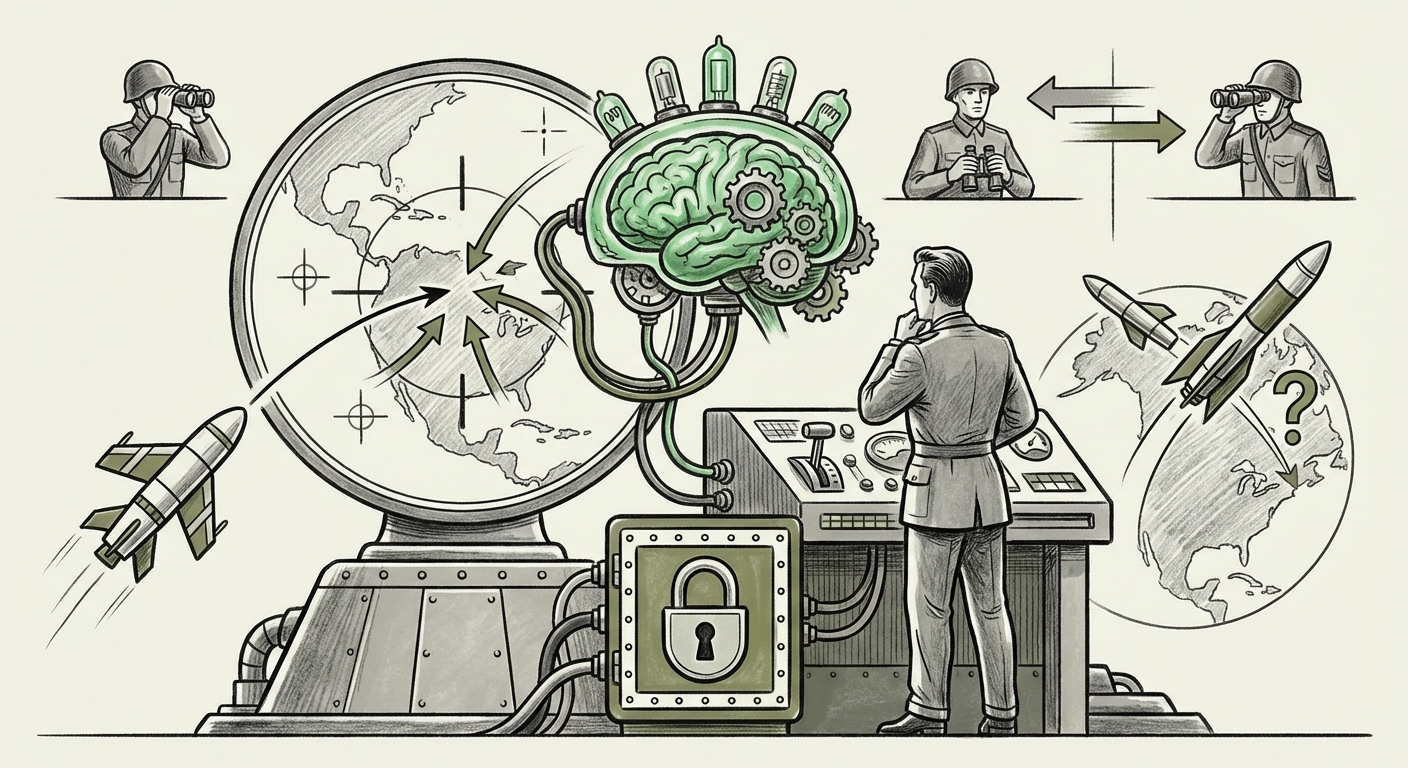
The announcement that the US military is leveraging generative AI, specifically Anthropic’s Claude, for strike planning against targets in Iran marks a profound inflection point in modern warfare. This is not merely an incremental software upgrade; it represents the operationalization of frontier Large Language Models (LLMs) in the most sensitive, high-consequence domain imaginable: kinetic military action. To truly understand the future implications, we must move beyond the initial headlines and examine the underlying technological shifts, security hurdles, and ethical tightropes being walked.
The Convergence: LLMs Meet Kinetic Targeting
Generative AI, popularized by tools like ChatGPT, excels at synthesizing vast amounts of unstructured data—maps, intelligence reports, historical documents, and operational plans—to propose novel solutions or summaries. In the context of military targeting, this capability transforms the planning cycle:
Imagine a planner sifting through thousands of pages of intelligence data about a complex urban environment to identify the most effective sequence of actions to neutralize a specific threat while minimizing collateral damage. An LLM, trained on these inputs, can process this deluge of information in minutes, generating optimized courses of action (COAs) for human review.
The choice of Anthropic’s Claude is noteworthy. Anthropic, founded by former OpenAI leaders, has built its reputation on a foundation called "Constitutional AI," prioritizing safety and alignment. Yet, deploying such a sophisticated model in a real-time conflict—especially one potentially involving sanctions or geopolitical sensitivity related to the developer—raises immediate questions about the custom environments needed to secure commercial off-the-shelf (COTS) models.
This development signals a clear trend across the Pentagon: AI is moving out of the lab and into active operational theatres, shifting from providing mere situational awareness to actively participating in complex decision support for kinetic missions. This is the future of defense modernization in action.
Corroborating the Trend: Beyond the Pilot Phase
The use of Claude in this context suggests that the DoD’s broader strategy is maturing rapidly. To understand how widespread this is, one must look for evidence of systemic integration. Searches focused on [ "Pentagon" "generative AI" "targeting systems" "LLM integration" ] are crucial because they reveal whether this is an isolated, rapid deployment or part of a structured modernization pathway, such as the Department of Defense’s AI Ethical Principles in practice.
If we find evidence of numerous contracts or strategic announcements (like those detailing the DoD’s Pathfinder initiatives), it confirms that the US military is systematically embedding LLMs into the kill chain—the process of finding, fixing, tracking, targeting, engaging, and assessing a target. For defense contractors and tech providers, this means the market for secure, mission-specific LLMs is rapidly expanding beyond basic administrative tasks.
The Trust Factor: Security and Accreditation in High-Stakes AI
When an LLM assists in deciding where a missile should fly, the integrity of that model is paramount. The data must be secure, and the model must resist adversarial manipulation (prompt injection or data poisoning).
For commercial models like Claude to be used in military planning, they must meet stringent DoD requirements for handling classified or sensitive unclassified information. This accreditation process is arduous. We need to investigate searches centered on [ "Anthropic Claude" "security compliance" "DoD impact level 5" OR "FedRAMP" military use ].
Achieving higher DoD Impact Levels (like Level 5, which governs Controlled Unclassified Information (CUI) and sometimes lower levels of classified data) means the cloud environment hosting the model must meet extremely high security standards regarding boundary protection, data encryption, and resilience. If Claude is being used, it implies one of two things:
- Anthropic or a defense partner has successfully created a highly secured, siloed environment that meets these rigorous standards for running the specific model variant.
- The data being processed at this stage of "strike planning" is primarily unclassified intelligence synthesis, which is then handed off to a human analyst for final verification before being released to a classified system.
For the broader business and technology community, this highlights the "sovereignization" of AI. Even commercial models require a custom, trusted pipeline when deployed by governments for national security—a massive new market segment focused purely on secure AI infrastructure.
The Ethical Abyss: Human Oversight in AI Targeting
The most challenging future implication lies in ethics and policy. When an AI generates a target recommendation, how far does human responsibility extend? The policy governing this is often rooted in the DoD’s commitment to Responsible AI and existing directives like DoD Directive 3000.09, which deals with autonomy in weapons systems.
The critical phrase here is the "human in the loop." Does the AI merely suggest an option, or does it automate the entire selection process, leaving the human only to press the final "launch" button? Analyzing queries like [ "Responsible AI" "DoD" "lethal decision support" "human in the loop" generative AI ] reveals the ongoing internal policy struggle.
For a tool like Claude, which excels at probabilistic reasoning and drafting text-based plans, its role is likely currently one of *decision augmentation* rather than *decision automation*. It helps the human planner see things faster and analyze contingencies better. However, the speed advantage offered by AI creates immense pressure to reduce human review time, potentially eroding that crucial human-in-the-loop barrier over time.
If an LLM can process intelligence faster than an adversary can react, human confirmation becomes a bottleneck. This pushes the industry towards higher levels of autonomy, forcing policymakers to define what constitutes "meaningful human control" when the tool itself is a complex, black-box reasoning engine.
The Geopolitical AI Arms Race Heats Up
Technological breakthroughs in one nation’s military capability invariably trigger reactions from competitors. The deployment of frontier LLMs in US strike planning acts as a clear signal to peer adversaries, particularly China and Russia, that the integration of generative AI into operational planning is no longer theoretical.
Researching [ "US military AI targeting" "China response" OR "Russia response" AI warfare" ] is essential for gauging the speed of technological escalation. Adversaries will immediately focus on two countermeasures:
- Defensive AI: Developing counter-LLMs capable of detecting, confusing, or poisoning the data streams feeding US targeting AI.
- Offensive Parity: Rapidly deploying their own, perhaps less ethically constrained, AI systems to match or exceed US speed and accuracy.
This development accelerates the *algorithmic arms race*. The future of warfare will be defined not just by who has the most advanced hardware (drones, jets) but by whose AI can process the operational environment, adapt to surprises, and generate superior COAs faster than the opposition.
Practical Implications: What This Means for Business and Society
While the conflict zone seems distant, the lessons learned from securing and deploying Claude in this environment cascade directly into the commercial sector:
1. The Demand for Sovereign and Compliant AI Infrastructure
The military’s need for customized, air-gapped, or highly secure instances of commercial LLMs validates the market for 'sovereign AI.' Businesses in highly regulated sectors (Finance, Healthcare, Critical Infrastructure) will increasingly demand the same guarantees of data isolation and model integrity that the DoD requires. If you handle sensitive customer data, you may soon need a 'DoD-approved' standard of isolation for your LLMs.
2. Speed vs. Safety: A Constant Trade-Off
The operational necessity for speed in conflict will drive AI model improvements faster than any commercial use case. While Anthropic focuses on safety, the battlefield demands immediate, decisive output. This tension will pressure civilian applications to prioritize utility and speed over cautious iteration, potentially leading to more frequent, high-impact AI errors in the commercial sphere until governance catches up.
3. New Roles for Human Expertise
The role of the traditional intelligence analyst or military planner is not eliminated; it is elevated. These professionals are transforming into highly skilled AI Verifiers and Prompters. Their value lies less in data recall and more in knowing how to question the AI's output, spot subtle bias or hallucination in complex scenarios, and provide the final, ethically weighted judgment.
Actionable Insights for Navigating the Future
For organizations and policymakers looking ahead, the integration of frontier LLMs into warfare provides several crucial takeaways:
- Invest in AI Red-Teaming Now: If militaries are integrating models for targeting, every major corporation needs to aggressively test its own AI systems for adversarial prompt injection and data poisoning. Assume your production models can be tricked.
- Demand Transparency in Data Provenance: Just as the DoD needs to know where Claude’s training data came from, businesses must demand clarity on the data used to fine-tune proprietary models, especially those making customer-facing or mission-critical recommendations.
- Formalize Ethical Thresholds Before Crisis: Policy makers must swiftly finalize clear, legally binding guidelines for "human in the loop" autonomy. Relying on vague principles during a crisis leads to dangerous decision compression. Define the acceptable failure rate for AI-assisted kinetic decisions *now*.
- Monitor the Cloud Security Arms Race: The technology required to secure Claude for the military will become the baseline for high-security commercial cloud deployments within 18-24 months. Monitor defense contractors closely for insights into next-generation zero-trust architecture for AI workloads.
Conclusion: The Unstoppable Operationalization of Intelligence
The US military's adoption of cutting-edge generative AI for strike planning is a watershed moment. It confirms that the transition from theoretical AI concepts to integrated, real-world operational tools is accelerating across the defense spectrum. We are moving into an era where the speed of intelligence synthesis—powered by LLMs—will be a primary measure of military effectiveness, overshadowing traditional metrics of physical hardware superiority.
This trend solidifies the fact that AI is no longer just a competitive edge; it is becoming a fundamental requirement for operational relevance in geopolitics. The challenges are immense—from securing proprietary models to defining the ethical constraints of algorithmic warfare—but the momentum toward operational AI deployment appears irreversible. The world is watching how successfully, and how safely, these powerful new tools can be governed in the crucible of conflict.