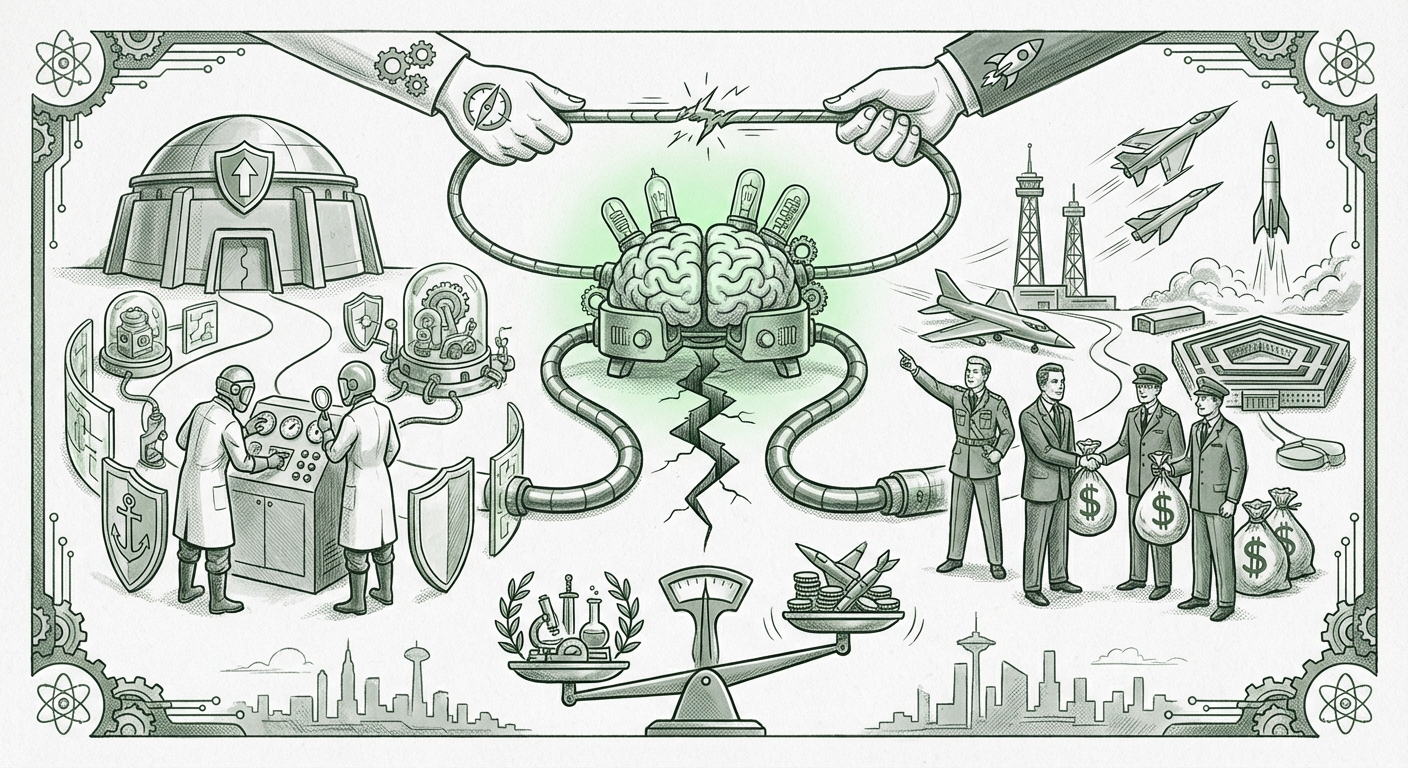
The Great AI Rift: Safety Theater, Pentagon Deals, and the Battle for AI's Soul
The world of Artificial Intelligence is no longer a quiet realm of academic papers and gentle innovation. It is a high-stakes arena where billions of dollars, national security interests, and the philosophical debate over humanity’s future collide. Recent events involving two titans of the field—Anthropic and OpenAI—have ripped this tension into the open, forcing every player, investor, and policymaker to confront a critical question: When AI companies promise safety, can they simultaneously profit from state power?
The immediate trigger was a pointed critique from Anthropic CEO Dario Amodei, who publicly slammed a contract between OpenAI and the Pentagon, labeling it as "80% safety theater." This statement, allegedly made in a leaked memo, immediately set off alarms, leading to rapid investor intervention and political maneuvering. This isn't just corporate rivalry; it’s a fundamental fracture in the narrative that has powered the AI boom.
The Clash: Safety Commitments Meet State Power
To understand the gravity of this situation, we must first examine the players. Anthropic, founded by former OpenAI leaders, built its brand on "Constitutional AI"—a commitment to building safe, steerable, and ethically aligned systems, often positioning itself as the cautious alternative to OpenAI’s breakneck speed. OpenAI, while also adhering to safety principles, has aggressively pursued lucrative commercial and governmental partnerships, most notably significant contracts with the U.S. Department of Defense (DoD).
Amodei’s accusation targets the core hypocrisy he perceives: how can a company prioritize safety while simultaneously embedding its powerful models into military applications, such as those potentially handled by DARPA or other defense research branches? Understanding the specifics of these defense engagements is crucial. If OpenAI’s involvement goes beyond general research into direct battlefield application support, Anthropic's critique gains significant weight. Conversely, if the contracts are strictly for early-stage, non-lethal research, the attack might indeed be rooted in politics, as Amodei also suggested, hinting at punishment for a lack of "political loyalty" to the Trump administration.
This debate centers on **Query 1:** *What are the actual details of the OpenAI/Pentagon deal, and how does that relate to existing AI ethics debates regarding defense spending?* The answer determines whether this is an ethical challenge or a political game.
Deconstructing "Safety Theater": Ethics as a Marketing Tool
The most provocative element of the dispute is the term "safety theater." This phrase suggests that the robust safety frameworks and public alignment commitments made by leading AI labs are less about fundamental scientific protection and more about public relations and regulatory buffering.
For the layperson, "safety theater" means putting on a show. Imagine a fire station that spends more time polishing the fire truck for parades than inspecting smoke detectors in homes. In AI, it means spending millions on benign alignment testing while accepting contracts that could accelerate deployment in high-risk areas without sufficient external review. As established in broader discussions surrounding **Query 3** (*"Safety theater" in AI ethics*), researchers worry that safety narratives allow companies to avoid stricter oversight while continuing rapid commercialization.
If Anthropic believes OpenAI is guilty of this, it means the race for Artificial General Intelligence (AGI) is not being led by the most responsible actor, but by the most pragmatic one—the one willing to blur the lines between safety doctrine and immediate profit, particularly from the world's largest spender on advanced technology: the military.
The Political Undercurrent: Loyalty and Retribution
Amodei’s claim that the alleged DoD scrutiny stems from political retribution adds a volatile layer of complexity. This brings us to **Query 2**: *Was Anthropic targeted due to perceived political misalignment?*
In the AI landscape, influence and access are commodities as valuable as compute power. If one lab perceives the other is favored or unduly targeted by a current or former administration, the resulting conflict becomes less about algorithms and more about access to contracts and favorable regulatory treatment. For businesses, this signals that geopolitical alignment, not just technological superiority, is becoming a prerequisite for massive government contracts.
The Investor Panic: De-escalation and Financial Risk
Crucially, this public feud triggered immediate market anxiety. The report noted that investors scrambled for de-escalation, and major industry groups swiftly backed Anthropic. This reveals the third front in this battle: **Finance.**
Venture Capital (VC) funds poured billions into these labs based on the premise of *controlled* risk, not *public infighting*. **Query 4** concerning *investor pressure on AI safety alignment* is vital here. Investors are less concerned with the philosophical purity of military contracts and more concerned with stability, brand reputation, and avoiding regulatory blowback that could freeze funding or deployment. When a CEO publicly attacks a competitor over ethics, it creates market volatility. The scramble for de-escalation shows that the financial backers are applying pressure to restore a unified, predictable front, even if the underlying ethical disagreements remain.
Future Implications: The Fracturing of the AI Ecosystem
What do these events mean for the future trajectory of Artificial Intelligence?
1. The Bifurcation of AI Development
We are witnessing the formal split of the industry into distinct ideological camps. On one side are labs prioritizing maximum access to state funding, potentially accepting looser definitions of immediate safety in favor of geopolitical leverage. On the other are firms that will double down on perceived ethical purity, perhaps seeking favor with international bodies or consumer protection groups.
Implication: This fragmentation could slow standardization. Instead of one path toward AGI safety guidelines, we might have multiple, competing safety standards, making global regulatory alignment much harder.
2. The Scrutiny of Defense Contracts
The spotlight is now intensely focused on DoD partnerships. Future bids by major AI companies for government work will face unprecedented scrutiny from ethics boards, the media, and competing firms. This might force defense agencies to become more transparent about what AI capabilities they are acquiring and how they are vetting the ethics of their commercial partners.
Implication: For policymakers, this highlights the need for clear "red lines" on AI usage, especially concerning autonomy, surveillance, and kinetic action, regardless of which company builds the underlying model.
3. Safety as a Competitive Differentiator (and Weapon)
Anthropic is effectively using OpenAI’s alleged actions as a competitive weapon. In the future, AI companies won't just sell performance; they will sell *trust*. A company’s historical record on alignment, data provenance, and military engagement will become a major factor in customer acquisition, especially for enterprise and regulated industries (like finance and healthcare).
Implication: We may see "Trust Audits" become standard practice, where third parties assess a vendor's ethical compliance history before deployment, similar to modern cybersecurity certifications.
Actionable Insights for Leaders and Policymakers
For Business Leaders Adopting AI:
- Demand Verifiable Audits: Do not accept marketing claims of "safety" at face value. Demand clear documentation on how your chosen AI vendor handles data security, bias mitigation, and especially any government or military contracts they hold. Trust is the new currency.
- Diversify Your Risk: Relying on a single foundational model provider is increasingly risky, not just technically, but politically and ethically. Begin modeling alternative providers in case regulatory pressure or public backlash forces a key vendor to change its terms of service or partnership scope.
For Policymakers and Regulators:
- Define "High-Risk" AI Use Cases Now: The current confusion suggests that the lines between benign research and dangerous capability acceleration are blurry. Immediate regulatory clarity is needed to define which applications of frontier AI models (especially concerning defense and national infrastructure) should be severely restricted, regardless of which company is involved.
- Address Political Influence: If claims of political retribution are valid, mechanisms must be established to ensure that government contracting for next-generation technology is based purely on technical merit and established safety protocols, shielding R&D from partisan swings.
The confrontation between Anthropic and OpenAI is more than just boardroom drama. It is the public unveiling of the inherent tension in building powerful, general-purpose intelligence while simultaneously navigating global competition and the immense financial gravity of defense budgets. The future of safe, beneficial AI hinges not on the elegance of the algorithms we create, but on the messy, human choices we make today about who we trust, and for what purpose, that intelligence will be deployed.
*This analysis synthesizes themes emerging from recent reports concerning AI corporate competition, defense engagement, and ethical critiques.