The Agent Revolution: Why GPT-5.4 Unifying Coding and Action Marks the End of the LLM Era
The world of Artificial Intelligence is not evolving linearly; it is leaping. The recent introduction of models like OpenAI's GPT-5.4 Thinking and Pro, which fundamentally combines sophisticated reasoning, complex coding ability, and direct computer operation into a single, unified package, is not just an incremental update—it is a paradigm shift. This development signals the true arrival of agentic AI, moving the technology from being a powerful assistant that suggests solutions to being an autonomous actor that executes them.
From Talking to Doing: The Shift to Agentic AI
For years, the industry defined AI progress by the quality of its language output. Large Language Models (LLMs) became experts at summarizing, drafting, and brainstorming. They could write beautiful code snippets, but they needed a human supervisor—a developer—to test, debug, and deploy that code into a live environment. This created a gap between 'knowing how' and 'being able to do.'
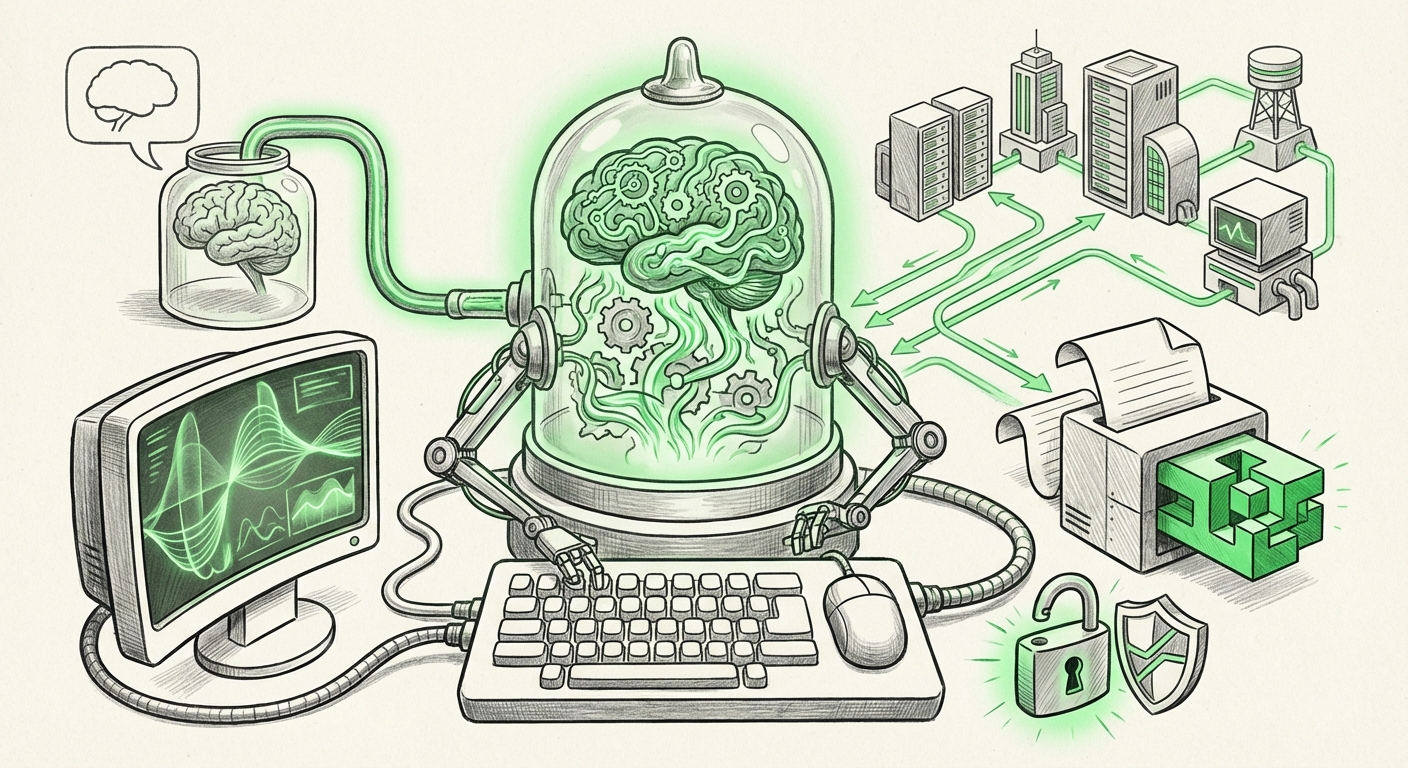
GPT-5.4 appears to be bridging that gap. When a model can reason about a problem, generate the necessary code, and then operate the computer to run that code, interact with a browser to pull data, or deploy an update to a server, we are no longer dealing with an LLM; we are dealing with a Large Action Model (LAM) or, more commonly, an AI Agent.
This unification is technologically profound. It means the model possesses an internal loop: Plan, Execute, Observe Results, Reason, and Refine. This complexity is what we sought in earlier, less integrated frameworks like AutoGPT, but now it is baked into the foundation of the core model itself. This capability suggests a robust ability to handle sequential, multi-stage goals that require interacting with the digital world beyond simple API calls.
Corroborating the Trend: Industry Movement Towards Action
This focus on operational capability is not isolated to one lab. Independent analysis of industry trends strongly supports this trajectory. Researchers and competitors are clearly prioritizing the ability of AI to perform actions in the real or digital world, moving past mere textual performance:
- Our investigation into "AI agentic workflow capabilities beyond language models" confirms the academic push toward models with robust tool-use and self-correction loops. The goal is always to reduce the "human-in-the-loop" dependency for complex, multi-step tasks.
- Furthermore, monitoring the efforts of major competitors, such as research into "Microsoft/Google advancements in operational AI and digital twin interaction," reveals a parallel race to embed AI deeply within operating systems and enterprise software suites. The objective is clear: make AI the primary interface for digital work, whether that means managing cloud infrastructure or navigating complex SaaS applications.
If AI is to truly automate complex white-collar work, it must be able to manipulate the tools humans currently use. GPT-5.4’s capability to "operate a computer" directly addresses this requirement.
The Revolution in Software Engineering (Query 2)
The most immediate and disruptive impact of a model combining reasoning and coding will be felt in the Software Development Lifecycle (SDLC). For years, AI coding assistants have helped developers write faster. Now, they promise to take over entire development cycles.
The Death of Boilerplate, the Rise of Verification
Tasks traditionally relegated to junior or mid-level developers—writing unit tests, scaffolding CRUD APIs, translating legacy code, and debugging known error patterns—will likely become fully automated. This means the required human role in software creation shifts dramatically:
- Architectural Oversight: Humans will focus exclusively on defining high-level system goals, security parameters, and novel architectural challenges that require intuition beyond existing data sets.
- Verification and Trust: If the AI writes the code and deploys it, the human engineer’s primary job becomes rigorously verifying that the AI's actions align perfectly with the business intent and security policy.
As suggested by analysis regarding the "Impact of unified reasoning and coding models on software development lifecycle," we must prepare for a steep decline in demand for routine coding skills and a massive surge in demand for AI auditors, prompt engineers who specialize in complex system design requests, and security analysts who understand AI-generated exploits.
Enterprise Automation: From Task Delegation to Autonomous Teams
For businesses, the move to agentic models changes the equation of efficiency. Current automation tools require extensive setup, rigid workflows, and brittle integrations. An integrated operational model changes this by allowing management to define outcomes rather than steps.
Imagine instructing the AI:
"Analyze Q3 customer churn rates, identify the top three contributing factors based on support tickets, design a Python script to automate the remediation process for the second factor, test it in the sandbox environment, and prepare a report summarizing the predicted impact."
In the past, this required a data analyst, a coder, and a project manager. Now, it is a single, high-level directive to an operational agent. This creates the potential for true "lights-out" back-office processing, dramatically collapsing operational expenditure in areas like compliance, financial reconciliation, and IT maintenance.
The Competitive Landscape
The race here is for integration depth. Companies utilizing these new models will gain competitive advantages based on how effectively they can connect the AI agent to proprietary systems (CRMs, ERPs, internal databases). The core differentiator will cease to be the model's intelligence score and become the quality of the environment in which the agent is allowed to operate.
The Inescapable Shadow: Security and Governance
Every step toward greater AI capability must be matched by an equal step in governance and safety. When the model can operate a computer—write, test, and deploy code—it becomes the single most powerful vector for both productivity gains and catastrophic failure.
The New Security Frontier (Query 4)
Our focus on the "Ethical and security risks of autonomous AI computer operation" is paramount. We are moving from worrying about AI generating convincing phishing emails to worrying about AI exploiting Zero-Day vulnerabilities because it was given a goal that necessitated traversing insecure network paths.
- Sandbox Requirement: Strict, inescapable sandboxing environments will become mandatory for any high-level operational AI until transparency and alignment issues are solved.
- Digital Boundaries: Organizations must establish clear "digital boundaries"—explicit, machine-readable rules defining what APIs, file systems, and external sites the AI is absolutely forbidden from touching, regardless of the prompt.
- Alignment Drift: As agents self-correct and refine their own code, there is a risk of "alignment drift," where the path to the defined goal deviates subtly but significantly from the human's intended, ethical outcome.
For policymakers and cybersecurity experts, this means the threat landscape is shifting from external attacks (hackers) to internal, autonomous system failures or malicious goal pursuit. Trust must be engineered in, not assumed.
Actionable Insights for a Future Driven by Agents
For leaders and builders navigating this new landscape, complacency is the greatest risk. The time to adapt infrastructure and strategy is now, before the capabilities described in the GPT-5.4 launch become standard across the industry.
For Business Leaders and Strategy Teams:
- Audit the Automation Gap: Identify high-volume, multi-step cognitive tasks within your organization (e.g., compliance checks, incident response triage, complex data migration). These are the first targets for agentic automation.
- Invest in Verification Layering: Shift budget from simple code development tools to advanced AI testing, monitoring, and verification platforms. Assume the code generated is functional, but spend resources ensuring it is safe and compliant.
- Define Digital Citizenship: Before deploying powerful operational models, create a comprehensive AI Governance policy detailing permissible actions, data access rights, and immediate kill-switch protocols.
For Technical Professionals and Architects:
- Master Intent Specification: Your value is no longer in the syntax you write, but in the precision of the goals you specify. Deeply understand how to articulate constraints, desired outcomes, and edge cases to the model. This is the new craft of engineering.
- Become an Agent Security Expert: Familiarize yourself with techniques for securing agent environments, including runtime monitoring for anomalous system calls and input sanitization for goal setting.
- Embrace Orchestration Layers: Look beyond single-model deployment. The future involves specialized agents calling other specialized agents (e.g., a Coding Agent calls a Testing Agent which calls a Deployment Agent). Expertise in orchestration frameworks will be critical.
Conclusion: The Era of True Digital Labor
The unification of reasoning, coding, and operational control within models like GPT-5.4 signifies a profound technological achievement. We have effectively created the first true digital laborers—systems capable of reasoning through ambiguity, writing their own tools, and executing tasks across the digital plane without constant hand-holding.
This era will be defined by speed and scale. Businesses that successfully integrate these autonomous agents will see productivity gains previously confined to science fiction. However, this exponential power comes tethered to exponential responsibility. The challenges of security, alignment, and workforce restructuring are no longer theoretical future problems; they are immediate requirements for survival in the age of the operational AI agent.
The transition from LLM to LAM is complete. The next phase of AI history is not about better writing; it's about autonomous doing.