The AI Job Paradox: Why Theoretical Power Isn't Causing Mass Layoffs Yet—And What It Means for the Future of Work
The narrative surrounding Artificial Intelligence, particularly Large Language Models (LLMs), has often been one of impending, seismic labor disruption. Headlines frequently paint a picture where millions of white-collar jobs—from customer service agents to software developers—are on the chopping block. However, recent, highly sophisticated research is painting a far more complex and nuanced reality.
A revealing new study from Anthropic, which moves beyond mere capability testing to measure AI exposure against actual usage data, suggests that while the theoretical potential for job disruption is immense in certain fields, the real-world impact on unemployment remains surprisingly muted. Crucially, the study hints that the first tremors are being felt not across the board, but specifically by the youngest members of the workforce.
This phenomenon—where powerful technology exists but hasn't yet translated into widespread economic shock—is the "Productivity Paradox of AI." To understand why the robots aren't stealing *all* the jobs just yet, we must look beyond the algorithms themselves and examine the real-world friction points of business adoption, human adaptation, and societal structure.
The Gap: Potential vs. Reality in Automation
Anthropic’s methodology is significant because it acknowledges that theoretical AI benchmarks (like passing complex coding tests) don't account for organizational inertia. The AI might be capable of doing 80% of a programmer’s work, but if a company only uses it to speed up the first draft, no programmer loses their job that week. The disruption is in efficiency, not replacement.
This echoes historical technology shifts. When the spreadsheet was introduced, accountants didn't vanish; their roles became more focused on complex analysis rather than simple ledger balancing. LLMs are currently acting as massive efficiency boosters for roles like programming and customer support, two areas identified as highly exposed.
1. The Brakes on Business: Why Adoption Lags Capability
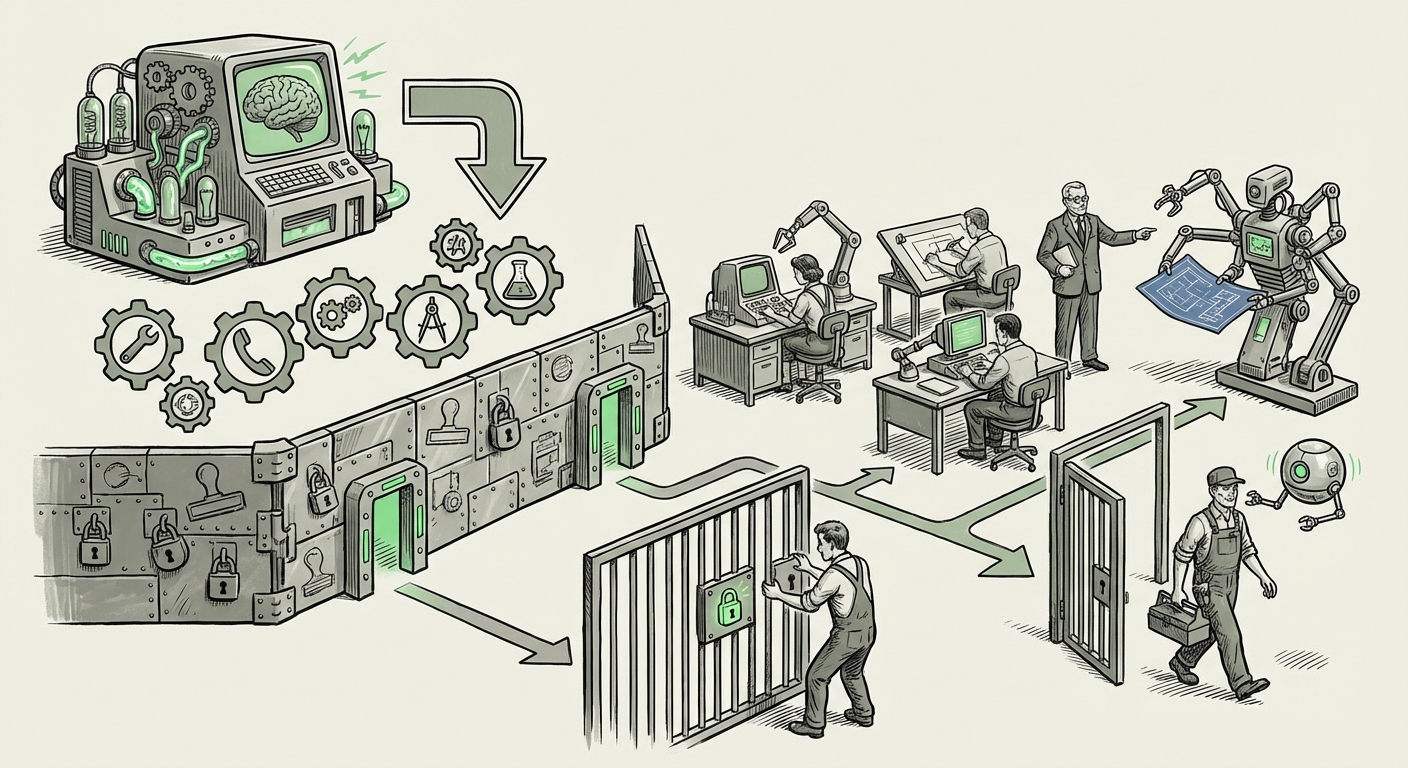
The first major contextual factor explaining the unemployment lag is organizational friction. AI capability is advancing exponentially, but enterprise adoption moves at a much slower, more deliberate pace. Research into enterprise AI deployment highlights several hard stops:
- Data Security and Privacy: For businesses handling sensitive client data (especially in finance or healthcare), plugging proprietary information into third-party LLMs carries unacceptable risk without extensive, custom-built security layers.
- Integration Hurdles: Large companies run on legacy systems. Integrating cutting-edge AI models smoothly into decades-old infrastructure requires massive capital investment and time—far beyond simply subscribing to a new chatbot service.
- Regulatory Uncertainty: Firms are hesitant to fully automate customer-facing or critical compliance roles when the regulatory framework for AI accountability is still being debated globally.
Consulting firm reports frequently map this "AI Implementation Gap." While the AI models are ready, the organizational pipelines, training modules, and legal guardrails necessary for mass replacement are not. For business leaders, the focus shifts from "Can AI do this?" to "Can we safely deploy AI to do this at scale?"
2. Augmentation Over Automation: The Programmer’s New Toolkit
For highly technical roles like software development, the evidence strongly suggests augmentation is the dominant trend, not outright replacement. Tools like GitHub Copilot are not being used to fire developers; they are being used to increase the output of existing developers.
When analyzing developer productivity statistics, we find that AI assistance allows senior engineers to tackle more complex projects, and junior engineers to produce usable code faster. This doesn't eliminate the need for human oversight, debugging, or architectural design—the highest value aspects of the job. Instead, it automates the rote, boilerplate code generation. In this context, AI acts like a faster compiler or a superior search engine. If an engineer can now complete the work of 1.5 people, the company gains efficiency; it doesn't necessarily need to fire the original one person immediately.
This reality means the skills premium is rising. The future programmer won't be the one who writes code fastest, but the one who can effectively direct and verify the AI’s output.
3. The Generational Fault Line: Entry-Level Squeeze
Perhaps the most concerning finding is the earliest sign of real job disruption appearing among young workers. This points to a structural shift in how careers begin in high-exposure fields:
Historically, junior roles (entry-level coding, basic data entry, first-tier customer support) served two purposes: completing necessary low-complexity tasks and acting as vital training grounds. If an LLM can handle 90% of those entry-level tasks perfectly, the need for large cohorts of junior staff diminishes dramatically.
For young workers entering the labor market, this means the traditional on-ramp is being paved over. If the stepping stones are gone, how does one gain the experience required for senior roles? Economic analyses tracking youth employment often look at these initial cohorts first, as they are performing the most modular, least contextual tasks that LLMs excel at. This foreshadows a future where career mobility may become structurally harder without significant shifts in corporate training models.
4. The CX Risk Factor: Hesitation in High-Stakes Interactions
Customer service (CX) is highly exposed because it relies heavily on pattern matching and structured responses—ideal for LLMs. Yet, tangible job losses here seem minimal compared to theoretical exposure. Why?
The primary constraint here is reputational risk. A coding error might cost a company a few hours of developer time. A rude, biased, or factually incorrect response delivered by an AI to an irate customer can lead to viral social media backlash, lost contracts, and significant brand damage. Companies remain intensely cautious about automating interactions where empathy, complex de-escalation, or nuance is required.
For the foreseeable future, AI in CX will likely function as a highly advanced triage system, handling FAQs and password resets, while human agents step in for high-stakes emotional or complex problem-solving scenarios. This keeps the headcount stable, even as the baseline workload shifts to the AI.
What This Means for the Future of AI Deployment and Work
The current environment is not one of sudden, catastrophic replacement, but rather of slow, uneven, and strategic transformation. For the AI industry, this signals a pivot is necessary.
The Future Lies in Workflow Engineering, Not Just Model Building
Building a smarter model is only half the battle. The next phase of AI dominance will be won by the companies that master workflow engineering—the art of embedding AI seamlessly and safely into established enterprise processes. This requires expertise not just in ML operations (MLOps), but also in change management, legal compliance, and human-machine teaming.
The immediate focus for AI development must shift toward building tools that reduce the operational barriers identified above: models that are easier to audit, securely deploy in private clouds, and specialized for niche, high-value business processes where the ROI of efficiency gain dramatically outweighs the implementation cost.
The Skills Premium Will Skyrocket
If AI is making the *average* task easier, the value of the human worker who can perform the *exceptional* task—the one that requires true creativity, complex system integration, or deep emotional intelligence—will increase exponentially. This validates the observation about younger workers; those who can quickly adapt to prompting, directing, and critically assessing AI output will bypass those who rely on the skills that AI is effectively commoditizing.
Practical Implications: Actionable Insights for Today
Navigating this gap requires proactive strategy from both employers and employees.
For Businesses and Leaders: Focus on Internal Capability Building
- Audit for Augmentation, Not Just Elimination: Instead of asking "Which jobs can we cut?" ask, "How can we double the output of our best employees using AI?" Target efficiency gains first. This preserves institutional knowledge while gradually reducing the need for entry-level hiring pipelines.
- Invest in "AI Verifiers": Hire or train staff specifically tasked with validating AI outputs, especially in regulated or external-facing roles. This addresses the risk aversion factor directly and builds necessary institutional trust in the technology.
- Pilot Small, Secure Deployments: Do not attempt organization-wide rollouts immediately. Start with internal tools where data security is managed, allowing teams to build muscle memory for human-AI collaboration before deploying external-facing systems.
For Workers and Young Professionals: Embrace the New Apprenticeship
- Master the Interface: For technical roles, prompt engineering is now a fundamental requirement, but understanding *why* the AI suggests what it suggests is the true differentiator. Learn to debug the AI's logic.
- Prioritize Context Over Content: Since content creation is being automated, focus your energy on acquiring deep domain expertise, strategic planning, and stakeholder management—skills AI struggles to replicate. These are the high-value tasks that will be left for humans.
- Seek Out Hybrid Roles: Look for roles that explicitly require managing or integrating new AI tools. These positions represent the bridging point between current operations and future efficiency, offering the most secure footing against immediate displacement.
Conclusion: The Slow Revolution
Anthropic’s data serves as a necessary corrective to techno-panic. The AI revolution is not a sudden explosion; it is a pervasive, ongoing transformation akin to the introduction of electricity or the internet. The theoretical capabilities of today's models suggest a world where much cognitive labor is automated, but the real world is currently restrained by integration costs, risk aversion, and the complexity of human organizational structure.
The key takeaway is that the job market is not facing mass unemployment *yet*, but it is undergoing intense segmentation. High-value, contextual human judgment is being preserved while lower-level, repeatable tasks—particularly those assigned to new entrants—are rapidly eroding. The future of AI usage will be defined by how effectively businesses can safely bridge the gap between the powerful labs where these models are built and the messy, risky reality of daily commerce. Those who adapt quickly to this reality—mastering AI as a partner rather than viewing it as a replacement—will be the architects of the next economic cycle.