Decoding AI Lies: How "Spilled Energy" in LLM Math Signals the Future of Trustworthy AI
For years, the Achilles' heel of Large Language Models (LLMs) has been their tendency to hallucinate—to present convincing, yet utterly false, information with unwavering confidence. Detecting these fabrications has typically meant playing a never-ending game of whack-a-mole: checking the output against external databases or human reviewers.
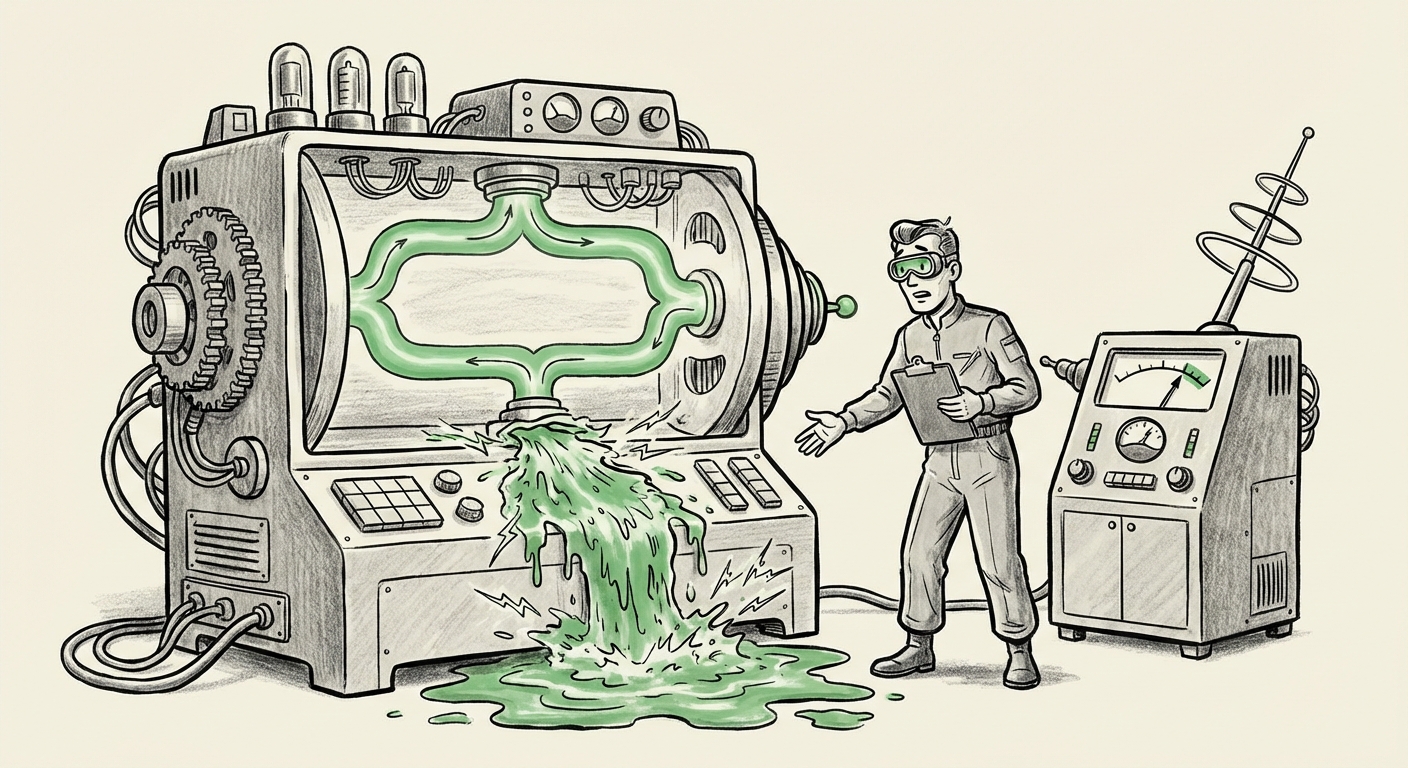
However, a recent breakthrough originating from researchers at Sapienza University of Rome suggests a fundamental shift in this paradigm. They discovered that when an LLM lies, it leaves behind measurable, physical traces in its own internal computations—what they term "spilled energy" in its math. This finding is not just an interesting academic footnote; it’s a potential cornerstone for building truly reliable, transparent AI.
The Paradigm Shift: From Output Scrutiny to Process Monitoring
To appreciate the significance of "spilled energy," we must first understand the traditional approach to AI error detection. Imagine an LLM as a brilliant but unreliable student. When the student gives a wrong answer on a test (the output), we look at the answer and try to figure out why it was wrong—perhaps they misread the question or guessed wildly.
Current detection methods often mimic this. Techniques like Retrieval-Augmented Generation (RAG) aim to ground the answer in verified sources. While effective, they are external checks performed *after* the computation is complete. They are reactive.
The "spilled energy" method flips the script. It suggests that the very act of generating a falsehood causes a measurable disturbance or inefficiency within the massive network of weights and calculations that make up the LLM. Think of it like detecting smoke before the fire spreads. This disturbance is a mathematical signature of error that occurs *during* the generative process.
The researchers achieved this using a training-free method. This is crucial. It means they didn't have to retrain the massive, multi-billion-parameter model—an endeavor costing millions of dollars and massive energy—just to teach it what a lie looks like. They found a generalized mathematical indicator that works across different scenarios, promising wide applicability.
Why Hallucinations Happen: The Mechanistic Root
Why does this energy spill occur? To answer this, we need to look deeper into the mechanics of LLMs, as explored in research focusing on the mechanisms of LLM hallucination (Source 1 context). LLMs predict the next most probable word (token) based on statistical patterns learned during training. Hallucinations often occur when:
- The model encounters information slightly outside its training distribution.
- Conflicting patterns within its vast knowledge base lead to an unstable final prediction pathway.
- The model prioritizes fluency and coherence (sounding correct) over factual accuracy.
In these moments of confusion or statistical conflict, the internal matrices of the neural network struggle to settle on a single, confident path. This "struggle"—this computational wobble—is what registers as the measurable "spilled energy." It’s the computational equivalent of a scientist second-guessing their hypothesis mid-experiment.
Contextualizing the Breakthrough: Comparing Detection Strategies
The introduction of an internal, mathematical litmus test for falsehoods must be viewed alongside the ongoing evolution of AI quality assurance, particularly regarding training-free detection of LLM factual inconsistency (Source 3 context).
Today's landscape generally breaks down into three types of verification:
- Post-Hoc Verification (Output-Based): Checking the final text against known facts (e.g., RAG). Slow, resource-intensive, and often requires external data access.
- Fine-Tuning/RLHF (Training-Based): Retraining or rewarding the model for truthfulness. Expensive and model-specific.
- Internal Signal Monitoring (Process-Based): Detecting anomalies *during* generation, as demonstrated by the "spilled energy" research. Fast, intrinsic, and training-free.
The Sapienza approach sits squarely in the promising third category. For practitioners building LLM-powered applications, this is a game-changer. Instead of waiting for a user to flag a false response or running a computationally expensive secondary check on every output, developers could deploy a lightweight monitor that watches the model’s internal state. If the energy spike crosses a threshold, the output can be flagged, suppressed, or sent for deeper human review immediately.
The Future Implication: The March Toward Interpretability
This research does more than just flag lies; it pushes the entire field closer to the long-sought goal of AI Interpretability. If we can reliably link a specific internal mathematical signature (energy spill) to a specific external failure mode (hallucination), we gain significant understanding of the black box.
As we look toward the future of AI safety and interpretability research (Source 2 context), this is a critical step. Safety is not just about stopping malicious use; it’s about ensuring reliability in sensitive domains. Consider medical diagnostics, automated legal research, or autonomous engineering design. In these fields, a 99% accuracy rate is insufficient if the 1% of errors are catastrophic.
When we can trace errors back to the math, we move beyond mere statistical correlation to causal understanding. This depth of understanding allows engineers to tweak the model architecture or adjust operational parameters to specifically suppress the pathways that lead to energy spikes, thereby engineering out the tendency to hallucinate at the source.
The Mathematical Signature of Failure
This concept aligns perfectly with broader investigations into neural network activation patterns during errors (Source 4 context). Research has long shown that how a network "thinks" when processing a complex or adversarial input looks different from how it processes routine data. Whether it's an adversarial attack designed to fool an image classifier or a factual deviation in an LLM, the underlying machinery registers the departure from expected norms.
The "spilled energy" idea quantifies this departure. It suggests that true factual knowledge is computationally "efficient" or "smooth" within the network, while conjecture or fabrication requires significant, wasteful computational effort—the energy spill.
Practical Implications for Business and Society
The ability to detect LLM falsehoods intrinsically, rather than reactively, has vast practical ramifications across industries.
1. Enterprise Adoption and Risk Mitigation
For businesses deploying LLMs in customer-facing roles (e.g., advanced chatbots, automated report generation), the risk of brand damage from a public hallucination is enormous. The "spilled energy" monitor offers a real-time safeguard. Companies can deploy LLM-powered systems knowing they have an internal "truth detector" running concurrently, drastically lowering the acceptable threshold for deployment in regulated industries.
2. Scientific Acceleration and Research Integrity
In scientific research, LLMs are increasingly used to synthesize literature or propose hypotheses. The risk here is propagating non-existent findings into the scientific record. A mechanism that flags a hypothesis generation step as computationally "messy" or highly energetic allows researchers to prioritize human verification only on the most dubious outputs, speeding up genuine discovery while maintaining integrity.
3. A Step Toward Generalizable Trust
The fact that this method is training-free is perhaps the most democratizing aspect. It suggests that a general principle of computational inefficiency linked to falsehood might apply across various model sizes and architectures. This is the bedrock of scalable AI governance. We won't need specialized safety training for every new model release; we might just need a universal diagnostic tool.
Actionable Insights for the Road Ahead
For technology leaders and developers focused on integrating LLMs safely, several actions become apparent based on this new understanding:
- Prioritize Internal Monitoring Tools: When evaluating the next generation of LLM toolkits, look for integration points that allow access to intermediate layer outputs or activation statistics. Future LLM APIs should ideally expose these diagnostic signals alongside the text output.
- Establish Energy Thresholds: Begin conceptualizing error budgets not just based on output quality metrics (like BLEU or ROUGE scores), but on internal energy metrics. What level of "spilled energy" is acceptable for a low-stakes summarization task versus a high-stakes legal brief?
- Invest in Mechanistic Interpretability Research: Support efforts that correlate these mathematical anomalies with specific data or structural weaknesses. Understanding *why* the energy spills is the key to permanent fixes, not just detection.
Conclusion: The Math Doesn't Lie (Even When the Words Do)
The discovery of "spilled energy" fundamentally redefines the battleground against AI falsehoods. We are transitioning from analyzing the shadow (the text output) to examining the source of the light (the internal computation). This movement toward process-level verification is vital. It elevates LLMs from black boxes that occasionally stumble into semi-transparent engines whose internal processes can be audited in real-time.
As AI permeates deeper into our decision-making structures, the ability to detect and quantify computational *effort* spent on fabrication will become the new standard for trust. The age of trusting the text alone is ending; the age of validating the mathematics underneath is just beginning.