Beyond the Chatbot: OpenClaw, Function Calling, and the Rise of Actionable AI Agents
For the last few years, Large Language Models (LLMs) have felt like incredibly smart parrots: eloquent, knowledgeable, but ultimately constrained to the text box. They could analyze, summarize, and generate poetry, but they couldn't do anything in the digital world outside their training data. That era is rapidly ending. We are witnessing the birth of Agentic AI, where LLMs gain true agency by being equipped with a 'body' to interact with external systems. A recent innovation, exemplified by concepts like OpenClaw, highlights this critical technological pivot.
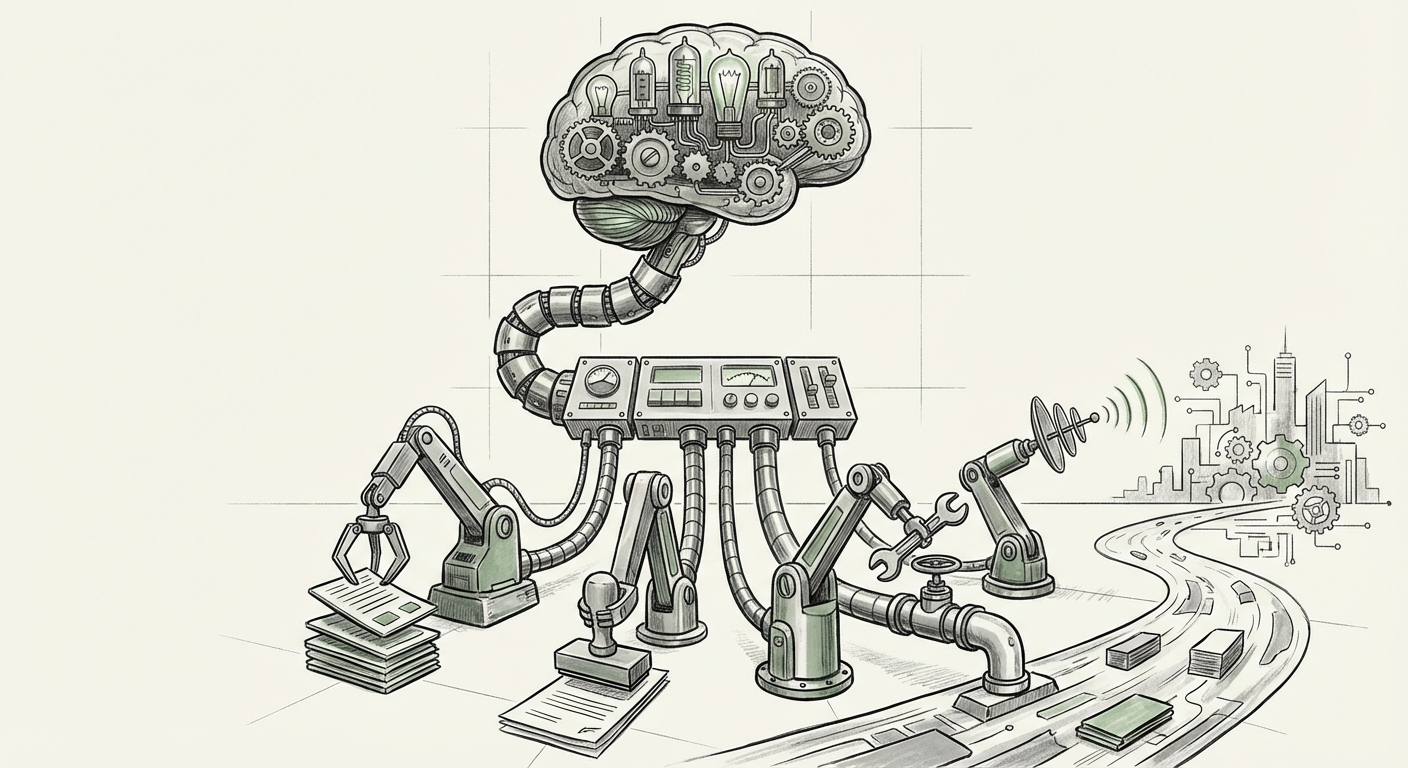
OpenClaw—which involves deploying public Model Control Plane (MCP) servers as standardized API endpoints integrated via LLM function calling—is not just another piece of developer tooling. It represents a necessary architectural evolution. It bridges the gap between the LLM (the reasoning brain) and the external world (the tools and APIs that perform actions). To truly grasp the implications, we must analyze the underlying mechanisms driving this obsession: reliable tool use, scalable agent frameworks, and the strategic shift toward open infrastructure.
The Core Mechanism: Function Calling as the Agent's Vocabulary
The reason developers are "obsessed" with concepts like OpenClaw lies squarely in the maturation of function calling (or tool use). Think of an LLM as a brilliant executive who doesn't know how to use a computer. Function calling gives the executive the mouse and keyboard.
When you ask an LLM a complex question, it doesn't just answer; it reasons through steps. If the task requires current stock prices, accessing a proprietary database, or sending an email, the model now has the ability to pause its text generation, format a request based on a predefined schema (the function description), and wait for the result. This structured interaction is essential for moving from suggestion to execution.
This capability is moving rapidly from experimental novelty to required standard. As research indicates on the general adoption of these techniques, LLMs that can reliably use tools are exponentially more useful than those that cannot (related research on LLM function calling adoption trends confirms this paradigm shift). Function calling transforms the model from a passive predictor into an active planner capable of navigating complex, real-world tasks requiring multiple steps and data sources.
Technical Underpinnings: Moving Beyond Simple API Calls
For a non-technical audience, imagine telling your smart assistant, "Book me a flight to New York next Tuesday and check if my favorite hotel has rooms." A simple chatbot would generate a nice paragraph about flying. An agent using function calling breaks this down:
- Plan: I need to use the 'FlightSearch' tool, then the 'HotelBooking' tool.
- Action 1: Call `FlightSearch(destination='NYC', date='Next Tuesday')`.
- Result 1: The tool returns flight options.
- Action 2: Call `HotelBooking(hotel='FavoriteHotel', date='Next Tuesday')` using data from Step 1.
- Final Output: Synthesize the results into a coherent recommendation.
OpenClaw’s approach of creating standardized Model Control Planes (MCPs) as API endpoints aims to formalize this "Action 1" and "Action 2" process across different tools, making tool deployment as straightforward as accessing a reliable web service.
The Ecosystem Battle: Standardizing the Agent Body
The current landscape of AI agents is fragmented. Developers often rely on massive, opinionated frameworks—like those being analyzed in current overviews of the State of AI Agent Frameworks 2024—that handle orchestration, memory, and tool integration all at once. While powerful, these systems can be monolithic and difficult to scale or customize granularly.
This is where the OpenClaw concept—standardized, public tool endpoints—gains traction. It suggests a move toward **decoupling the brain from the body**. The LLM (the brain) remains powerful, but the tools (the body) become modular, interchangeable components accessible via a stable API governed by the MCP.
Implications for Scalability and Multi-Agent Systems
This modularity is vital for the future of Multi-Agent Systems (MAS). Instead of one giant agent trying to do everything, we move toward teams of specialized agents. One agent might be the data scientist, another the customer service representative, and another the code executor. If each agent uses the same standardized interface (the MCP API) to access tools, they can collaborate seamlessly. This architecture promises:
- Interoperability: Agents built on different LLMs (e.g., one on GPT-4, another on Llama 3) can reliably use the same set of tools.
- Maintainability: Updating a tool's underlying infrastructure doesn't require retraining the core LLM; only updating the API endpoint definition.
For organizations, this means building robust automation pipelines that are less susceptible to single-vendor lock-in and more resilient to API version changes.
Control, Customization, and the Self-Hosting Imperative
The explicit mention of deploying "Public MCP servers" is significant because it speaks directly to the growing enterprise demand for control over their AI infrastructure. While public APIs from major providers are convenient, they carry inherent risks concerning data privacy, latency, and cost scalability.
The trend toward self-hosted LLM serving infrastructure is not slowing down. Enterprises are demanding solutions where sensitive data never leaves their control. OpenClaw, by suggesting a standard way to expose these self-hosted tools as reliable endpoints, caters perfectly to this need. It allows companies to deploy powerful, customized local models (the brain) and connect them securely to standardized local tools (the body).
Security and Performance Advantages
When tools are exposed via a well-defined MCP, security boundaries become clearer. Instead of giving a general-purpose LLM access to raw database credentials, the connection is brokered through the controlled MCP layer, which enforces specific permissions for each function call. This significantly reduces the attack surface.
Furthermore, proximity matters. Hosting the tool server close to the inference engine minimizes network latency, which is crucial for time-sensitive agentic actions.
The Next Frontier: Embodied and Actionable AI
If LLMs are currently in their "talking" phase, architectures like OpenClaw are ushering in the "doing" phase. This pushes the entire field toward what many researchers call Embodied and Actionable AI, moving "beyond text generation."
This shift implies that the next generation of AI applications won't just answer questions about the world; they will actively manage, optimize, and change the world based on complex goals. This aligns perfectly with ongoing explorations into AI agent capabilities beyond text generation.
From Information Retrieval to Real-World Impact
Consider the difference:
- Old Model: "Analyze these customer support tickets and tell me the top three complaints." (Text Analysis)
- New Agent Model: "Use the tickets to identify the top three bugs, automatically generate Jira tickets for them, assign them to the relevant engineering team using the Internal HR API, and notify the CEO via Slack." (Complex, Cross-System Execution)
The second scenario requires robust function calling, standardized tools, and reliable orchestration—the exact problem OpenClaw seeks to solve at an architectural level.
Practical Implications: What This Means for Your Business
The convergence of function calling, modular agent frameworks, and standardized tool exposure is moving rapidly from research labs to production environments. Businesses need to prepare for this transition now:
For AI Engineers and Developers: Actionable Insights
1. Master Function Calling Schemas: Spend significant time perfecting the JSON schemas used for function descriptions. Garbage in means flawed decision-making out. The clarity of your tool definitions directly determines the reliability of your agent.
2. Explore Agent Orchestration: Look beyond simple single-step calls. Experiment with frameworks (like those referenced in the context of the AI agent ecosystem) to manage complex sequences and error recovery.
3. Standardize Tool Exposure: If you plan to build proprietary agentic systems, start defining your internal APIs as clean, idempotent functions ready for LLM consumption, perhaps modeling them after a standardized control plane structure like the MCP.
For Business Leaders and Strategy Teams: Future Proofing
1. Reassess Vendor Strategy: Relying solely on proprietary AI models for workflow automation creates a future integration bottleneck. Favor architectures that embrace open standards and modular components (like standardized APIs) that can swap out the "brain" (the LLM) without rebuilding the entire "body" (the tool access layer).
2. Identify High-Value Automation Targets: Focus automation efforts on processes that require decision-making across multiple, disparate software systems (e.g., finance reporting, supply chain optimization). These are the areas where agentic execution provides the highest ROI.
3. Invest in Data Governance for Actions: Since agents can now *act*, the stakes for data governance and security are higher. Ensure that any tool exposed via an API has rigorous access control policies, as a compromised agent tool endpoint could lead to direct system manipulation.
Conclusion: The Era of Digital Executors
OpenClaw and the broader trend toward structured LLM tool use signify a fundamental maturation of artificial intelligence. We are moving from the era of the knowledgeable assistant to the era of the digital executor. The LLM is evolving from a passive knowledge repository into an active participant in business processes.
By standardizing how the reasoning engine interfaces with external systems—whether through community-driven standards like OpenClaw or proprietary solutions—we are building the necessary scaffolding for truly autonomous, scalable, and integrated AI systems. This convergence of powerful reasoning models with standardized action interfaces is not just a technological upgrade; it is the foundation upon which the next generation of software and workforce augmentation will be built.