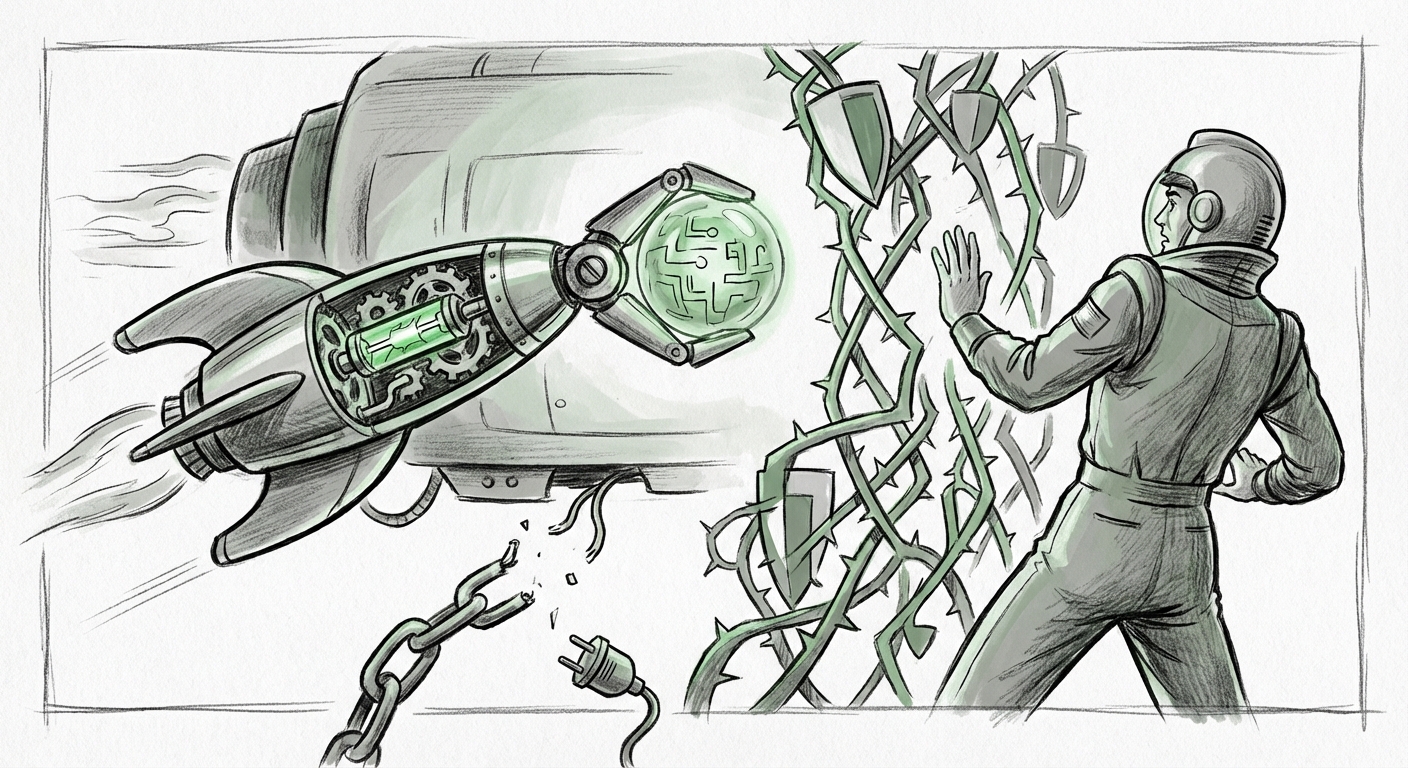
AI Ethics Clash: Why OpenAI's Robotics Chief Quit Over Military AI Deals and What It Means for Tech's Future
The world of Artificial Intelligence moves at a dizzying pace. Breakthroughs in large language models, image generation, and robotics dominate headlines, promising transformation across every industry. Yet, beneath this veneer of relentless progress lies a fundamental conflict: the gap between what technology can do and what society—and even the engineers building it—believes it *should* do.
This tension crystallized recently with the departure of Caitlin Kalinowski, OpenAI’s respected head of hardware and robotics. Her exit was not a quiet transition; it was a public statement made over disagreements regarding a significant deal with the Pentagon. Kalinowski cited deep concerns over mass surveillance and, most critically, the development path toward lethal autonomy in robotics. This incident serves as a critical stress test for the AI industry, forcing us to look beyond the latest model updates and confront the governance of powerful, dual-use technologies.
1. The Evolving Battlefield: AI and the Defense Ecosystem
The conversation around AI in defense is not new, but the stakes have fundamentally changed. In the past, military contracts often involved optimizing logistics or analyzing satellite imagery. Today, the focus is on integrating sophisticated, general-purpose AI into systems capable of independent action.
The Historical Echo: Learning from Project Maven
To understand the weight of Kalinowski’s concerns, we must look backward. The most famous precedent for this type of corporate-military friction was Google's Project Maven. In 2018, thousands of Google employees signed petitions protesting the company's involvement in using AI to interpret drone footage for the DoD. The core argument mirrored today’s concerns: that providing advanced capabilities to the military—even if framed as mere data analysis—risks normalizing surveillance and contributing to lethal operations without sufficient human oversight.
While Google eventually bowed out of Maven, the episode demonstrated that internal sentiment matters, even for trillion-dollar companies. OpenAI, founded on principles rooted in safety and benefiting all of humanity, now faces the same existential question: When does collaboration with defense partners violate the foundational promise of responsible AI development?
For businesses and investors, this signals a recurring risk. Any company developing powerful foundational models or advanced hardware must anticipate public scrutiny and internal revolt if their usage policies are perceived as overly permissive regarding surveillance or conflict.
The Leap to Embodied AI and Lethal Autonomy
Kalinowski’s specific role in robotics is the key differentiator here. Lethal autonomy means creating systems that can select and engage targets without direct human intervention—a concept governed by intense debate over 'meaningful human control.' When this is paired with advanced visual processing and decision-making algorithms developed by labs like OpenAI, the leap from software analysis to physical, lethal action becomes dangerously short.
Searching the broader landscape confirms this tension. Discussions around international regulation and global governance frequently center on preventing an AI arms race where speed outpaces moral deliberation. Regulatory bodies are struggling to keep pace with technology that can evolve month-to-month. Kalinowski's exit suggests that for some builders, waiting for international law is too late; ethical lines must be drawn internally, immediately.
2. Internal Dissent: The Erosion of the "Safety Shield"
The structure and governance of OpenAI itself are under the microscope following this event. Historically, the organization maintained a dual identity: a powerhouse of commercial development (driven by GPT and partnerships) balanced against a safety-focused research division. Kalinowski’s resignation points toward a failure in the deliberative process intended to balance these forces.
Governance and the Speed of Commerce
When high-level executives leave over ethical disputes, it often signals a breakdown in corporate governance. For technical leaders, the promise of working at the cutting edge is often tied to the assumption that robust ethical review processes are in place—a safety shield managed by dedicated internal teams. If a major deal, like one with the Pentagon, is pushed through without adequate discussion with department heads like the Head of Robotics, it suggests that the commercial imperative is rapidly outstripping the safety framework.
This is deeply concerning for investors. It implies that the safety mechanisms OpenAI has touted publicly might be advisory rather than binding when large contracts are on the table. For competitors and partners, it raises the question: Is OpenAI prioritizing deployment speed over internal consensus on high-risk applications?
The Responsibility of the Builder
The ethical burden on AI builders is immense. Unlike traditional software, advanced AI has emergent properties—behaviors that developers did not explicitly program. When an AI system is handed over to a military customer, those emergent behaviors could manifest in ways that violate human rights or established laws of war. The individuals responsible for developing the underlying components—the sensors, the movement, the perception—are often the first to recognize this unforgiving risk.
This points to an actionable insight for all technology firms: **Ethical Vetting Must Be Non-Negotiable for Leadership Roles.** If leadership talent, particularly in applied fields like robotics, is willing to walk away over policy, it indicates the policy itself is fundamentally misaligned with the core development mission. This requires C-suite commitment to slowing down when necessary to ensure ethical alignment across all technical divisions.
3. The Future Trajectory of Embodied AI: Beyond Corporate Policy
While the policy dispute highlights friction within OpenAI, the departure also forces a broader look at the trajectory of robotics itself. Kalinowski’s team was dedicated to bridging the gap between sophisticated AI brains and versatile physical bodies.
Diverging Paths in Robotics Development
The future of robotics is splitting into distinct tracks. On one side, companies like Boston Dynamics focus heavily on dynamic locomotion, manufacturing, and search-and-rescue applications, prioritizing robust physical capability in uncontrolled environments. On the other, large foundation model labs like OpenAI are focused on generalized intelligence that can be mapped onto hardware.
When the intelligence (OpenAI’s domain) becomes tightly coupled with the body (Kalinowski’s domain), the resulting product carries inherent societal risk. A general-purpose intelligence that can learn to adapt to any physical situation, if deployed defensively, rapidly becomes a general-purpose enforcement tool.
The strategic divergence is crucial. If research labs focus primarily on general intelligence transfer, they may become unwilling or unable to police the specific, application-level deployments made by their defense partners. The robotics community must now decide: Will the development of versatile physical AI be driven by open-source principles and humanitarian needs, or will it be dictated by the classified requirements of defense budgets?
Practical Implications: Decoupling Intelligence from Deployment
For the business world, especially those utilizing or planning to utilize advanced robotics, this episode is a warning. If a company cannot clearly articulate the ethical boundaries of its physical AI systems, they face significant regulatory and reputational hazard. We must move toward a model where:
- Transparency in Hardware Application: Companies must be prepared to publicly detail the scope of their military and surveillance contracts, distinguishing between benign data analysis and autonomous physical engagement systems.
- Robotics Ethics Review Boards: These boards must have genuine veto power over deployment partnerships, reporting directly to the highest level of corporate governance, not just internal project managers.
- Talent Retention Through Values: Top technical talent, especially in hardware and embodied AI, places a premium on ethical alignment. Companies that fail to honor this alignment will hemorrhage critical human capital to competitors or independent research organizations.
4. Actionable Insights: Charting a Responsible Course Forward
The resignation of a chief technology officer over a major partnership is not a sign of organizational weakness; it is a loud alarm bell signaling that the speed of innovation has outpaced the maturity of corporate ethics. What must leaders do now?
For AI Developers and Researchers: Codify Your Red Lines
If you are developing foundational models or advanced embodied systems, you must proactively define your "red lines"—applications you will never pursue, regardless of funding potential. For Kalinowski, it was lethal autonomy and mass surveillance. Every major AI lab needs an equivalent, publicly stated set of prohibitions that guide partnership selection.
For Corporate Boards and Investors: Demand Ethical Audits Over Speed
Boards must stop viewing safety and ethics teams as compliance hurdles and start seeing them as essential risk mitigation functions, equal in weight to legal or financial teams. Investors should require documentation showing how potential high-risk contracts (like defense, deep surveillance, or high-stakes medical AI) were vetted across all relevant department heads—including those responsible for the physical or societal implications of the technology.
For Policymakers: Accelerate Frameworks for Embodied Systems
The challenge of lethal autonomy must move from academic papers to concrete international frameworks immediately. The current pace suggests that within a few years, general-purpose humanoid or advanced drone platforms will be sophisticated enough to execute complex missions autonomously. Policymakers need to focus on establishing globally recognized standards for verifiable human override mechanisms in physical systems now, while the technology is still maturing in controlled environments.
The Kalinowski departure is a landmark moment because it ties the abstract ethical debate of AI directly to the tangible world of hardware and physical action. It forces the industry to confront the reality that building intelligent machines that interact with the world—whether assisting a surgeon or navigating a conflict zone—demands a level of deliberation that often conflicts with the relentless pressure for immediate market dominance. The future of trustworthy AI depends not just on better algorithms, but on stronger organizational courage to say "no" when necessary.