The Cognitive Cliff: Why "AI Brain Fry" Means We Must Redesign Human-AI Collaboration
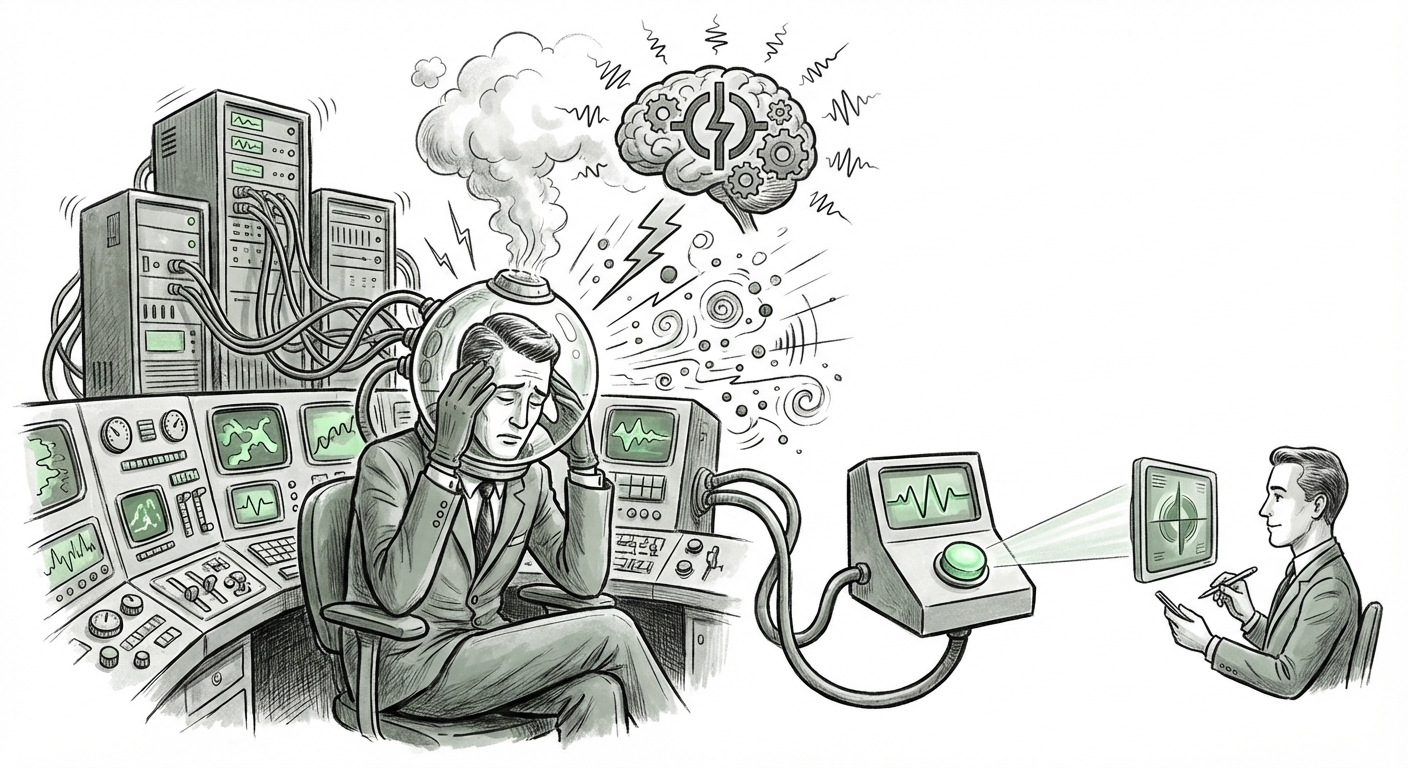
The promise of Artificial Intelligence has always been efficiency—delegating tedious, repetitive, or high-volume tasks so that human workers can focus on strategy, creativity, and complex problem-solving. However, a crucial reality check has arrived, delivered by a recent BCG study. Far from freeing up cognitive bandwidth, simultaneously overseeing too many AI agents is causing measurable exhaustion, leading to higher error rates and increased employee turnover. This phenomenon, dubbed "AI Brain Fry," signals that we have reached a critical juncture in technology deployment: we are outpacing our workers’ inherent capacity for supervision.
This isn't merely a complaint about workplace stress; it is a fundamental design flaw in the current model of Human-in-the-Loop (HITL) interaction. If AI integration leads to burnout, it defeats the entire purpose of automation. To understand what this means for the future of AI and how we must adapt, we need to move beyond the single study and seek corroborating evidence across cognitive science, risk management, and interface design.
The Evidence: From Monitoring to Mental Exhaustion
The core finding from the BCG research is straightforward: there is an upper limit to how much algorithmic output a human brain can reliably monitor without suffering performance degradation. Think of it like trying to listen to 10 different radio stations at once—the brain cannot effectively process any of them, and eventually, it shuts down the effort just to cope.
When an employee manages one AI tool, they might review its output critically. When they manage five, they are often forced into superficial, "check-the-box" verification, driven by the sheer volume of alerts and data streams. This forces a mental shift that is inherently taxing. We need to investigate the technical reality behind this feeling of fatigue.
Corroboration 1: Quantifying the Cost of Monitoring
To confirm that "Brain Fry" is a measurable cognitive event, we must look toward research focused on "Cognitive Load Monitoring in Human-AI Teaming." This area of study, traditionally focused on high-stakes fields like air traffic control or cybersecurity, seeks to measure the mental energy (cognitive load) expended when a human supervises an automated system.
The insights here suggest a critical distinction: interacting with an AI (giving a clear prompt, refining an output) is often an active process, which can be engaging. But monitoring—staring at a screen waiting for the one moment the AI might fail—is a passive but highly demanding state. This sustained vigilance taxes the brain's executive functions, depleting the resources needed for complex decision-making later. For the average knowledge worker deploying multiple Large Language Models (LLMs) across daily tasks, this translates directly into the exhaustion reported.
Corroboration 2: The Dangerous Flip Side: Complacency
While "Brain Fry" highlights exhaustion leading to errors (known in psychology as a vigilance decrement), relentless automation also breeds its opposite danger: Automation Complacency. This is where the AI is so reliable, for so long, that the human supervisor begins to implicitly trust it too much and disengages entirely.
Research into this dual risk—fatigue from too much monitoring versus dangerous over-trust from too little—is essential for organizational leaders. If an AI system consistently performs at 99.9% accuracy, the human operator expects 100%. When the 0.1% error finally appears, the operator lacks the focused mental acuity to catch it because their brain has been trained to relax its vigilance.
The future of AI integration depends on striking the perfect, dynamic balance between these two forces. We cannot design systems that demand constant, fatiguing vigilance, nor can we deploy systems that allow human operators to completely check out.
The Multi-AI Fragmentation Problem
The BCG study noted overseeing "too many AI tools." In 2024, this means juggling a diverse ecosystem. An analyst might use one AI for drafting internal emails, another specialized model for synthesizing market research reports, and yet another for generating presentation outlines. This forces the worker into rapid context-switching across disparate AI personalities, data sources, and output formats.
Searches related to "The Impact of Multitasking Multiple LLMs" confirm that this fragmentation is crippling deep work. Every time a worker switches from reviewing an LLM output to debugging a data visualization tool, they pay a "context-switching tax." This tax is amplified when the tools themselves are all operating simultaneously, bombarding the user with disparate notifications and required checks.
For business leaders, this means the ROI of deploying 10 separate, siloed AI tools might be lower than deploying two deeply integrated, context-aware platforms. Fragmentation equals cognitive debt.
What This Means for the Future of AI Deployment
If the human supervisor is the weak link due to cognitive overload, the responsibility shifts squarely onto the developers and deployers of AI systems. The current paradigm—AI performs the task, human validates the result—is insufficient. The future requires a complete re-imagining of Human-AI Collaboration Interfaces.
Actionable Insight 1: The Move to Exception-Based Reporting
The primary directive for future AI interface design must be to eliminate the need for continuous overview. We must shift from "Check Everything" to "Alert Me Only When Necessary."
This concept, rooted in exception-based reporting, means the AI should handle the 99% of tasks that are routine and correct. It should only interrupt the human when one of two things happens:
- Anomaly Detected: The AI detects a high probability that its own output is incorrect or novel, triggering a required human review point.
- Human Discretion Required: The task requires ethical judgment, strategic nuance, or input that the AI cannot generate (e.g., selecting the tone for a delicate negotiation).
Designing systems that accurately assess their own uncertainty levels—rather than relying on a fatigued human to guess—will be the hallmark of next-generation enterprise AI.
Actionable Insight 2: Designing for Human State, Not Just Task State
To address "Brain Fry," interfaces must become aware of the user's cognitive state. This moves beyond simple task management into Adaptive User Experience (UX). Imagine an AI interface that monitors the complexity of the tasks it has presented to the user over the last hour. If the user has reviewed 50 complex AI suggestions in a row, the system should dynamically adapt:
- It might temporarily stop presenting low-priority suggestions.
- It might consolidate outputs into fewer, higher-level summaries.
- It might suggest a short break or shift to a less cognitively taxing activity.
While real-time monitoring of internal mental states is complex (and raises privacy concerns), developers can use proxy measures like task density and error rate trends to create healthier workflows.
Actionable Insight 3: Consolidation Over Proliferation
The immediate business implication is restraint. Before deploying a new, specialized AI tool, organizations must ask: "Does this solve a problem that our existing integrated AI environment cannot?" IT leaders should prioritize platforms that offer a unified dashboard for supervising multiple AI functions, rather than allowing dozens of siloed, single-purpose agents to proliferate across teams.
The goal is to reduce the number of contexts the human must switch between, even if the total volume of data remains high. Fewer dashboards, deeper integration, and smarter aggregation are essential antidotes to fragmentation.
Looking Ahead: From Automation to True Augmentation
The "AI Brain Fry" warning is a necessary friction point in our rapid adoption curve. It forces us to recognize that hyper-automation does not automatically lead to human liberation; poorly designed automation leads to human overload. For technology to truly succeed, it must integrate seamlessly without demanding constant, exhausting surveillance.
The next era of AI development won't just be about making the models smarter; it will be about making the *collaboration* smarter. We are moving away from simply automating tasks toward intelligently augmenting human judgment. This requires AI systems that understand their own limitations well enough to manage their human supervisors effectively. If we fail to redesign our interfaces based on these cognitive constraints, we risk burning out the very talent we hoped AI would elevate, stalling the transformative potential of this technology before it has truly begun.