The Leap to 4D AI: How DeepMind's D4RT and World Models Are Revolutionizing Predictive Intelligence
The artificial intelligence landscape is always moving, but sometimes, a development emerges that feels less like an iteration and more like a genuine paradigm shift. Recent explorations into **World Models**, particularly those highlighted by DeepMind's D4 Dynamics/Reinforcement Learning (D4RT) system, represent exactly that moment. We are witnessing the pivot from AI that *recognizes* the world to AI that can accurately *predict* it.
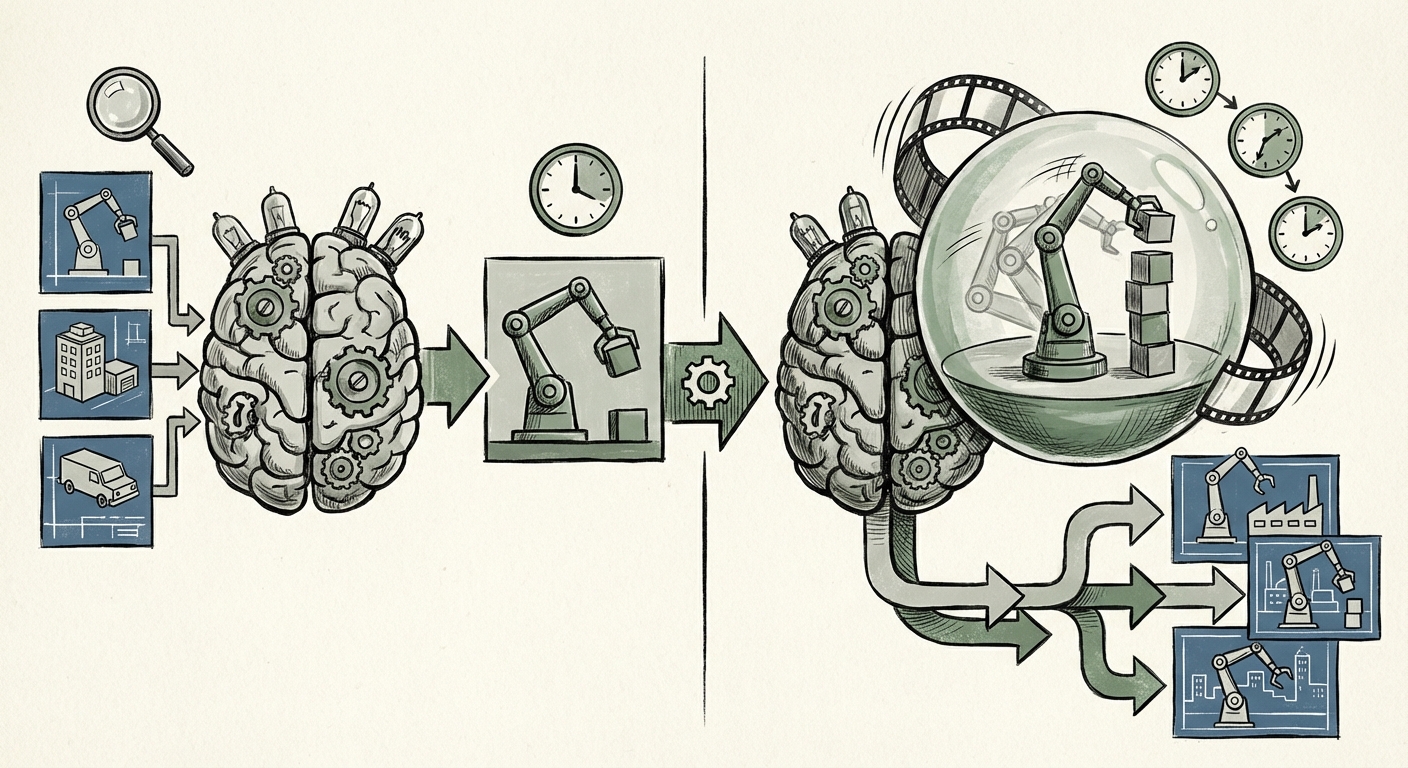
For years, major AI models excelled at interpreting static data—identifying objects in photos, translating text, or classifying sounds. However, the real world is fundamentally dynamic. It operates in four dimensions: three spatial dimensions plus the constant, relentless dimension of time. The ability to model these temporal dynamics—to understand that pushing a glass will cause it to fall, or that a robot needs to adjust its grip mid-movement—is the key ingredient missing for true general intelligence and useful, autonomous systems. This is where 4D World Models enter the picture.
What Are 4D World Models and Why Do They Matter?
Imagine you are trying to teach a child to stack blocks. If the child only sees the final stack (a 3D snapshot), they don't learn the process. They need to see the blocks being placed, one after the other, over time. A **World Model** in AI is similar: it’s an internal simulator that the AI builds within itself. It learns the "physics" of its environment.
When we add the '4D' element, we mean this internal simulator must master *dynamics*—how objects change over time. DeepMind’s D4RT is a powerful example of this in action, showing an agent learning complex movement and interaction patterns by running countless mental simulations based on its learned dynamics model.
In simpler terms: **The AI stops reacting to what it sees right now and starts planning based on what it predicts will happen next.** This predictive capability is crucial for complex tasks, from navigating a busy street to optimizing a fusion reactor.
The Theoretical Foundation: Predictive Coding and the AGI Roadmap
This drive toward dynamic prediction isn't isolated to one lab. It represents a core architectural belief held by many AI leaders about how advanced intelligence must be built. As corroborated by influential thinkers in the field, the theoretical bedrock of this approach is **predictive coding**.
Leading AI researchers, such as Yann LeCun, argue that systems must constantly generate predictions about the sensory input they expect to receive next. The difference between the prediction and the actual incoming data is the "error signal"—this error is what the system learns from. If an AI can accurately predict the next frame of a video, it has implicitly understood the underlying physical laws governing that scene.
The Embodied AI Race: Dynamics in Action
The most tangible beneficiaries of 4D modeling are systems that interact with the physical world: **Robotics and Embodied AI**. An agent that merely recognizes a door handle won't open the door effectively if it hasn't learned the *force* required or the slight rotation needed. D4RT is showing remarkable progress in mastering these physical tasks.
This work is mirrored across major labs. We see parallel efforts focusing on agents that learn entirely within simulated, dynamic environments before deployment. The performance of agents like Google’s **DreamerV3**, which relies heavily on an internal world model to "dream" successful actions, demonstrates that this approach is rapidly becoming the industry standard for learning complex motor control.
For a robotics engineer, this means less time programming explicit movements and more time refining the simulated world where the agent trains itself. The AI learns to become its own physics engine.
(Search Query Used for Context: Embodied AI simulation dynamics "Google Robotics" "DreamerV3")
The Scaling Challenge: Why 4D is Computationally Demanding
If 4D World Models are so powerful, why aren't they everywhere already? The answer lies in the sheer **computational cost**. Training a large language model (like GPT) requires massive datasets to learn static relationships between words. Training a 4D dynamics model requires massive computational power to learn the consistent, non-breaking rules of physics across millions of simulated time steps.
The challenge shifts from storing data to **continuous, high-throughput simulation**. These models require dedicated, persistent computational environments to run millions of "mental rehearsals" every hour. This demands specialized hardware and significant energy expenditure, creating a high barrier to entry. The scaling laws for dynamic models are fundamentally different from those for static pattern recognition models.
This constraint highlights a critical future bottleneck: the ability to supply affordable, scalable simulation infrastructure will dictate who leads the next wave of advanced autonomy.
(Search Query Used for Context: Scaling laws for "4D world models" computational requirements)
From Lab Bench to Industrial Revolution: The Digital Twin Era
While D4RT is exciting for AGI enthusiasts, the most immediate economic impact of mastering 4D simulation lies in enterprise applications, specifically **Digital Twins**.
A Digital Twin is a high-fidelity virtual copy of a real-world system—a manufacturing plant, an entire electrical grid, or a logistical network. Until now, these twins were often based on pre-programmed engineering models. World Models offer the ability to create *adaptive, learning* Digital Twins. If an AI can predict the 4D behavior of a complex supply chain or a jet engine under stress, engineers can run infinite "what-if" scenarios safely and cheaply.
This transition is profound: the AI is no longer just analyzing past data; it is stress-testing the future.
- Manufacturing: Predicting equipment failure days in advance based on subtle dynamic shifts.
- Urban Planning: Simulating the impact of new infrastructure on traffic flow and energy consumption over seasonal cycles.
- Drug Discovery: Modeling the dynamic interaction of molecules over time rather than just static binding probabilities.
(Search Query Used for Context: "Predictive simulation for industrial digital twins" future trends)
Practical Implications: What Businesses Need to Do Now
The emergence of reliable 4D World Models signals a clear direction for technology investment over the next decade. For both technical and business leaders, ignoring this shift is risky.
For Technology Leaders (CTOs & Engineers):
Your focus must shift toward building robust, high-throughput simulation environments. If your current AI tools are purely observational (looking at fixed datasets), they will soon be outperformed by agents that learn within dynamic, simulated realities. Invest in expertise in Reinforcement Learning (RL) architectures that can incorporate latent space dynamics.
For Business Strategists (CEOs & Investors):
Identify areas where dynamic prediction yields the highest value. Where is the cost of failure highest? Autonomous systems, complex logistics, and rare event forecasting are prime targets. Start conceptualizing how a 'learning twin' of your core operation—be it a factory floor or a financial trading platform—could reduce risk and unlock efficiency gains far beyond what static analytics currently provide.
Conclusion: Living in the Age of Anticipation
DeepMind’s D4RT, viewed through the lens of established theories like predictive coding and parallel work on embodied agents like DreamerV3, confirms that AI is successfully crossing a critical threshold. We are moving beyond sophisticated pattern matching into the realm of genuine *anticipation*. The ability to reliably model the fourth dimension—time—is the prerequisite for creating truly robust, adaptable, and intelligent machines.
The excitement around 4D World Models is warranted. These systems are not just faster; they are fundamentally smarter because they grasp causality and consequence across temporal gaps. While the computational demands are high, the potential payoff—safe robotics, optimized industries via Digital Twins, and ultimately, progress toward Artificial General Intelligence—makes this the most important technological frontier right now.