The Digital Fly: Analyzing the First Full Fruit Fly Brain Emulation and Its Impact on Future AI
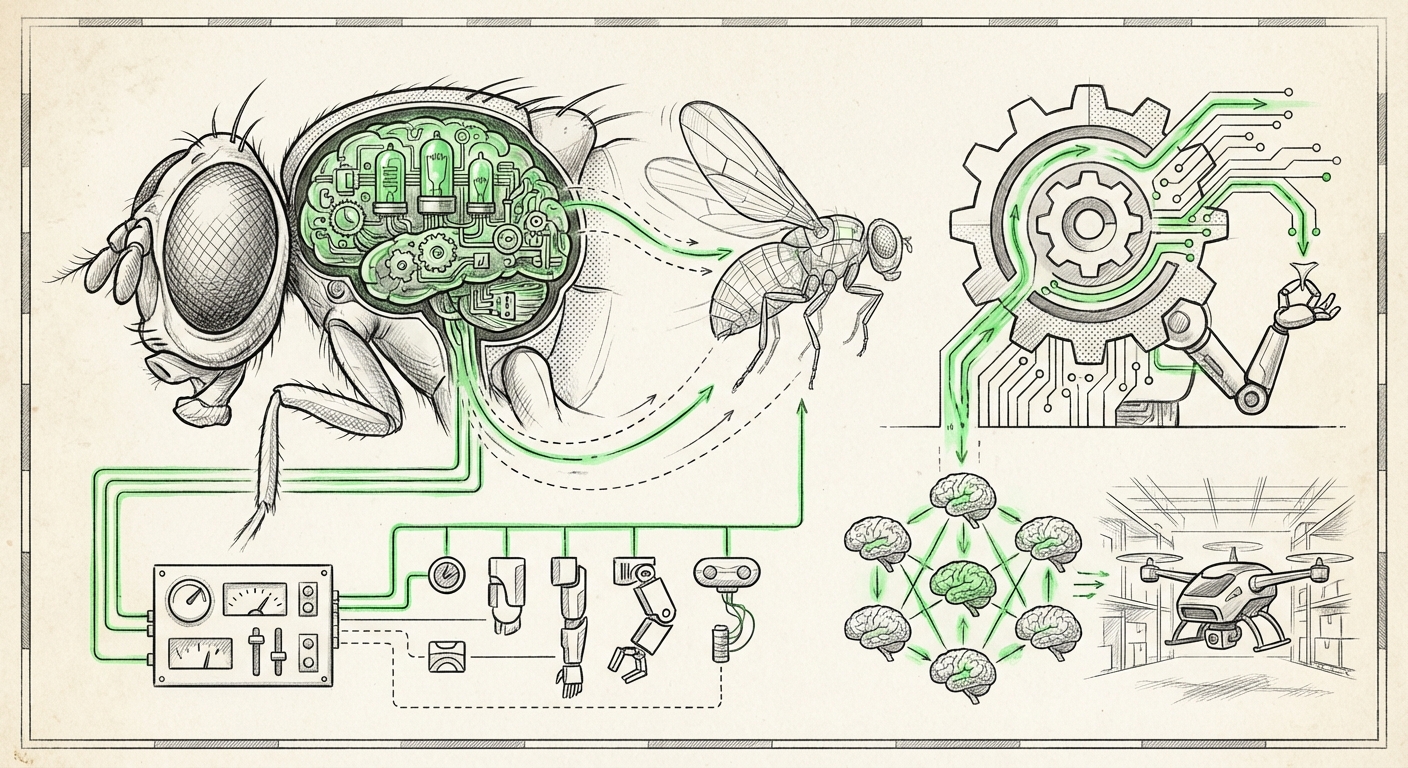
The pursuit of replicating biological intelligence in silicon has long been the stuff of science fiction. Yet, recent claims suggest we are crossing a threshold previously reserved for thought experiments. Eon Systems asserts they have successfully created the first full brain emulation of a fruit fly (*Drosophila melanogaster*), connecting its digital circuitry to a virtual body capable of producing observable behaviors.
This announcement, involving the simulation of approximately 125,000 neurons and 50 million synapses, isn't just a clever piece of code; it is a profound engineering and scientific achievement. For both the AI industry and the world of biological research, this moment forces us to re-evaluate the timeline for achieving complex artificial intelligence.
The Significance of Simulating the Fly: Beyond the Buzz
Why focus on a fruit fly? While a fruit fly's brain is orders of magnitude simpler than a human's, it possesses all the fundamental components necessary for life: sensory processing, decision-making, navigation, and motor control. It is the perfect, manageable starting point for Whole Brain Emulation (WBE).
Eon Systems’ claim rests not just on mapping the physical structure (the connectome), but on creating a functional model. The connection to a simulated body that yields measurable behavior is the key differentiator.
Bridging Structure and Function
For years, neuroscience has mapped the physical wiring diagrams of organisms. This is like having a perfect blueprint of a city's roads. However, knowing the roads doesn't tell you how traffic flows or why accidents happen. Eon Systems claims to have simulated the 'traffic'—the electrical and chemical signalling—that results in walking, turning away from danger, or seeking food. This functional integration moves the effort from mere structural modeling to true simulation.
To gauge this achievement, researchers typically look at benchmarks set by larger projects. Historically, efforts like the Blue Brain Project (BBP) at EPFL have focused on simulating microscopic sections of mammalian brains, often struggling with the computational demands of even a single cortical column. An article comparing progress in WBE benchmarks would immediately highlight that simulating an entire insect nervous system is a monumental leap, demanding advances in both biological accuracy and high-performance computing.
The Computational Gauntlet
Simulating 50 million synapses requires immense, dedicated computing power. This development suggests that the necessary High-Performance Computing (HPC) infrastructure is finally catching up to the theoretical demands of biological modeling. We are talking about specialized software architectures capable of handling the asynchronous, event-driven nature of neural spiking far more efficiently than standard graphics processing units (GPUs) typically used for deep learning.
This reliance on specialized computational methods underscores a vital trend: the convergence of neuroscience and computer architecture. If we can run a fly's brain in simulation, we are proving the viability of the platform required for more complex future emulations.
What This Means for the Future of AI
The immediate impact of this digital fly is not that it will pass the Turing Test next week, but rather that it validates an entirely different path for achieving advanced AI.
The Neuromorphic Revolution vs. Deep Learning
Currently, the dominant AI paradigm is Deep Learning (DL)—vast, layered artificial neural networks trained on massive datasets (like GPT-4). Biological emulation, or neuromorphic computing, is an alternative. It seeks to replicate intelligence by mimicking nature's successful architecture.
When we simulate a brain, we often observe emergent behavior—complex actions arising naturally from simple rules operating across the network. Articles focusing on emergent behavior in large-scale networks often contrast this organic intelligence with the brittle, over-specialized intelligence of current DL models. The digital fly provides a tangible, testable system where emergent behaviors can be studied in a controlled environment.
This shift implies that future AI development may bifurcate: scaling up current LLMs (Large Language Models) will continue, but a parallel track focused on bio-plausibility—learning how to build systems that learn, adapt, and use energy efficiently like a biological brain—will become heavily funded and crucial.
Accelerating Robotics and Embodied AI
The most immediate beneficiaries of this technology are robotics and embodied AI. For a robot to navigate the messy, unpredictable real world, it needs intuition, rapid processing, and robust fault tolerance—hallmarks of biological systems.
Imagine testing a new control strategy for a drone. In the current environment, engineers must build hardware, install software, test, crash, repeat. With a validated digital brain simulation, engineers can test millions of scenarios—from high winds to sensor failure—against the emulated brain's control algorithms instantly, in a perfect virtual environment. This synergy between simulated neuroscience and digital embodiment dramatically cuts development time and cost for advanced autonomous systems.
Practical Implications: Business, Research, and Ethics
The successful emulation of even a simple brain ripples outward, affecting several critical sectors.
For Researchers: Deconstructing Cognition
For biologists and neuroscientists, the digital fly is the ultimate laboratory tool. The complexity of real biological experiments is immense; isolating variables is nearly impossible. In a simulation, one can selectively "knock out" specific sets of neurons or instantly alter synaptic strengths to observe the precise behavioral consequences. This allows for rapid hypothesis testing regarding fundamental questions like how flies learn to associate smells with rewards—a key area of study in the *Drosophila* neural circuit simulation space.
For Business: The Roadmap to Artificial General Intelligence (AGI)
While human-level AGI remains decades away, the fruit fly simulation acts as a crucial stepping stone. It proves the technological pathway. Businesses relying on cutting-edge AI—from autonomous vehicles to advanced manufacturing—must monitor WBE advancements closely.
If the fidelity of these models continues to improve, the next targets are organisms with more complex decision-making capabilities, such as rodents. Companies that master the simulation pipeline now will be perfectly positioned to license or deploy the first viable AGI architectures based on biological principles rather than today’s statistical models.
The Emerging Ethical Landscape
As computational fidelity increases, so does the ethical weight. If the simulation reliably produces behaviors that mimic pain, fear, or complex social responses in a virtual body, society must grapple with the moral status of that simulation. Although a fruit fly simulation is far from raising moral alarms, its existence forces early conversations regarding digital sentience and the responsible use of bio-mimetic technology.
Actionable Insights for Navigating the Shift
The era of purely data-driven AI scaling is beginning to meet the age of bio-plausible engineering. Organizations need to adapt their strategies now:
- Invest in Neuromorphic Literacy: Traditional AI teams focused solely on transformers and convolutional neural networks need cross-training in spiking neural networks (SNNs) and event-based processing. Understanding the mathematics of biological signal propagation is becoming essential for accessing next-generation AI performance.
- Prioritize Embodiment: Any business aiming for truly autonomous systems (e.g., last-mile delivery, complex industrial inspection) should shift R&D focus toward simulation environments capable of hosting realistic digital brains. The payoff in reduced real-world testing cycles will be enormous.
- Monitor Open-Source Connectomics: The success of Eon Systems relies on underlying connectome data. Businesses and researchers should track open collaborations in neuroscience that aim to map and share brain architecture data, as this forms the foundational "training data" for future WBE systems.
The digital fruit fly may seem small, but its successful emulation casts a long shadow over the future of technology. It confirms that understanding nature’s blueprint for intelligence is not just an academic pursuit, but a viable, practical engineering route toward unlocking true artificial cognition.