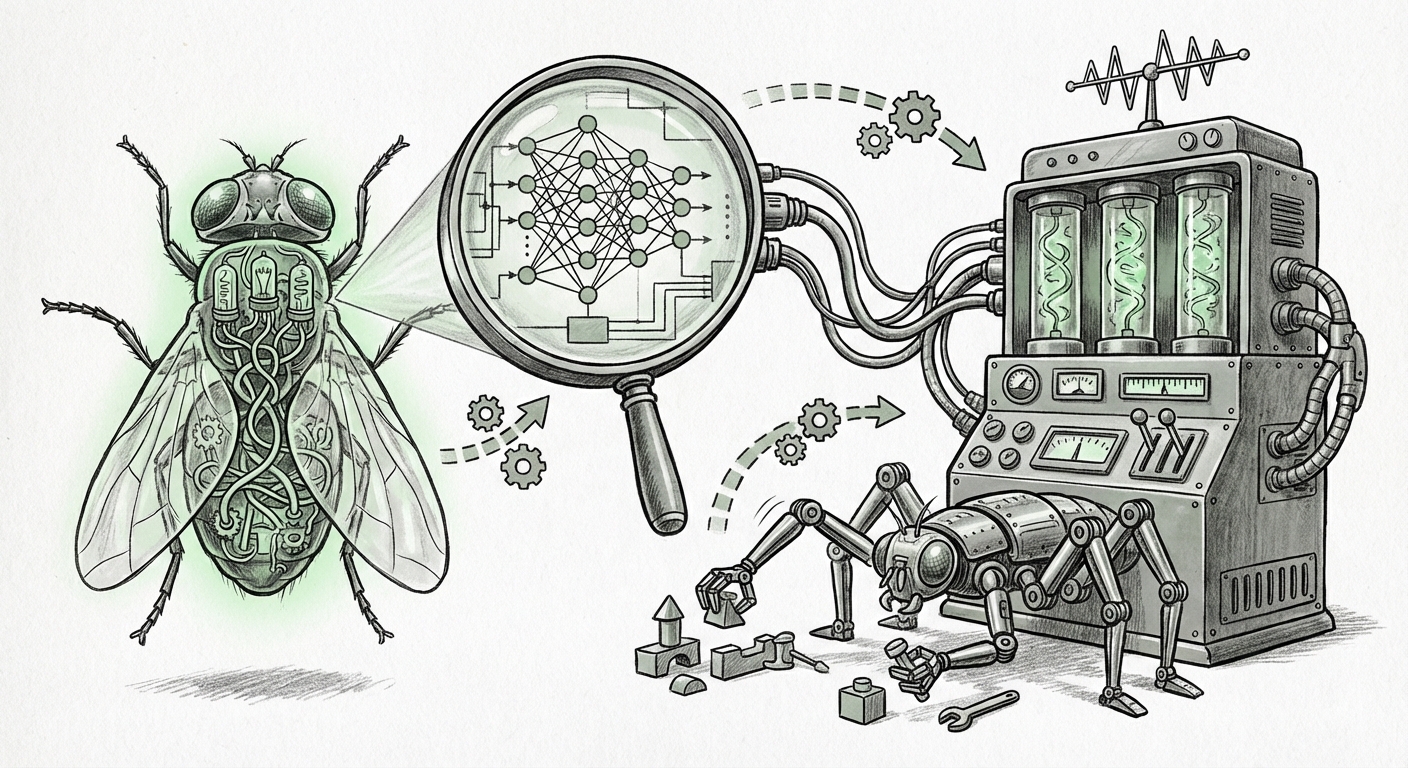
The Fly in the Machine: Analyzing the First Full Fruit Fly Brain Emulation and Its Leap Toward AGI
The landscape of Artificial Intelligence is constantly being reshaped by breakthroughs that bridge the gap between silicon computation and biological reality. Recently, the claim by Eon Systems to have successfully executed the first full brain emulation of a fruit fly, complete with a simulated body producing verifiable behaviors, has sent ripples through the computational neuroscience and AI communities. This achievement, involving a system modeling over 125,000 neurons and 50 million synapses, is not just a technical victory; it represents a crucial, tangible step toward the long-sought goal of Whole-Brain Emulation (WBE) and the creation of truly biologically inspired intelligence.
For years, Artificial Intelligence has been dominated by deep learning—vast, statistical models optimized for massive datasets. While phenomenally effective at tasks like image recognition and language generation, these models often lack the efficiency, adaptability, and inherent understanding of physical reality that biological brains possess. The fruit fly emulation suggests a pivot toward reverse-engineering nature’s most efficient computer.
Deconstructing the Milestone: What Exactly Was Achieved?
To appreciate this development, we must simplify the complex science. Think of the fruit fly (*Drosophila*) brain as a meticulously mapped blueprint, or a connectome, describing exactly how every neuron connects to every other. Eon Systems claims they have taken this blueprint and brought it to life in a computer simulation.
The magnitude is significant:
- Scale: 125,000 neurons is tiny compared to the human brain’s 86 billion, but the fly brain is a complete, functional, operating nervous system responsible for everything the fly does.
- Fidelity: The emulation includes 50 million synapses, the critical connections that determine how information flows.
- Embodiment: Crucially, this digital brain was not isolated. It was hooked up to a *simulated body*, allowing it to receive inputs (sensory data) and execute outputs (motor commands), thus generating observable behaviors.
This transition from a static map to a dynamic, behaving model is the breakthrough. It moves the field beyond mere anatomical replication into the realm of functional equivalence. If the simulated brain reacts to virtual light, navigates virtual space, or performs basic decision-making mirroring a real fly, the simulation is proving its worth as a model of intelligence.
Contextualizing the Progress: Where Does This Fit in the WBE Landscape?
Eon’s claim needs to be viewed alongside other colossal neuro-simulation efforts. When researching projects like the **Human Brain Project (HBP)** or the **Blue Brain Project**, we often see goals focused on simulating vast swathes of mammalian brain tissue, often for pharmacological testing or fundamental research. These projects tackle unprecedented scale and complexity, focusing heavily on the underlying biology.
The fly emulation differentiates itself by prioritizing *completeness* over sheer scale. By tackling the entire, small brain of the fly, Eon Systems appears to have achieved a fully closed-loop system—a singular, verifiable whole. While other projects may boast more neurons, achieving functional behavior from the *entire* network of a smaller organism is often a more direct pathway toward understanding the fundamental algorithms of intelligence.
The feasibility of this scale hinges on the parallel evolution of computing power, specifically advancements in **neuromorphic hardware**. Traditional computers process information sequentially; biological brains process it massively in parallel using 'spikes.' To run 50 million dynamic synapses efficiently, simulations increasingly rely on hardware designed to mimic this spiking behavior, often utilizing technologies related to research from companies like Intel (**Loihi**) or IBM (**TrueNorth**). This development signals that the required computational substrate for early WBE is maturing rapidly.
The Technical Hurdle: Structural Fidelity vs. Functional Equivalence
The most profound technical discussion surrounding this achievement relates to the concept of functional equivalence. Is a perfect digital copy of the wiring diagram sufficient to recreate the mind?
Imagine a highly detailed blueprint of an engine (the connectome). If you build the engine exactly according to the blueprint (the emulation), it should run. However, if the engine runs sluggishly, sputters, or stalls, it means something vital is missing—perhaps the exact chemistry of the fuel, the precise elasticity of a rubber gasket, or the environmental temperature. In neuroscience, this ‘missing fuel’ could be the precise timing of neurotransmitter release, the analog nature of ion channels, or the dynamic influence of glial cells.
When Eon reports producing “multiple behaviors,” they are asserting that they have successfully modeled not just the static connections, but the *dynamics* that allow the fly to sense, decide, and act. This forces researchers to confront the limitations of using current AI techniques (often based on Artificial Neural Networks, or ANNs) versus biologically grounded approaches like Spiking Neural Networks (SNNs), which are inherently better suited for capturing the temporal dynamics of brain activity.
Future Implications: The Dawn of Embodied, Efficient AI
The successful emulation of the fly brain offers immediate, tangible implications across several high-value sectors, all stemming from the concept of **Embodied Intelligence**.
1. Revolutionizing Robotics and Autonomous Systems
The ability to control a simulated body is the gateway to controlling real-world hardware. Current robotics often relies on complex, hand-coded control algorithms or reinforcement learning that requires vast amounts of trial and error in simulation. If researchers can successfully map the fly's efficient, low-power neural architecture onto a drone or a legged robot:
- Energy Efficiency: Biological brains operate on mere watts of power. Robots controlled by bio-inspired circuits could achieve astonishing battery life and operational endurance compared to conventional processors.
- Robustness: Biological systems are inherently robust to noise and damage. A system that mimics this redundancy could lead to robots capable of operating reliably in unstructured, hostile environments.
- Rapid Adaptation: The fly brain is adept at rapidly updating its behavior based on simple sensory cues. This speed translates directly into superior autonomous navigation and decision-making in complex scenarios.
This trajectory suggests a future where control systems are less programmed and more *grown* or *trained* via biological analogues, drastically accelerating development timelines in industries from delivery logistics to search and rescue.
2. Accelerating Drug Discovery and Toxicology
The *Drosophila* is a major model organism in genetics and toxicology. Being able to test the effects of novel compounds, genetic modifications, or environmental toxins on a digital, functional replica of its entire nervous system is a game-changer. Instead of lengthy and expensive live-animal trials for preliminary safety screening, companies could rapidly assess impacts on behavior, sensory processing, and motor control within the simulation.
3. A Stepping Stone to Human-Level Intelligence (AGI)
While we are decades away from human WBE, the fruit fly achievement serves as a crucial proof of concept. It validates the methodology: mapping connectomes and building dynamic simulators are technically achievable goals. This success emboldens the WBE community, providing a scalable template. If the architecture works for 125,000 neurons, the challenge shifts to scaling the hardware and mapping the exponentially more complex structures of mammals.
Navigating the Ethical and Investment Landscape
Developments at this frontier inevitably raise questions that must be addressed proactively:
The Functional Barrier: When does a complex simulation become worthy of ethical consideration? If the simulated fly exhibits suffering or goal-oriented behavior that mirrors life, society must begin defining the boundaries between advanced modeling and digital sentience. This debate is critical now, long before we approach higher-order organisms.
Investment Focus: For investors, this development validates the convergence of neuroscience, high-performance computing, and specialized hardware. The actionable insight is that the next generation of AI advantage may not lie purely in large language models, but in companies that can efficiently translate biological principles into computational architectures.
Actionable Insights for Technology Leaders
For CTOs, R&D directors, and technology strategists, the message from the fruit fly emulation is clear: the biological substrate matters.
- Invest in SNN Expertise: Move beyond traditional deep learning frameworks where appropriate. Begin experimenting with Spiking Neural Networks (SNNs) and neuromorphic computing principles, as these are the native languages of biologically realistic models.
- Prioritize Embodiment: Focus R&D efforts on linking computational models to physical or realistic simulated actuators. Intelligence is demonstrated through action, not just prediction.
- Scout Neuromorphic Hardware: Understand the roadmaps of companies producing specialized AI accelerators that optimize for event-driven, sparse computation rather than dense matrix multiplication. The efficiency required for WBE will necessitate purpose-built silicon.
The work being done on the humble fruit fly is anything but humble in its ambition. It is forcing a necessary conversation about what intelligence truly is and providing the first working prototype of a nervous system reverse-engineered in silicon. As we look forward, the integration of embodied, biologically plausible systems promises an era of AI that is not only smarter but fundamentally more efficient and grounded in the reality of the physical world.