AI Copyright Showdown: Why German Court Ruling on 'It's AI' Signals a New Era of Creator Accountability
The rapid democratization of powerful generative AI tools—from text models that write poetry to music generators like SunoAI that compose complete songs—has thrown a wrench into the established world of Intellectual Property (IP). For years, creators and lawyers have worried: If a machine makes it, who owns it? And if the machine gets it wrong, who is liable?
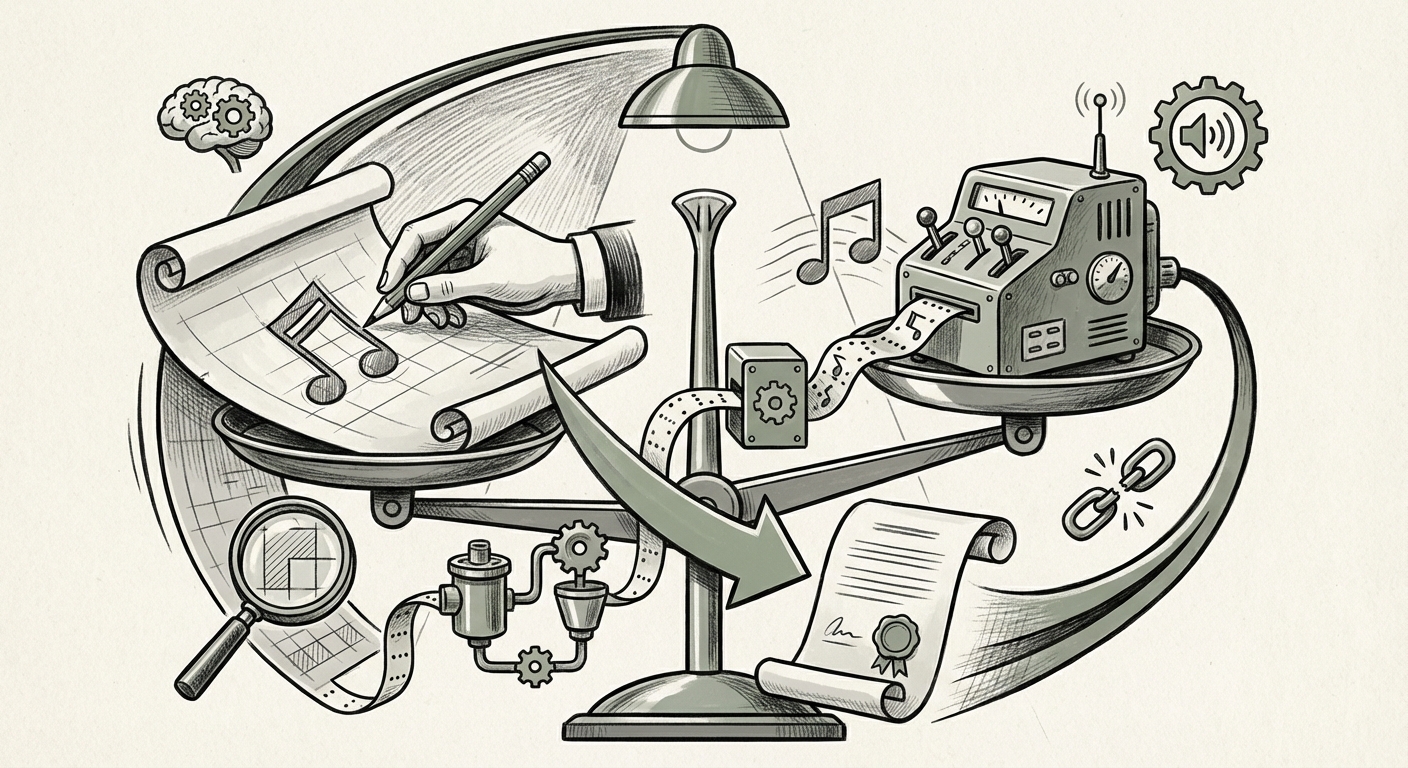
A recent ruling from a German regional court provides a critical, early answer, at least for now. The court determined that simply waving a hand and saying, "It's AI-generated," is not enough to void copyright protection on creative elements, such as song lyrics, that were undeniably written by a human. This is not just a legal technicality; it is a profound statement about the continuing **centrality of human agency** in the creative ecosystem.
This development forces us to move past the simplistic binary of "Human vs. Machine" and into a complex spectrum of "Human-Assisted Creation." To truly grasp what this means for technology trends, future business models, and the careers of creators everywhere, we must synthesize this ruling with global legal responses and the inner workings of the AI itself.
The Core Conflict: Authorship vs. Tool Use
At the heart of the copyright debate is the fundamental question of authorship. Traditional IP law, stemming from centuries of common law, is designed to reward the human mind that conceives and executes an original work. Generative AI challenges this because the execution—the actual rendering of the melody or the crafting of the sentence—is performed by an algorithm trained on billions of existing, copyrighted works.
The German court’s decision seems to draw a line: If a human created the lyrics, even if they used an AI to generate the musical accompaniment (as was implied in the case involving SunoAI), the human-created component retains its protected status. The defense against copyright infringement cannot simply rely on the presence of AI; it must actively demonstrate that the human contribution was negligible or non-existent.
Contextualizing the Global Legal Landscape
This regional ruling gains immense significance when viewed against simultaneous global legal movements. The world’s major economic blocks are drawing up their responses:
- The US Approach: In the United States, the Copyright Office has been explicit: human authorship is non-negotiable. If AI generates the work without significant human creative control, it won't be registered. Comparing this stance with the German ruling shows a shared goal—protecting human effort—but a potentially different procedural emphasis. While the US focuses on *registration denial*, Germany focuses on *validating existing protection* against an AI claim.
- The EU’s Comprehensive Stance: The European Union’s developing AI Act is set to enforce strict transparency rules, especially for General Purpose AI Models (GPAIMs). This legislation demands clear labeling of AI-generated content. This directly corroborates the German finding: if a work is AI-assisted, future EU law will likely demand it be marked as such, making it harder for creators to hide AI involvement, yet simultaneously demanding clarity on what *part* was human.
The differing emphasis highlights a critical future challenge: Will creators need to abide by the most restrictive copyright standard globally, or will their protection vary depending on where the work is distributed?
Diving Deep: The Mechanics of AI Creation
To understand the legal implications, we must understand the technology that prompted this ruling. Tools like SunoAI use complex diffusion models to generate music from text prompts. These models don't "think"; they statistically predict the next most likely sequence of notes or words based on patterns learned from vast datasets.
The legal gray area emerges when analyzing the **human input** versus the **machine output**: Was the human input just a simple prompt ("Write a sad song about rain"), or did the human select, edit, refine, and curate dozens of AI iterations until a final, unique vision was realized? The latter suggests high human agency, akin to a photographer choosing a single perfect shot from a thousand bracketed exposures.
Further complicating this is the ongoing legal battle over the training data itself. Many lawsuits filed against large generative model developers center on the initial ingestion of copyrighted material. If the underlying model is found to have infringed copyright through its training data, the output—even if highly transformed—remains tainted in the eyes of some plaintiffs.
The Spectrum of Human Input
This is perhaps the most crucial takeaway for the creative industry. The legal standard is moving away from "Was AI used?" to "How much human input was essential?"
Imagine a sliding scale:
- Fully Automated (Low Human Agency): A single, vague prompt generates a complete piece. Likely little to no copyright protection.
- AI-Assisted Iteration (Medium Agency): A creator provides a detailed structural outline, receives several outputs, and then manually rewrites 50% of the resulting lyrics or melody. This area is the current legal battleground. The German ruling leans toward protecting the human-written 50%.
- AI as Editor/Enhancer (High Agency): A human writes the entire work, then uses AI tools only for polishing grammar, mastering the audio, or suggesting alternative phrasing. Copyright protection is almost certainly secure here.
The future legal standard will demand granular detail on where a creator falls on this spectrum.
Practical Implications for Businesses and Creators
This ruling is not merely academic; it dictates new operational requirements for businesses leveraging AI and for individual creators seeking to monetize their output.
For Content Creators and Artists: The Age of Traceability
Creators can no longer rely on the mystique of their process. If you use SunoAI or similar tools, you must become a meticulous record-keeper. This requires:
- Prompt Archiving: Saving detailed logs of every prompt, parameter change, and iteration used to guide the AI.
- Editing Logs: Utilizing software that tracks every modification made to the AI’s output, creating an auditable history of human refinement.
- Defensive Documentation: Preparing a "Copyright Defense Dossier" upfront for high-value works, clearly illustrating the human conceptualization that preceded the AI generation.
This shifts creative workflow slightly, prioritizing documentation alongside creation. For many artists, this will feel bureaucratic, but for monetization and legal defense, it becomes mandatory.
For Technology Developers: Building Trust and Transparency
AI model developers must adapt to these emerging accountability standards. If their tools are perceived as purely infringing or entirely autonomous, they risk being shut out of major markets or facing crippling liability.
- Provenance Technology: There is a massive, immediate market need for better watermarking and content authentication standards that go beyond simple metadata. Technologies leveraging decentralized ledgers (like blockchain) to timestamp and verify the **chain of custody** for creative input will become paramount.
- Clear Licensing Tiers: Models may need to offer distinct licensing tiers: one for purely autonomous output (with no copyright assurance) and another for "AI-assisted" output, requiring the user to upload documentation proving their contribution.
For Businesses (Media, Marketing, Gaming): Risk Mitigation
Businesses that license or rely heavily on AI-generated content must reassess their risk profile. A marketing campaign relying on an AI-generated jingle might be perfectly legal in one country but vulnerable to an IP challenge in another where human authorship thresholds are higher.
The key actionable insight here is *due diligence*. Before deploying an AI asset commercially, businesses should demand verifiable documentation from their vendors proving the requisite level of human creative oversight, adhering to the highest common denominator of international IP standards where possible.
What This Means for the Future of AI Innovation
The German court’s decision is fundamentally pro-human innovation, not anti-AI innovation. It suggests that the technology is most valuable when it acts as a powerful **augmenter** rather than a wholesale **replacement** for human creativity.
This legal clarity will likely accelerate development in two key areas:
- Hyper-Specific AI Tools: Instead of monolithic, all-in-one generators, we will see more tools designed specifically for the "human augmentation" layer—AI that excels at specific tasks like harmonization, rhyming suggestions, or complex sound engineering, making the creator’s role as the final editor more powerful and easier to prove.
- Hybrid IP Frameworks: Expect to see new legal concepts emerge, perhaps "Co-Authored Rights" or "Tool-Assisted Copyrights," that grant protection based on verifiable contribution metrics rather than absolute human originality. This acknowledges the reality that the best art in the next decade will be a partnership.
The legal system, often slow to adapt, is beginning to assert that **Intent Matters**. Simply pointing to the machine as the culprit is a weak defense. Future success, both legally and commercially, in the creative technology space will belong to those who can clearly articulate and prove the human thought, direction, and judgment embedded within the final digital product.