Decoding the Digital Dilemma: How a German Court Ruling Re-Shapes the Future of AI Authorship and Copyright
The rise of generative AI tools—from large language models creating essays to platforms like SunoAI composing music—has thrown the legal world into flux. For years, the unspoken assumption was that if an AI made it, it belonged to no one, or at least, lacked the fundamental protection of copyright. However, a recent ruling from a regional German court has provided a crucial, and perhaps surprising, counterbalance to this assumption.
The court determined that simply stating a work, such as song lyrics, was generated by AI tools is *not* enough to automatically strip it of copyright protection. If a human was involved in the creation process—even if the music generation used AI—the copyright remains unless proven otherwise. This decision shifts the burden of proof and forces us to confront the messy reality of human-machine collaboration.
This is more than just a local legal victory; it’s a critical waypoint on the global map of AI governance. To understand the technological and societal implications, we must look beyond Germany and examine how this ruling aligns, or conflicts, with global trends in AI regulation and IP doctrine.
The Core Conflict: Automation vs. Authorship
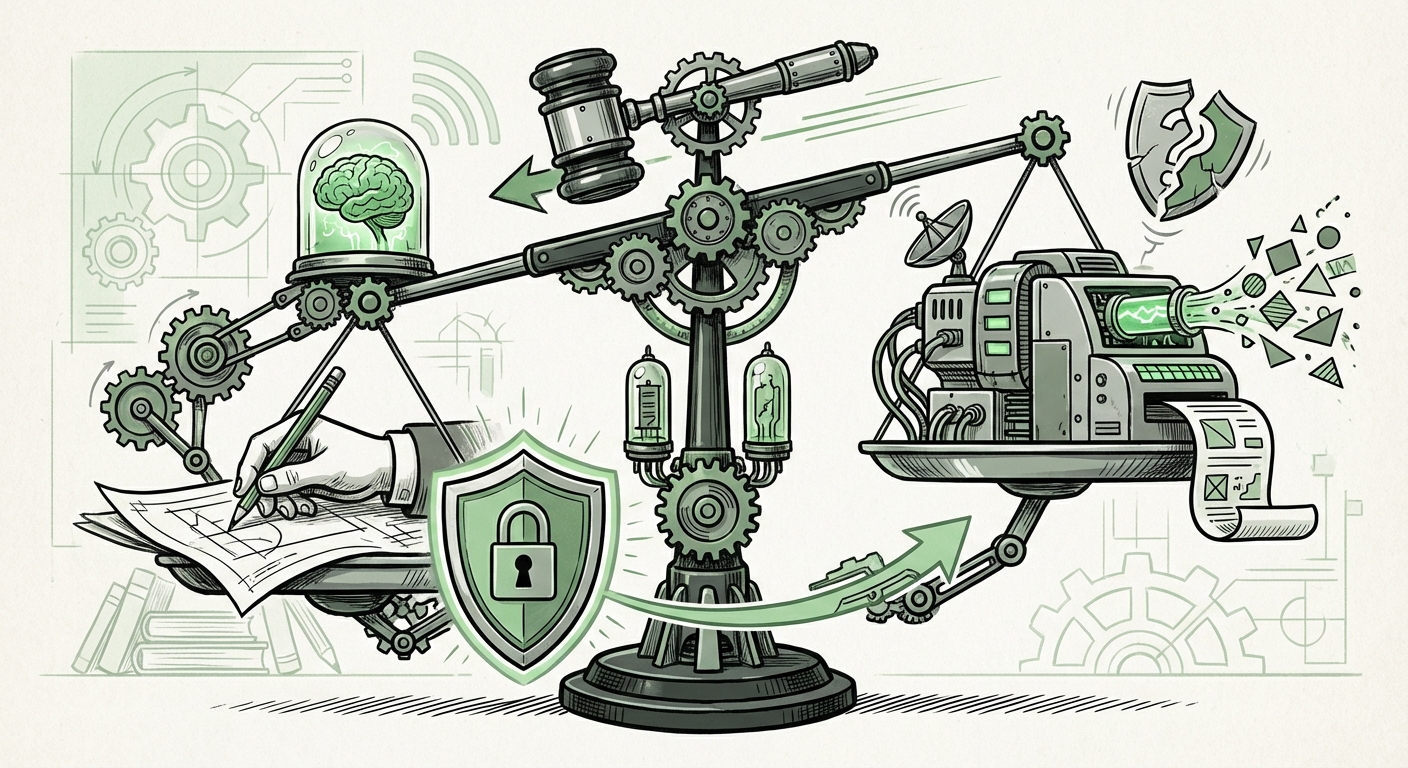
At its heart, intellectual property law—especially copyright—is designed to reward human creativity. The legal premise relies on the concept of an author: a person who exercises skill, judgment, and labor to bring an original work into existence. When tools like SunoAI generate complex musical arrangements or sophisticated text, the question becomes: Is the human prompting the machine the author, or is the machine merely a sophisticated tool, like a paintbrush or a piano?
The German court appears to lean toward the latter interpretation in this specific case: the tool (AI) does not negate the underlying human contribution. This contrasts with initial, strict interpretations in some jurisdictions where any substantial AI contribution leads to the work being deemed uncopyrightable.
The Shifting Burden of Proof
The most actionable takeaway from the German ruling is the concept of the burden of proof. In the past, the default might have been: "If it looks like AI, it’s probably public domain." Now, the default shifts slightly: "If a human claims authorship, that protection stands unless you can definitively prove the human contribution was negligible or non-existent."
For creators, this offers a measure of immediate security for works where human effort—editing, curating, selecting, or deeply prompting—is undeniably present. For technology companies, this presents a compliance hurdle: they must document the degree of human intervention if they wish to claim copyright or enforce ownership.
A Global Scorecard: Comparing Jurisdictions
Legal interpretation of AI creation is anything but uniform. Examining international benchmarks helps us place the German decision within the broader context of technological governance.
1. The United States Perspective: Strict Human Originality
The US Copyright Office (USCO) has been vocal about its stance, often requiring demonstrable human authorship for registration. The famous case involving the comic book Zarya of the Dawn highlighted this: while the *selection and arrangement* of AI-generated images by the human author were copyrightable, the individual images themselves, created purely by Midjourney, were not.
Comparison Point: While the USCO focuses heavily on what *can* be protected based on human input, the German ruling seems focused on what *cannot* be easily unprotected. The German court seems less interested in policing the *quality* of the human input initially, and more interested in upholding existing copyright unless overwhelming evidence suggests otherwise. This suggests a potentially more creator-friendly baseline in German IP law, or at least, a less interventionist judicial approach to established creative works.
For those tracking global standards, understanding the US Copyright Office’s Compendium of Practices regarding generative AI is essential context for legal comparisons.
2. The European Framework: Heading Toward Mandated Transparency
Europe is rapidly moving toward comprehensive AI regulation through the **EU AI Act**. This legislation is not primarily focused on copyright in the traditional sense, but it mandates transparency for generative models, especially those impacting fundamental rights or public trust.
Implication: The EU AI Act will likely require AI systems to clearly label or water-mark outputs, identifying them as machine-generated. This regulatory push for transparency could eventually intersect with copyright claims. If a work is legally required to be labeled "AI-Generated" under EU law, that label could become the very evidence the German court asked for—but used in reverse—to challenge the claim of human authorship. The regional ruling might therefore be temporarily useful until the continent-wide AI Act sets a binding standard.
Tracking analyses of the final text of the EU AI Act reveals the direction European policymakers are taking regarding data and transparency in AI outputs.
The Commercial Reality: Platform Terms of Service
Beyond national laws, the immediate reality for users of tools like SunoAI lies within the Terms of Service (ToS). A user might win a copyright battle in court, but if their platform ToS grants the company significant rights or restricts commercial use, the practical benefit is limited.
Practical Angle: If SunoAI’s terms state that the user owns the output they create (subject to licensing the output back to the platform for training), that contractual ownership may hold more weight in day-to-day business than the philosophical debate over original authorship in a national court.
The ongoing scrutiny of generative AI platforms means ToS are constantly being updated. Creators must be hyper-vigilant about whether they are licensing their work *to* the platform, or if the platform is licensing the output *to* them. The German court’s ruling addresses the external legal status of the work; the ToS addresses the internal contract between creator and vendor.
Understanding how companies like SunoAI structure their ownership policies is key for entrepreneurs using these tools commercially.
What This Means for the Future of AI and Technology
This ruling signals a future where the line between human and machine creation will be heavily litigated, leading to nuanced legal standards rather than broad dismissals.
1. The Rise of 'Co-Authored' IP
We are entering an era of officially recognized co-authored intellectual property. Future IP claims will likely require a "Authorship Scorecard." This scorecard will quantify human input—the complexity of the prompt, the amount of post-generation editing, the iteration process, and the creative choices made in steering the AI.
For technology developers, this means building tools that can log and export this 'authorship fingerprint' will become a crucial feature, moving beyond simple output generation to robust provenance tracking.
2. Academic Deep Dives into 'Human Authorship'
The vague term "human authorship" will come under intense academic and legal pressure. As the German court indicated, simply using AI isn't enough to void protection; therefore, the legal community must define what *is* enough to sustain it. We will see increased focus on:
- Skill and Labor Doctrine: Does the complex, iterative process of prompt engineering constitute sufficient "skill and labor" akin to traditional craftwork?
- Intent vs. Execution: Does the human’s *intent* to create a specific novel outcome outweigh the machine’s execution of that command?
Legal scholarship will focus heavily on developing the "skill and labor" doctrine as applied to modern digital creation, trying to quantify creativity in a way never before required.
3. Legal Strategy: Defense Over Offense
For businesses utilizing generative AI, the lesson here is strategic defense. If you use AI to create marketing copy or generate background music for a commercial, you must be prepared to defend the copyright claim in court. This means:
- Document Everything: Save the prompt chains, the raw AI outputs, and all human modifications (edits, color grading, sound mixing).
- Implement Internal Policies: Establish clear guidelines on when AI use requires formal human review and sign-off to solidify the claim of human involvement.
In this new environment, the technology itself is less risky than the *lack of documentation* surrounding its use.
Actionable Insights for Creators and Businesses
The digital frontier of AI copyright is not settled, but we can derive immediate, actionable insights from the current legal climate:
- Don't Assume Public Domain: If you use AI as a tool and significantly shape the result, proceed as if you hold the copyright. The legal starting point is now tilted toward protecting the human user.
- Read the Fine Print (ToS): For commercial projects, prioritize the platform's contractual terms over vague legal precedents. Ensure you have perpetual, unrestricted commercial rights from the AI vendor.
- Embrace Hybrid Workflows: The safest path legally is the hybrid workflow. Generate the base with AI, but ensure the final 20-40% of the work involves significant human modification, arrangement, or creative curation. This hybrid approach is the most defensible position against future legal challenges, aligning with emerging US and potential EU guidance.
- Advocate for Clarity: As the EU AI Act develops, businesses and creators must lobby for clear, technology-neutral definitions of authorship that support investment in human creativity augmented by AI, rather than stifling it through ambiguity.
The German court’s decision is a necessary step away from legal absolutism. It recognizes that generative AI is a tool wielded by human hands, not a fully autonomous creator operating outside our established legal systems. As AI integration deepens, the future of IP will not be about banning AI tools, but about meticulously defining the boundary where machine execution ends and human ingenuity begins.